
The On-Page SEO Audit Process That Finds What Actually Affects Your Rankings
Most on-page SEO audits we inherit from other agencies look the same: a 40-page PDF listing 127 issues, colour-coded by severity, with every missing alt tag and duplicate meta description flagged. The business owner has dutifully worked through the red items, then the amber ones. Rankings haven’t moved.
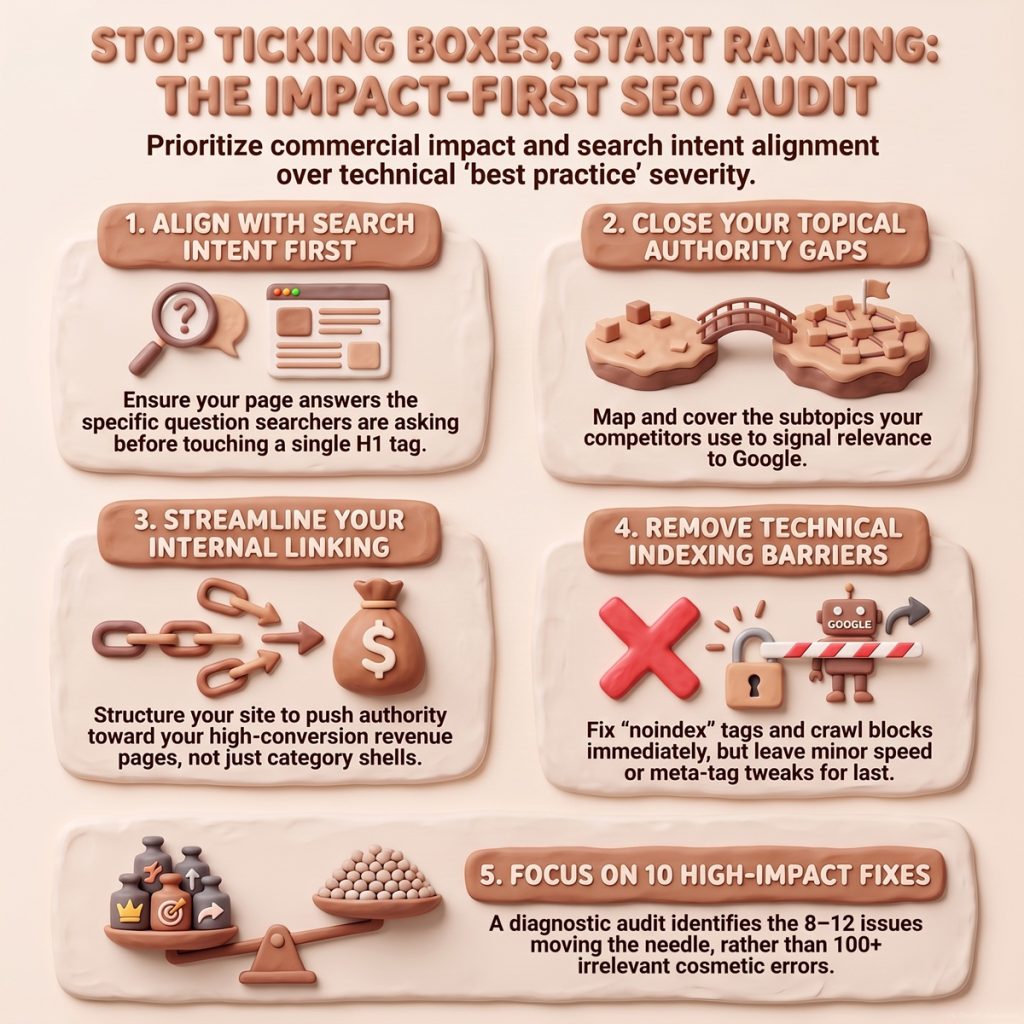
That’s because a checklist treats all issues as equal. A genuine on-page SEO audit separates the cosmetic from the commercial, it identifies which issues are actually suppressing your rankings, which are irrelevant to your specific situation, and in what sequence to address them for the fastest return.
After 25 years auditing UK business websites, we’ve seen the pattern: the issues that move the needle are rarely the ones that automated tools flag first.
What Separates a Diagnostic Audit From a Checklist Exercise
A checklist audit answers “What’s wrong?” A diagnostic audit answers “Why aren’t we ranking for the terms that drive revenue?”
The difference matters commercially. When you start with a checklist, you optimise in the wrong order. You fix technical issues that don’t affect your target keywords. You add schema markup that Google already understands from your content. You rewrite meta descriptions for pages that aren’t even competing for rankings.
A diagnostic approach works backwards from the business goal:
Which keywords would move revenue if we ranked higher? Not vanity terms. Not everything you sell. The 5–10 commercial terms where moving from position 8 to position 3 changes the maths.
What’s currently preventing those specific pages from ranking? Not every issue on the site. The issues affecting those pages, for those queries, in the current competitive context.
What’s the constraint we remove first? Not the easiest fix. The one that unlocks the ranking.
This requires judgement, not just tools. An automated crawler will flag a thin content warning on a 300-word product page. A diagnostic audit asks: are your competitors ranking with 250 words because this product category doesn’t need essays, or are they ranking *despite* thin content because they’ve nailed other signals?
The Issues That Actually Suppress Rankings (And the Ones That Don’t)
Most checklists conflate issues that affect crawlability, issues that affect relevance signals, and issues that affect nothing but best practice.
Here’s what we prioritise in a genuine on-page audit, in order of ranking impact:
1. Search Intent Misalignment
If your page answers a different question than the one Google believes the searcher is asking, no amount of technical optimisation will help.
Example: A Midlands-based accountancy firm wanted to rank for “limited company accountant.” Their service page explained their credentials, accreditations, and process. Every result on page one answered a different question: how much does a limited company accountant cost, and what’s included?
The issue wasn’t keyword density or title tags. It was that the page didn’t match what searchers were actually trying to find out. That’s the first thing we look for, before checking a single H1 tag.
2. Topical Authority Gaps Relative to Competitors
Google doesn’t rank pages in isolation. It ranks them against the other ten results. If every competing page covers five subtopics and yours covers two, you’re signalling less relevance, regardless of whether your content is “good.”
This isn’t about word count. It’s about coverage. A diagnostic audit maps what your competitors are semantically covering that you’re not.
A Bristol-based HR software company was stuck on page two for “HR software for small business.” Their page listed features. The ranking pages all addressed the same unstated question: which features do small businesses actually need, versus enterprise features they’re paying for but won’t use? Adding that framing, without changing the feature list, moved them to position 4 within three weeks.
3. Internal Linking Structure That Undermines Priority Pages
If your site structure doesn’t signal which pages are commercially important, Google often guesses wrong.
We see this constantly with UK SMEs: the homepage links to “Services” (a category page with no conversions), which links to six subcategory pages, which finally link to the actual service pages you want to rank. You’ve built a hierarchy that tells Google the category pages matter more.
A diagnostic audit traces how PageRank flows through your site. It identifies where you’re inadvertently strengthening the wrong pages and how to restructure internal links to push authority toward revenue pages.
4. Technical Barriers That Prevent Indexing or Ranking
Only after we’ve diagnosed the above do we look at technical issues, and even then, we prioritise by actual impact.
Yes, page speed matters. But a 2.5-second load time isn’t why you’re on page three. Core Web Vitals that fail by a small margin rarely affect rankings in commercial niches where every competitor also fails. It’s easy to spend heavily on site speed optimisation whilst missing an accidental noindex tag on your main product category.
A diagnostic audit distinguishes between “this is preventing Google from indexing the page” (fix immediately), “this is a ranking signal where you’re notably worse than competitors” (fix tactically), and “this is best practice but not material to your rankings” (deprioritise).
Why Most Audits Prioritise the Wrong Issues First
Automated tools prioritise by severity, not by impact. They flag a missing canonical tag as “high priority” because canonicals are important in principle. They don’t ask whether that specific missing canonical is causing a ranking problem on that specific page.
This creates a predictable pattern: businesses fix dozens of issues and see no ranking movement, because they’ve optimised pages that weren’t competing for rankings in the first place.
A genuine audit prioritises differently:
High impact, specific to your target keywords. The homepage title tag is generic and doesn’t include your primary keyword. You’re trying to rank locally but there’s no city name in the H1. Your main service page is 180 words and every competitor is 1,200+ words with structured subtopics.
Moderate impact, affects multiple pages. Your blog is accidentally competing with your service pages for the same keywords (cannibalisation). You’re not linking from relevant blog posts to your commercial pages. Your URL structure obscures topical relationships.
Low impact or not material to your situation. Missing image alt tags on decorative graphics. A meta description that’s 165 characters instead of 155. An H2 that should semantically be an H3.
The last category might appear in a checklist audit as “medium priority.” In a diagnostic audit, it’s deprioritised entirely until the high-impact issues are resolved and we’ve confirmed what’s actually moving rankings.
How to Turn Audit Findings Into a Sequenced Action Plan
The output of a genuine audit isn’t a list. It’s a sequenced plan that says: do this first, measure the impact, then do this next.
Here’s the structure that works:
Phase 1: Remove Barriers (Week 1–2)
Fix anything that’s preventing pages from being indexed or understood. Noindex tags on important pages. Broken canonicals causing indexing confusion. Redirect chains. Crawl blocks in robots.txt.
These aren’t the issues that will move rankings, but they’re the issues that prevent everything else from working.
Phase 2: Align With Search Intent (Week 2–4)
Rewrite or restructure pages where intent is misaligned. This usually means changing the primary question the page answers, not just adding keywords.
This is the highest-leverage change. If you’re answering the wrong question, technical optimisation is irrelevant.
Phase 3: Build Topical Authority (Week 4–8)
Expand content on priority pages to cover subtopics your competitors address. Add semantic depth. Improve internal linking to signal page importance.
This is where you’ll see ranking movement on commercial terms, but only if phases 1 and 2 are done first.
Phase 4: Technical and UX Refinement (Week 8+)
Once rankings are moving, optimise page speed, schema markup, and user experience signals. These improve click-through rate and engagement, which reinforces rankings. But they don’t create rankings from nothing.
The businesses that see ROI from on-page SEO work through phases sequentially and measure after each. The ones that don’t see results try to do everything at once, or start with phase 4 because it feels more concrete.
When to Audit Yourself (And When You Need Professional Judgement)
You can run a basic on-page audit with free tools. Screaming Frog will crawl your site. Google Search Console will show which queries you’re ranking for. You can manually compare your pages to the top ten results.
What you can’t easily do yourself:
Distinguish between issues that matter for your keywords and issues that don’t. Tools can’t tell you whether thin content is your constraint or whether you’re losing on intent alignment. That requires experience with what Google is actually rewarding in your specific niche.
Prioritise by commercial impact. A diagnostic audit accounts for keyword difficulty, search volume, conversion value, and competitive context. It tells you which pages to optimise first based on business return, not technical severity.
Sequence fixes in the right order. Knowing what to do is one thing. Knowing what to do first, and what to measure before moving to the next phase, requires pattern recognition from hundreds of sites.
If you’re a UK SME with 20–50 pages and you’re trying to rank for 3–5 core terms, a professional on-page SEO audit will typically identify 8–12 high-impact issues, not 127. The return comes from fixing those issues in the right sequence, not from working through a generic checklist.
Frequently Asked Questions
Q: How often should we run an on-page SEO audit?
A: For most UK SMEs, annually is sufficient unless you’ve made significant site changes or seen unexplained ranking drops. The exception is if Google has updated how it interprets search intent in your niche, then a targeted re-audit of affected pages makes sense. Auditing more frequently than you can act on findings just creates noise.
Q: Can we fix on-page issues ourselves after an audit, or do we need ongoing agency support?
A: Depends on the issues. If the audit identifies content rewrites and internal linking changes, most businesses can action those with clear instructions. If it identifies intent misalignment or topical authority gaps, you’ll likely need a content strategist who understands what Google is rewarding in your niche. Technical fixes are often straightforward once diagnosed.
Q: What’s a realistic ranking improvement timeline after implementing on-page fixes?
A: For intent and content improvements on pages already indexed and ranking on page 2–3, we typically see movement within 3–6 weeks. For new content or pages with technical barriers, expect 8–12 weeks. If you’re seeing no change after three months, either the wrong issues were prioritised or off-page factors (backlinks, domain authority) are the actual constraint.
Q: How do we know if an audit has found the right issues, or just the obvious ones?
A: A good audit will explain why each issue is affecting your rankings for your specific target keywords, not just that the issue exists. If the audit says “title tag should be 50–60 characters” without explaining how the current title is hurting your ability to rank for a specific term, it’s a checklist. If it says “your title tag for ‘commercial solicitor Manchester’ doesn’t signal local intent and competitors all lead with the city name,” that’s diagnostic.
If your site isn’t ranking for the terms that drive revenue, an on-page SEO audit that prioritises by commercial impact, not technical severity, is where we’d start. We’ll identify the 8–12 issues actually affecting your target keywords and give you a sequenced plan. [Get in touch for a diagnostic audit](https://thickrope.com) that finds what automated tools miss.