
Why Your Social Media Strategy Falls Flat in Sheffield (And What to Do About It)
Sheffield doesn’t respond to brands the way Manchester does. It doesn’t engage like Leeds. And if you’re running the same social media strategy here that you’d run in Birmingham or Nottingham, you’re likely talking to an empty room.
This isn’t about Sheffield being difficult. It’s about Sheffield being specific. The city has one of the strongest local identities in the UK, shaped by steel, music, sport, and a working-class heritage that still informs how people talk, what they value, and which brands they’ll actually give their time to on social media.
If your social media content doesn’t account for that, it’ll consistently feel tone-deaf. And in a city this tight-knit, tone-deaf doesn’t just mean low engagement. It means you’re marked as an outsider.
What Makes Sheffield Different on Social Media
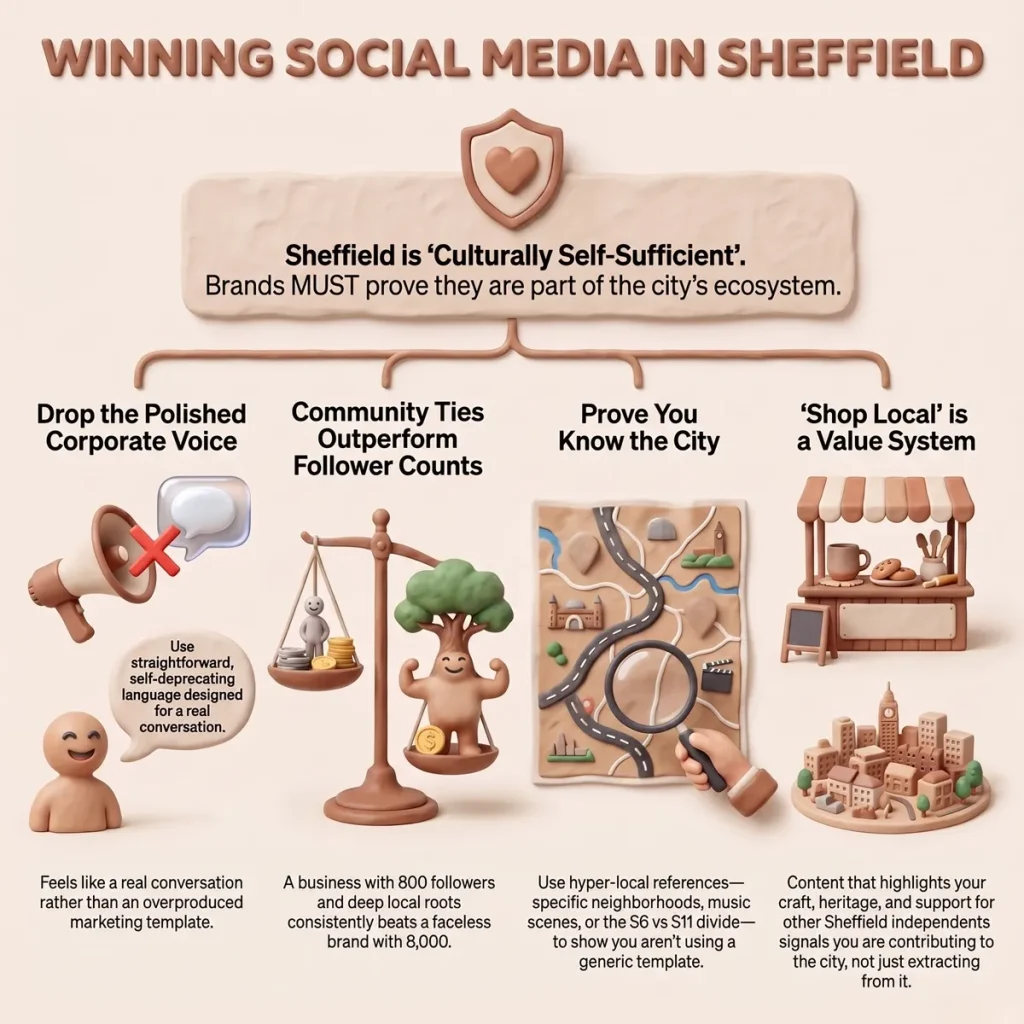
Most UK cities have local pride. Sheffield has something closer to cultural self-sufficiency. It’s a city that’s historically been let down by Westminster, by corporate promises, and by outsiders who didn’t understand what they were walking into. That shapes social media behaviour in three specific ways:
1. Locals distrust polished corporate voice
The slick, aspirational tone that works in London or Bristol often reads as inauthentic here. Sheffield audiences respond better to straightforward language, a bit of self-deprecation, and brands that don’t take themselves too seriously. Look at how Sheffield businesses that do well on social, from independents like Bungalows and Bears to larger local names like Henderson’s Relish, talk. There’s warmth, but it’s never overproduced.
2. Community endorsement matters more than follower count
A Sheffield business with 800 followers and strong ties to local causes, venues, or people will outperform a faceless brand with 8,000 followers and no roots. Social proof here isn’t about numbers. It’s about who’s vouching for you. A share from a respected local figure, a collaboration with a neighbourhood venue, or a visible presence at community events carries more weight than any paid campaign.
3. There’s a strong filter for “is this actually for us?”
Sheffield people are quick to spot when content is generic UK marketing with “Sheffield” stuck on top. They’ll ignore it. But they’ll actively engage with content that reflects genuine knowledge of the city, references that only make sense if you know S6 from S11, nods to the music scene, or an understanding of why Wednesday vs United isn’t just football, it’s identity.
What This Means for Platform Strategy
You can’t approach Instagram, Facebook, LinkedIn, and TikTok the same way in Sheffield as you would nationally. The platforms people use, and how they use them, skew differently here.
Facebook Still Dominates for Local Discovery
Whilst younger demographics nationally have largely moved off Facebook, Sheffield’s community-first culture keeps Facebook Groups unusually active. Local selling groups, neighbourhood watch communities, recommendations pages, these are where Sheffield people go to find tradespeople, restaurants, services. If you’re a local business and you’re not visible in these spaces (either through organic participation or careful, non-spammy promotion), you’re missing the primary discovery mechanism.
Instagram Works, But Only If You’re Visibly Local
National Instagram strategies built around aspirational lifestyle content rarely land here. What does work: behind-the-scenes content showing your actual team, posts that tag and collaborate with other Sheffield independents, Stories that show you’re embedded in the city’s day-to-day life. If your Instagram feed could be anywhere in the UK, it won’t connect in Sheffield.
LinkedIn Is Underused by Sheffield SMEs
There’s a tendency to see LinkedIn as a corporate London platform. But Sheffield has a growing digital and advanced manufacturing sector, a major university producing graduates, and a tight professional services community. For B2B businesses especially, a Sheffield-focused LinkedIn strategy, thought leadership that speaks to local economic challenges, posts that highlight partnerships with Sheffield institutions, is an open goal most competitors aren’t taking.
TikTok Needs a Specific Tone
TikTok’s younger demographic is the same everywhere, but Sheffield’s self-aware, slightly irreverent humour travels exceptionally well on the platform. Businesses that lean into Sheffield stereotypes (steel, hills, the accent, the rivalry with Leeds) with affection rather than cliché can build followings quickly. But it has to come from a place of genuine familiarity, not lazy caricature.
Content Themes That Connect in Sheffield
Generic content pillars, “motivational Monday,” “customer spotlight,” “product features”, won’t cut through. Sheffield social media content works when it’s built around themes that reflect what the city actually cares about:
Heritage and Craft
Sheffield’s identity is rooted in making things, steel, cutlery, tools, beer, music. Content that shows how you make what you sell, the craft behind it, or your connection to Sheffield’s manufacturing heritage consistently performs. Even if you’re a service business, content that emphasises skill, attention to detail, and local expertise will resonate more than generic “we’re the best” messaging.
Independence and Supporting Local
“Shop local” isn’t a trend in Sheffield; it’s a value system. Content that highlights your relationships with other Sheffield independents, your use of local suppliers, or your involvement in the city’s economy connects because it signals you’re part of the community, not extracting from it. Collaborations, shout-outs to neighbouring businesses, and visible support for local causes aren’t just nice-to-haves, they’re table stakes.
Music and Culture
Sheffield’s music heritage, from Def Leppard to Pulp to Arctic Monkeys, isn’t nostalgia. It’s ongoing. The city has an active grassroots music scene, independent venues, and a population that genuinely cares about cultural output. Even if you’re not in the creative sector, content that references or supports local music, art, or events positions you as embedded rather than transactional.
Humour That Doesn’t Punch Down
Sheffield humour is dry, self-aware, and rooted in not taking yourself too seriously. Social media content that’s too earnest or self-congratulatory won’t land. But content that acknowledges the realities of running a business in Sheffield, the hills, the weather, the underdog status compared to Manchester and Leeds, with affection rather than complaint, will.
What Doesn’t Work (And Why Agencies Keep Getting It Wrong)
National agencies running Sheffield social media accounts make predictable mistakes:
Using generic “Northern” voice. Sheffield isn’t Manchester. It isn’t Leeds. Lumping it into a generic Northern tone (usually a caricature of Mancunian) reads as lazy and alienates the audience.
Over-indexing on steel references. Yes, Sheffield’s steel heritage matters. But reducing the city to endless steel puns and industrial imagery is reductive. Modern Sheffield is universities, digital agencies, advanced manufacturing, independent food and drink, creative industries. Your content should reflect that breadth.
Ignoring hyper-local geography. Sheffield is a collection of distinct neighbourhoods, each with its own character. Broomhill isn’t Kelham Island isn’t Ecclesall Road. Content that treats Sheffield as one homogenous market misses opportunities to speak directly to the communities you’re actually trying to reach.
Treating social media as broadcast, not conversation. Sheffield audiences expect reciprocity. If you’re posting but never replying to comments, never engaging with other local accounts, never participating in the wider conversation, you’ll be seen as a brand that doesn’t actually care about the community, just the revenue it can extract from it.
How to Build a Social Media Strategy That Actually Reflects Sheffield
Start with three foundational questions:
1. Can we prove we’re local?
This isn’t about claiming you’re based in Sheffield. It’s about demonstrating it through content. Do you regularly feature your team? Do you tag and interact with other Sheffield businesses? Do you reference specific places, events, and cultural moments that only locals would recognise? If your feed could belong to a business in any UK city, it’s not specific enough.
2. Are we contributing to the community or just selling to it?
Sheffield social media audiences have a finely tuned radar for transactional behaviour. Brands that only post when they’re promoting something, that never amplify other local voices, that don’t visibly support community causes or initiatives, they’re tolerated at best, ignored at worst. Your content mix should reflect a business that’s part of Sheffield’s ecosystem, not just operating within it.
3. Does our tone sound like us, or like a marketing template?
If you’re using the same polished, corporate language every other business uses, you sound like everyone else. Sheffield responds to authenticity, which doesn’t mean being unprofessional, but it does mean sounding like actual people. Write the way you’d talk to a customer in person. If that’s straightforward and no-nonsense, lean into it. If it’s warm and conversational, own that. The worst thing you can do is adopt a voice that isn’t yours because you think it’s what “social media marketing” is supposed to sound like.
Measuring What Actually Matters
Vanity metrics, follower counts, likes, matter less in Sheffield than in larger, less community-focused markets. What you should be tracking:
Engagement rate, not reach. A post seen by 5,000 people that generates three likes is worth less than a post seen by 300 that generates 40 comments and shares. Sheffield social media success is about depth of connection, not breadth.
Inbound enquiries attributed to social. Are people finding you through social and then contacting you? Track this explicitly. Ask new customers how they heard about you. If social isn’t driving real enquiries, your content isn’t working.
Community growth through local endorsement. Are Sheffield-based accounts sharing your content? Are local figures engaging with your posts? Growth driven by local endorsement is far more valuable than growth driven by paid promotion.
Offline impact. Social media in Sheffield often drives offline behaviour, people walking into your shop, attending your event, recommending you to a neighbour. If your social media is working, you should be able to trace it to real-world outcomes, not just digital metrics.
Frequently Asked Questions
Q: Should we be using Sheffield dialect or slang in our social media posts?
A: Only if it’s genuinely how you speak. Forced use of dialect or slang when it’s not natural to your brand reads as performative and will backfire. Authenticity matters more than trying to sound “Sheffield enough.” If you naturally use certain phrases, use them. If you don’t, straightforward English is fine.
Q: How often should a Sheffield business be posting on social media?
A: Consistency matters more than frequency. Three high-quality, genuinely local posts a week will outperform daily generic content. Sheffield audiences would rather see you post less often with something worth saying than fill their feeds with filler. Focus on quality and relevance first.
Q: Is it worth paying for social media ads in Sheffield, or should we focus on organic?
A: Both have a place, but organic community-building should come first. Paid ads can amplify reach, but if your organic content isn’t connecting with locals, paid promotion won’t fix it. Build the organic foundation, authentic content, local engagement, community ties, then use paid strategically to extend reach for specific campaigns or offers.
Q: We’re a national brand with a Sheffield location. How do we balance local identity with brand consistency?
A: Give your Sheffield social channels autonomy to reflect local character within your broader brand guidelines. A tone that works nationally may need adjusting here. Empower your Sheffield team to create content that genuinely reflects the city rather than forcing every post through a national template. The businesses that do this well treat their Sheffield presence as a distinct entity, not a clone.
If your social media presence in Sheffield feels like you’re shouting into the void, or if you’re getting followers but no actual business from them, the problem is likely strategy, not effort. We’ve spent over 25 years working with businesses across Yorkshire, and we’ve seen what separates social media that generates revenue from social media that just generates noise. If you’d like to talk through what a Sheffield-specific social media strategy would look like for your business, get in touch for a straightforward conversation about what’s actually achievable.