

Social Media Marketing in Poole: Why Community Context Matters More Than Posting Frequency
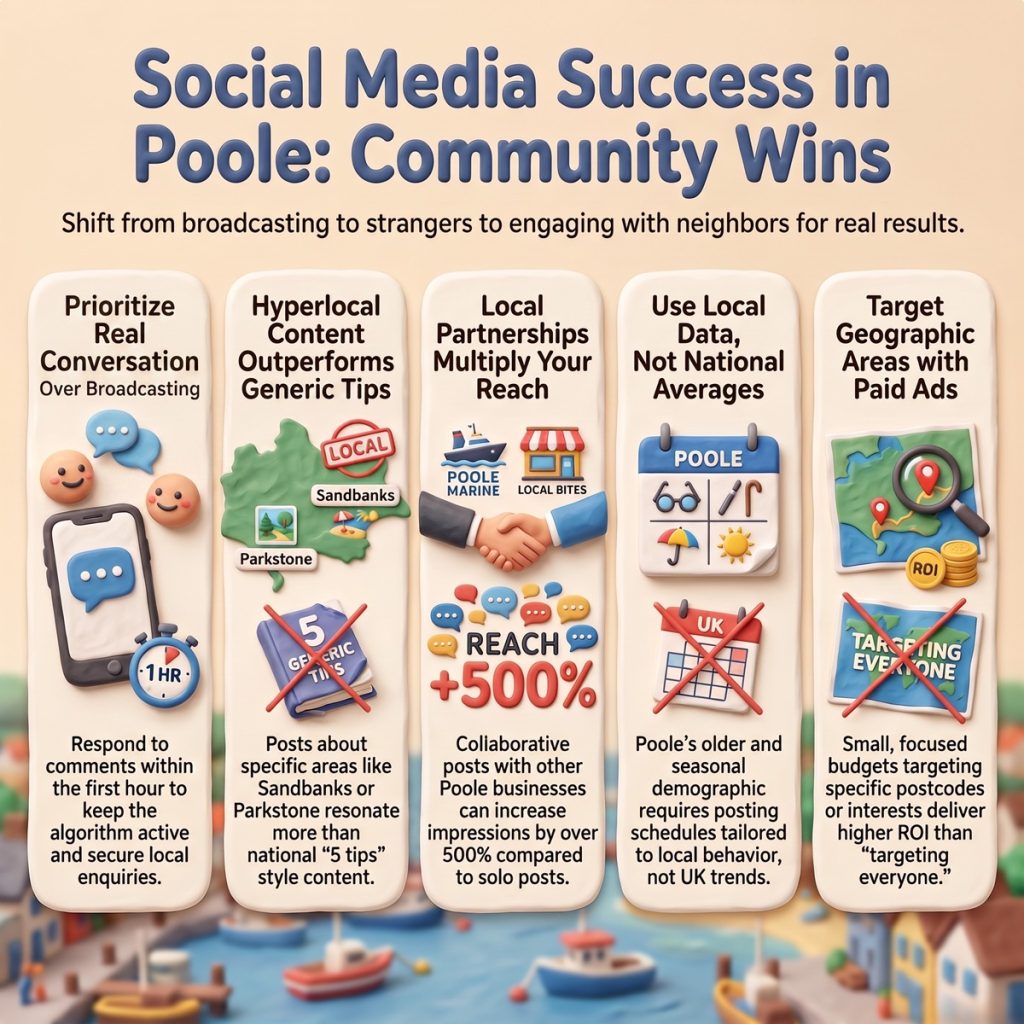
If you’re running a business in Poole, you’ve probably noticed something unusual about social media marketing: what works in London or Manchester doesn’t necessarily translate here. A café in Ashley Cross can fill its tables through Instagram, whilst another with three times the following struggles to convert posts into footfall. The difference rarely comes down to content quality or posting frequency, it’s about understanding how Poole’s specific community dynamics shape social media behaviour.
The Poole Problem: When National Strategies Hit Local Reality
Most social media advice is written for businesses operating in large, anonymous markets. But Poole, and the wider Bournemouth, Christchurch and Poole conurbation, operates differently. With roughly 150,000 people in Poole itself and strong neighbourhood identities (Sandbanks, Lilliput, Parkstone, Oakdale), you’re not broadcasting to strangers. You’re entering conversations in a community where reputation spreads offline faster than it does online.
This creates a dynamic most agencies miss: your social media presence in Poole needs to reinforce what people already hear about you, not replace it. If your Facebook page says you’re open Tuesday to Saturday but locals know you’re routinely shut on Thursdays, that disconnect doesn’t just confuse, it actively damages trust.
We’ve worked with Poole businesses for over a decade, and the pattern is consistent: social media works when it reflects genuine community involvement, not when it’s trying to create it from scratch.
What Actually Drives Enquiries (And What Just Looks Busy)
The Difference Between Activity and Traction
Here’s what most Poole businesses don’t realise: social media platforms prioritise content that keeps users on the platform. That Instagram Reel about your new product line? It performs well if it entertains. But the post asking people to “click the link in bio” or “visit our website”? That gets suppressed because you’re trying to move people away from Instagram.
For a Poole business, this matters because your natural instinct, to use social media as a signpost to your website or shop, works against how the algorithms actually function.
What works better: Content that gets saved, shared, and commented on within Poole networks. A Sandbanks estate agent posting about local coastal erosion news will outperform generic “5 tips for first-time buyers” content because it’s specifically relevant to people in that postcode. The engagement signals local relevance to the algorithm, which then shows it to more local accounts.
The Underused Power of Local Tagging and Community Partnerships
Poole has active community groups, residents’ associations, and neighbourhood pages with genuine reach, often more than business pages achieve organically. A post tagged with #ParkstoneLife or #PooleMums reaches people who are actively identifying themselves by location and life stage.
But here’s the lesser-known part: collaborative posts with other local businesses exponentially increase reach compared to solo content. When a Poole café partners with a local bakery for a supplier feature, both audiences see the content, and Instagram’s algorithm treats it as higher value because it’s connecting communities, not just broadcasting.
We tested this with a client in Ashley Cross. Solo posts averaged 350 impressions. The same business doing monthly “Local Supplier Spotlight” collaborations averaged 1,850 impressions per post, and generated direct enquiries from people who’d seen them tagged by businesses they already trusted.
Why “Best Posting Times” Data Misleads Poole Businesses
National data suggests posting at 7am, 1pm, or 7pm maximises engagement. That’s based on general UK behaviour patterns. But Poole’s audience skews older than the UK average, has a higher proportion of retirees, and includes significant seasonal population shifts when second-home owners arrive.
For businesses targeting Poole residents (rather than tourists), we consistently see stronger engagement between 8-10am and after 8pm, particularly on Facebook, which still dominates the 45+ demographic that makes up a substantial portion of the year-round Poole market.
For businesses targeting the visitor economy (hospitality, marine services, retail in the town centre), the pattern is completely different: Instagram engagement peaks Thursday through Saturday as people plan weekend activities, with a secondary spike on Sunday evenings as day-trippers extend their visit planning.
The point isn’t that one schedule is universally correct, it’s that Poole businesses need data from their own audience, not national averages.
The Hidden Cost of Managing Social Media as a Content Calendar Exercise
Most Poole businesses we meet have tried social media marketing the same way: they’ve created a content calendar, scheduled posts for consistency, and wondered why nothing happens.
The problem is structural. A content calendar assumes your job is to broadcast. But social media marketing that actually drives enquiries requires conversation. That means:
- Responding to comments within the first hour (when the algorithm still considers the post “active”)
- Engaging with other local businesses’ content so your name appears in the feeds of their followers
- Monitoring local hashtags and joining conversations where your expertise adds value
- Actually messaging people back when they send enquiries via DM
This isn’t exotic strategy, it’s basic community behaviour. But it requires time and attention that a pre-scheduled content calendar doesn’t provide. When a Poole resident comments on your post asking if you’re open Bank Holiday Monday, and you respond three days later, you’ve lost the enquiry. They’ve already made other plans.
The businesses that see ROI from social media in Poole treat it as a communication channel first and a broadcasting platform second. That’s a fundamentally different operating model from “post three times a week and hope something sticks.”
Where Paid Social Fits (And Where It’s Wasted Budget)
Organic reach on Facebook and Instagram has declined for years. For many Poole businesses, that prompts the question: should we just pay to reach our audience?
Sometimes, yes. But the answer is more nuanced than most agencies admit.
When Paid Social Works for Poole Businesses
Geographic targeting makes sense when you have a defined service area. If you’re a trades business serving Poole and surrounding areas, a £10/day Facebook campaign targeting homeowners within 10 miles can generate genuine enquiries, particularly if you’re targeting people whose interests suggest home improvement intent (following DIY pages, renovation programmes, interior design accounts).
Event promotion benefits from paid boost. If you’re a Poole Quay restaurant with a one-off jazz evening, organic reach won’t cut it. A £30 boost targeting Poole residents interested in live music typically pays for itself in additional bookings.
Retargeting website visitors converts. If someone visits your website from Poole but doesn’t enquire, showing them a specific offer via Facebook or Instagram over the next week keeps you front-of-mind when they’re ready to decide. This works particularly well for considered purchases, home services, professional services, higher-value retail.
When It’s Wasted Money
Boosting every post because “the algorithm punishes businesses” is throwing money away. Reach without relevance is vanity metrics. If 2,000 people see your post but none of them were ever going to buy, you’ve achieved nothing except spending budget.
Targeting “everyone in Poole” dilutes impact. A 20-year-old student and a 65-year-old retiree need different messages, respond to different content formats, and use different platforms. Broad targeting means you’re compromising on all of it.
Paying to promote content that doesn’t work organically won’t fix it. If your organic posts generate no saves, shares, or meaningful comments, paid distribution just shows ineffective content to more people. Fix the content first, then amplify what’s already working.
What Poole-Specific Social Media Strategy Actually Looks Like
Let’s ground this in a real example. We worked with a Poole-based home services business that was posting consistently, three times a week, mix of project photos and tips, but generating virtually no enquiries.
What We Changed
Shifted from generic tips to hyperlocal relevance. Instead of “5 signs you need a new boiler,” we created content around “Why Poole’s hard water shortens appliance lifespan” and “Preparing Sandbanks properties for winter: what second-home owners miss.” The content was specifically valuable to the local audience, not just SEO-friendly generics.
Built partnerships with complementary Poole businesses. Monthly features on local suppliers, tradespeople, and property managers. Each partner shared the content to their audience, creating compound reach effects.
Engaged with local community groups. Not spamming services, but genuinely answering questions in Poole residents’ groups when heating or plumbing topics came up. Profile visibility led to direct enquiries.
Used paid targeting strategically during seasonal peaks. November boost targeting Poole homeowners interested in home improvement, focusing on winter preparation. January boost targeting the same audience with “new year, sorted home” messaging.
The Results
Over six months, social media went from generating 1-2 enquiries per quarter to 3-4 per month. More importantly, enquiries were pre-qualified, people were familiar with the business through repeated content exposure before they made contact, so conversion rates improved significantly.
The total cost? Roughly £200/month in ad spend and 8-10 hours of management time (content creation, engagement, partnership coordination). For a business where average job value is £800-2,000, the ROI was clear.
The Credibility Problem: Why Some Poole Businesses Should Deprioritise Social
Here’s what agencies rarely admit: not every Poole business needs an active social media presence.
If you’re a B2B professional services firm serving corporate clients, your decision-makers aren’t finding you through Instagram. If you’re a niche industrial supplier, LinkedIn might matter but Facebook definitely doesn’t. If you already have more work than capacity, social media marketing is solving a problem you don’t have.
The question isn’t “should we be on social media?”, it’s “what problem are we trying to solve, and is social media the most efficient way to solve it?”
For many Poole businesses, the honest answer is: you need to be present and credible, but you don’t need to be prolific. A Facebook page that’s kept updated with opening hours, responds to messages promptly, and occasionally posts genuine business updates is often sufficient. The alternative, an abandoned Instagram account with the last post from 2022, actively damages credibility.
Measuring What Actually Matters
Most Poole businesses track the wrong metrics. Follower count, post reach, likes, these measure activity, not results.
What to Track Instead
Enquiry source. When someone contacts you, ask how they found you. If social media is working, you’ll hear “I saw your Facebook page” or “someone shared your Instagram post.” Track this monthly.
Website traffic from social. Check Google Analytics for sessions originating from social platforms. Are they visiting one page and leaving, or exploring your services? Low bounce rate suggests genuine interest.
Message response rate. If people are messaging your business page, are you responding within hours? A high response rate badge on Facebook signals reliability to potential customers.
Engagement rate on local content vs generic content. Which posts generate saves, shares, and comments from Poole-based accounts? Double down on what’s working.
Cost per enquiry for paid campaigns. If you’re spending £100/month on ads and generating 5 enquiries, that’s £20 per enquiry. Compare that to your other marketing channels, is it competitive?
The businesses that succeed with social media marketing in Poole are measuring business outcomes, not social media metrics.
What Poole Businesses Need to Decide
Social media marketing isn’t binary, it’s not “essential” or “useless.” The right answer depends on your business model, target audience, and competitive landscape.
If your customers are local, price-sensitive, and making relatively quick decisions (hospitality, retail, some trades), active social media presence with community engagement delivers ROI.
If you’re serving a niche B2B market, infrequent high-value clients, or professional services, your time is better spent on targeted networking, referral partnerships, and search visibility.
If you’re in the middle, residential services, health and wellness, family-focused retail, social media works when it’s treated as one part of a broader local marketing strategy, not the entire strategy.
The mistake we see repeatedly is Poole businesses investing significant time in social media because they feel they should, without clear commercial logic for why it makes sense for their specific circumstances.
Frequently Asked Questions
Q: How much should a Poole business spend on social media marketing?
A: If you’re handling it in-house, expect to invest 6-10 hours per month for meaningful engagement plus £100-300 in ad spend for targeted campaigns during peak seasons. If you’re outsourcing to an agency, budget £400-800/month for strategy, content creation, and community management. Less than that typically means you’re getting scheduled posts without the engagement that actually drives results.
Q: Which platform matters most for Poole businesses, Facebook or Instagram?
A: For most Poole businesses serving local residents, Facebook still delivers better ROI because the 35+ demographic is more active there and the local group ecosystem is stronger. Instagram works better if you’re targeting under-35s, tourists, or businesses where visual appeal is central (hospitality, retail, lifestyle services). LinkedIn is underutilised by Poole B2B businesses, if you’re selling to other companies rather than consumers, that’s where decision-makers actually are.
Q: Can social media marketing work for Poole businesses outside the tourism sector?
A: Absolutely. We’ve seen strong results for trades, professional services, health and wellness, and retail businesses with no tourism connection. The key is understanding that you’re marketing to a defined local community, not trying to build a national following. That actually makes it easier, you need relevance and trust within a smaller audience, not viral reach.
Q: How quickly should we expect to see results from social media marketing in Poole?
A: Genuine enquiry generation typically takes 3-4 months of consistent, strategic effort. You’ll see engagement metrics improve within weeks, but converting that into actual business enquiries requires building familiarity and trust. If an agency promises immediate results, they’re likely talking about vanity metrics (reach, impressions) rather than business outcomes. The exception is paid campaigns for specific events or offers, which can generate immediate response if targeting is precise.
If you’re a Poole business trying to work out whether social media marketing makes commercial sense, or you’ve been posting consistently without seeing enquiries, we’re happy to review your current approach and show you what strategically targeted social media actually looks like. Book a no-obligation consultation with our team.