

What a Thickrope Local SEO Audit Actually Covers — and What You Learn Before Committing to Anything
If you’re a UK business relying on local customers — whether you’re a solicitor in Manchester, a plumber in Bristol, or an accountant in Edinburgh — you’ve likely been told you need local SEO. Maybe enquiries have dropped off. Maybe you’re invisible when someone searches for your service in your town. Maybe a competitor who opened six months ago is somehow ranking above you.
The question isn’t whether local SEO matters. It’s whether you can trust an agency to diagnose the real problem rather than sell you six months of work you don’t need.
That’s what our local SEO audit is for. It’s a fixed-price diagnostic that tells you exactly where you’re losing visibility, why, and what it would actually cost to fix. You get the findings, the data, and the recommendation. What you do next is entirely up to you.
Here’s what we examine, what the deliverable looks like, and what happens after.
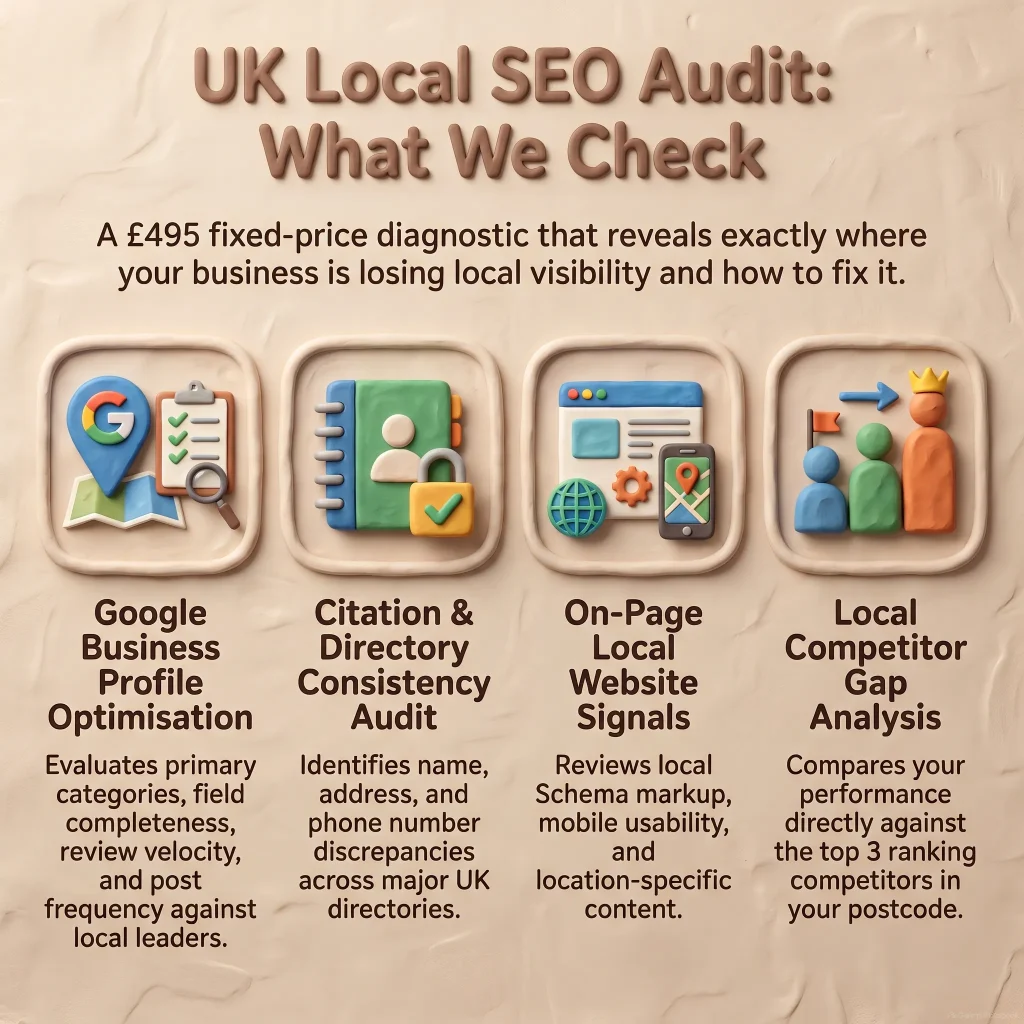
What We Actually Look At During a Local SEO Audit
Your Google Business Profile — Not Just Whether It Exists, But Whether It’s Working
Most businesses have a Google Business Profile. Few have optimised it properly. We check:
Category accuracy: Your primary category determines which searches Google considers you relevant for. If you’re a “marketing consultant” when you should be a “marketing agency,” you’re invisible for half the searches that matter. We compare your current selection against what your highest-value competitors are using and what actually triggers visibility in your sector and postcode.
Completeness score:Google rewards profiles that fill in every field — services, attributes, opening hours, booking links. We measure your completeness against the local pack leaders in your area. A 60% complete profile won’t outrank a 100% one, all else being equal.
Review velocity and recency: It’s not just the star rating. Google favours businesses that get regular, recent reviews. We track how often you’re getting reviews compared to competitors, and whether you’re responding (which also affects ranking).
Post frequency: Most businesses don’t realise Google Business posts affect visibility. We check whether you’re publishing regularly and whether those posts align with what people in your area are actually searching for.
Citation Consistency Across UK Directories — Because One Wrong Postcode Costs You Rankings
A citation is any online mention of your business name, address, and phone number. Google cross-references these to verify you’re a legitimate local business. Inconsistencies — “Ltd” in one place and “Limited” in another, an old address still listed on Yell, a landline on your website but a mobile on Yelp — damage your rankings.
We audit your presence across the directories that matter for UK businesses:
- Core UK directories: Yell, Thomson Local, Scoot, 192.com, Yelp UK
- Industry-specific directories: Checkatrade, Trustpilot, Rated People (if relevant to your sector)
- Data aggregators: These feed information to dozens of other sites. If the aggregator has wrong data, it spreads everywhere.
We don’t just flag inconsistencies. We give you a spreadsheet showing exactly what needs updating and where.
On-Page Local Signals — The Bits on Your Website That Tell Google Where You Actually Operate
Your website needs to make it obvious — to Google and to users — where you’re based and where you serve customers.
NAP (Name, Address, Phone) consistency: Is your business information identical on every page where it appears? Is it marked up with Schema so Google can read it reliably?
Location-specific content: If you serve multiple areas, does each have a dedicated page with genuine, useful content about that location? (Not ten pages of identical text with just the town name swapped out — Google isn’t fooled, and neither are customers.)
Embedded map and directions: Simple, but many sites miss it.
Local keywords in titles and headings: Not stuffed, but naturally integrated where relevant.
Mobile usability: Over 60% of local searches happen on mobile. If your site is slow or hard to navigate on a phone, you’re losing both rankings and customers.
Competitor Gap Analysis for Your Specific Postcode and Sector
We identify the three businesses ranking consistently in the local pack for your most valuable search terms. Then we compare:
- Their Google Business Profile setup vs. yours
- Their citation footprint vs. yours
- Their on-page local signals vs. yours
- Their review count, rating, and velocity vs. yours
- Their website authority (backlink profile, domain age, content volume)
This isn’t abstract benchmarking. It’s a specific answer to the question: “Why is this competitor ranking above me, and what would it take to overtake them?”

What You Actually Receive
The deliverable is a PDF report, typically 20–30 pages depending on the complexity of your business and competitive landscape. It includes:
1. Executive summary (one page): The three biggest opportunities and the estimated effort to capitalise on each. This is the page for business owners who don’t have time to read the rest.
2. Google Business Profile scorecard: Your current optimisation level vs. local pack competitors, with a prioritised action list.
3. Citation audit results: A table showing every directory we checked, current listing status, and discrepancies found. Colour-coded so you can see at a glance what’s broken.
4. On-page local SEO review: Page-by-page findings for your key landing pages, with specific recommendations (e.g., “Add Schema markup to the contact page footer,” not just “improve Schema”).
5. Competitor comparison matrix: Side-by-side view of you vs. your top three local competitors across every metric that affects rankings.
6. Keyword opportunity analysis: The search terms you should be ranking for based on your location and services, but currently aren’t. Includes estimated monthly search volume for your area.
7. Recommended action plan: Sequenced priorities — what to fix first, what can wait, and realistic timeframes.
8. Estimated investment: If you were to engage us (or any competent agency) to execute the plan, what would it likely cost? We break this into one-off setup work vs. ongoing monthly activity.
You own the report. You can act on it yourself, hire us, or take it to another agency. No lock-in, no obligation.
What Happens After You Receive the Audit
Option 1: You implement it yourself. Plenty of businesses do, especially if the issues are mainly citation clean-up and GBP optimisation. We’ve written the report to be actionable without needing an agency. If you get stuck on something technical (Schema markup, for instance), we’re happy to answer a quick question or two.
Option 2: You engage us for the implementation. We provide a fixed-price quote based on the audit findings. No surprises, no scope creep. Typical turnaround for foundational local SEO work is 4–6 weeks. After that, some businesses stay on for ongoing optimisation (content, reviews, local link building), others don’t. Depends on your sector and competitive pressure.
Option 3: You take the audit to another provider. Fine by us. You’ve got an objective diagnostic, and any decent agency will know what to do with it.
The audit itself is fixed-price: £495 + VAT. Turnaround is usually 7–10 working days from the date we receive access to your Google Business Profile and website analytics (if you’re willing to share them — not required, but helps us give better recommendations).
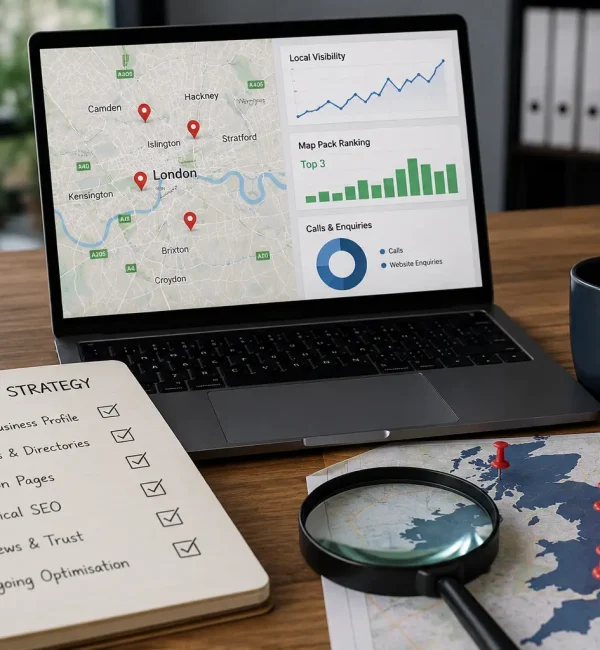
Why Transparency About the Audit Process Matters
We’ve been doing this for over 25 years. We’ve seen every trick agencies use to justify ongoing retainers without showing results. The classic move is the vague “comprehensive SEO audit” that’s really just a sales document — lots of frightening graphs, minimal actionable detail, and a recommendation to sign a twelve-month contract.
Our view: if you’re going to pay someone to improve your local visibility, you should know exactly what’s broken before you commit to fixing it. You should be able to see the findings, understand the work involved, and make an informed decision about whether the investment is worth it for your business.
Some businesses discover their issues are minor — a few citation corrections, some GBP optimisation — and the audit alone gives them everything they need. Others learn they’re facing a significant rebuild (website issues, virtually no citations, strong competition) and need ongoing support. Both outcomes are useful. The worst outcome is spending money on SEO without knowing what you’re actually paying for.
When a Local SEO Audit Isn’t What You Need
If your website is brand new (less than three months old), an audit is premature. You need foundational setup, not diagnosis.
If you’re a national or international business without a physical location serving local customers, local SEO isn’t your priority. You need a different approach.
If you’ve already had a thorough local SEO audit in the past six months and the competitive landscape hasn’t shifted, you probably don’t need another one. You need implementation.
But if you’re an established UK business that depends on local customers, and you’re not consistently appearing in the local pack (the map results) when someone searches for your service in your area, an audit will tell you why — and, crucially, what it would cost to fix.
Frequently Asked Questions
Q: How long does the audit take?
A: Turnaround is typically 7–10 working days from when we receive access to your Google Business Profile (view access is sufficient) and confirm the scope. Rush service is available for an additional fee if you’re working to a deadline.
Q: Do I need to provide access to anything?
A: View access to your Google Business Profile is essential. Read-only access to Google Analytics and Google Search Console is helpful but not required. We won’t make any changes during the audit — it’s purely diagnostic.
Q: What if I operate in multiple locations?
A: We can audit multi-location businesses, but the pricing adjusts based on the number of locations (each needs separate GBP and citation analysis). We’ll give you a quote based on your specific setup before you commit.
Q: Is this just for service-area businesses, or can retailers benefit too?
A: Both. If customers visit your physical location (retail, restaurant, clinic), local SEO is critical. If you travel to customers (trades, mobile services), it’s equally important but the strategy differs slightly. The audit covers both models.
Q: What happens if the audit reveals I need a new website?
A: We’ll tell you. Sometimes the most honest recommendation is “your website is fundamentally broken for local SEO, and patching it will cost more than rebuilding.” If that’s the case, we’ll explain why and what a fit-for-purpose site would involve. We build websites, but we’re not going to push you toward one unless the audit genuinely supports it.
If you’d like to know exactly where you stand with local SEO — and what it would take to start appearing where your customers are actually searching — you can commission a local SEO audit here or get in touch for an informal conversation about whether it’s the right next step for your business.