

Why Most UK Businesses Are Building Citations in All the Wrong Places
If you’re a UK business owner who’s been told to “build citations everywhere,” you’ve likely wasted hours submitting your details to directories that Google doesn’t care about. The uncomfortable truth: most citation advice is written for American businesses, and what works in Phoenix doesn’t work in Portsmouth.
Here’s what actually matters for local search visibility in the UK — and the three mistakes that cost businesses Map Pack rankings every single day.
The UK Citation Landscape Works Differently (and Most Guides Ignore It)
When Google decides which businesses to show in the Map Pack — those three local results that appear above organic listings — it looks for consistent business information across what it considers authoritative sources. But “authoritative” varies by country.
In the UK, Google weighs specific platforms more heavily:
Yell.com remains the single most important UK business directory for local SEO, despite many business owners assuming it’s outdated. It’s still one of the strongest signals Google uses to verify UK business legitimacy.
Thomson Local carries similar weight, particularly for service-based businesses outside London.
Scoot (formerly 192.com) is indexed heavily by Google and provides strong citation value, yet rarely appears in generic citation-building guides.
FreeIndex matters specifically for trades and professional services — plumbers, solicitors, accountants. If you’re in these sectors and you’re not listed, you’re invisible to a ranking signal Google actively checks.
Yelp UK is not Yelp US. It has far less influence here, yet American SEO guides list it as essential. It won’t hurt to be listed, but it’s not where you should spend your time first.
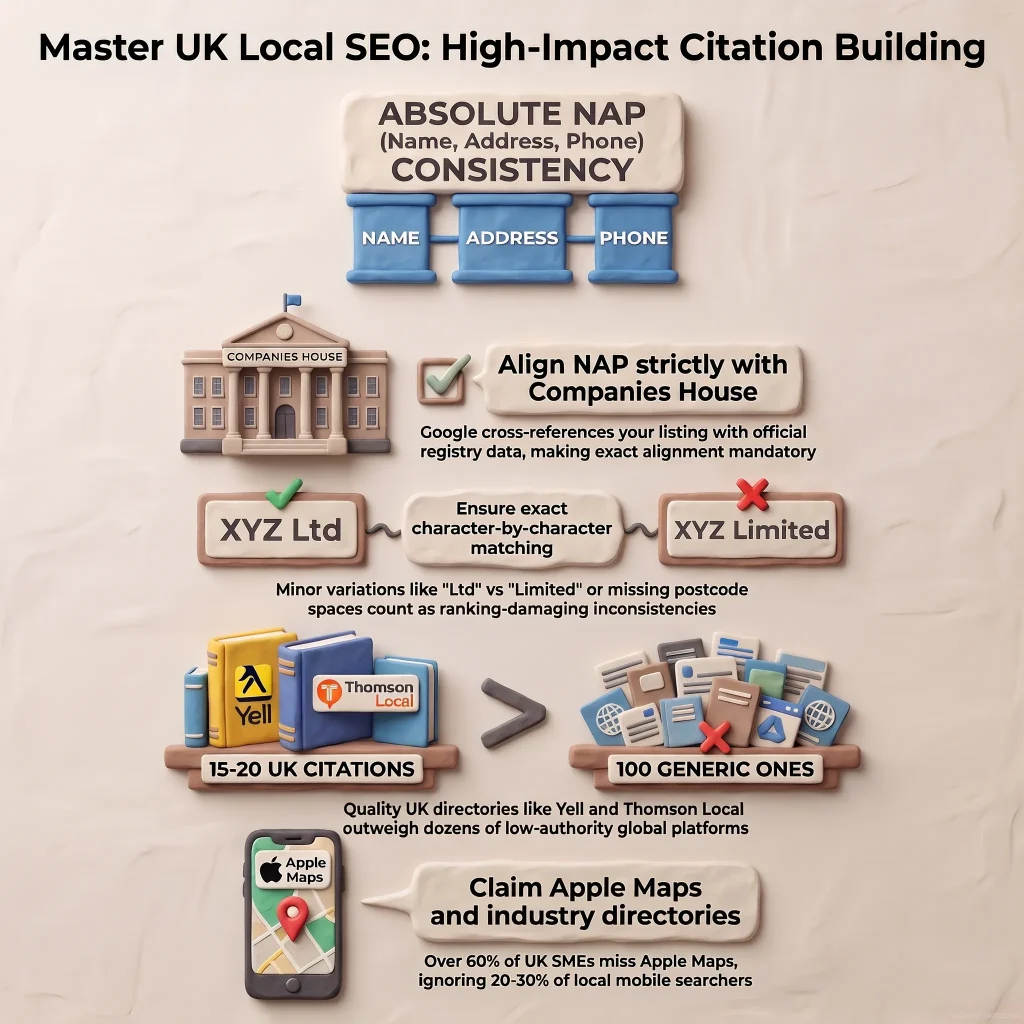
The pattern most businesses miss: UK citation strength comes from a smaller number of high-authority, UK-specific directories, not from submitting to 50+ global platforms.
The Companies House Problem No One Mentions
Here’s the citation consistency issue that trips up UK businesses more than any other: your Companies House registration data.
When Google crawls your business information, it cross-references what you’ve claimed in Google Business Profile against what appears in official registries. In the UK, that’s Companies House.
If your registered office address at Companies House differs from your trading address on Google Business Profile, you’ve created a citation inconsistency that undermines every other citation you build.
We see this constantly with:
- Businesses that moved premises but didn’t update Companies House
- Directors who used their home address for incorporation but trade from a separate location
- Companies using a registered office service in one city whilst operating in another
The fix isn’t complicated, but it’s non-negotiable: your NAP (Name, Address, Phone) must match Companies House exactly, or you need to update your official registration. Everything else you build sits on that foundation.

What “NAP Consistency” Actually Means in Practice
The advice to maintain NAP consistency across citations is everywhere. What’s rarely explained is how precise this needs to be — and where UK businesses typically fail.
Google doesn’t just check if your business name is “roughly similar” across platforms. It’s looking for exact matches, character by character.
These count as inconsistencies:
- “John Smith Plumbing Ltd” on one platform, “John Smith Plumbing Limited” on another
- “Flat 3, 45 High Street” versus “45 High Street, Flat 3”
- “Tel: 020 7946 0958” versus “020-7946-0958”
- Trading name on Google Business Profile, registered company name on Yell
The postcode problem: Some businesses list “SW1A 1AA” whilst others use “SW1A1AA” (no space). Both are technically correct, but Google treats them differently. Pick one format and use it everywhere.
The business impact isn’t theoretical. We’ve seen Bristol businesses ranking fourth in the Map Pack jump to first position within three weeks simply by correcting NAP inconsistencies across six major UK directories. No new content, no backlinks — just data hygiene.
The Three Citations Most UK Businesses Get Wrong
1. Apple Maps (Via Apple Business Connect)
Most citation-building efforts focus entirely on Google. But if you serve a local area, 20-30% of your potential customers are searching on Apple Maps, particularly on mobile.
Apple Business Connect is free, takes 15 minutes to set up, and provides a strong citation signal that Google also sees. Yet fewer than 40% of UK SMEs have claimed their listing.
The commercial impact: if you’re a restaurant, salon, or retail business in a town centre, you’re invisible to every iPhone user searching “near me” if you haven’t claimed this listing.
2. Industry-Specific Directories
Generic advice tells you to submit to broad directories. But for UK local SEO, one industry-specific citation often outweighs ten general ones.
If you’re a solicitor, the Law Society’s Find a Solicitor directory is more valuable than 20 generic business listings.
If you’re a plumber, Checkatrade and TrustATrader are worth more than almost any general directory (though they’re review platforms first, citations second).
If you’re an accountant, the ICAEW and ACCA directories carry authority that Bing Places never will.
The pattern: find the two or three directories that your customers actually use to find businesses like yours, and prioritise those over chasing citation volume.
3. Historical Business Data Aggregators
This is the citation issue that causes the most persistent ranking problems, and it’s nearly invisible to business owners.
In the UK, several data aggregators supply business information to hundreds of smaller directories: Factual, Foursquare, and others. If these aggregators have old or incorrect information about your business — perhaps from a previous owner, a former address, or a closed location — that outdated data propagates across dozens of platforms.
You’ll correct your Google Business Profile, update Yell, fix Thomson Local… and then discover 30 other sites still show your old address because they’re pulling from an aggregator you’ve never heard of.
The solution requires either:
- Tracking down and updating the source aggregators directly (time-consuming)
- Using a citation management platform that can push corrections at scale
- Working with an agency that has access to data aggregator feeds
This is where DIY citation building typically fails. The effort-to-outcome ratio tips sharply against doing it yourself.

When Citation Building Actually Moves Rankings (and When It Doesn’t)
Citation building isn’t universally valuable. Its impact depends on your competitive situation.
High impact scenarios:
- You’re a local service business competing in a specific town or region
- You’re trying to rank in the Map Pack for “near me” searches
- Your competitors have strong citation profiles and you don’t
- You operate in trades, hospitality, retail, or professional services with clear geographic service areas
Low impact scenarios:
- You’re a national online business with no physical location
- You already rank #1 in the Map Pack consistently
- Your industry doesn’t use local search (rare, but exists)
- You’re competing primarily on product/service-specific keywords rather than local intent
The mistake we see most often: businesses building citations because they’ve been told it’s “important for SEO” without checking whether it’s important for their SEO.
If you’re a London-based e-commerce business selling nationwide, citations won’t move the needle. If you’re a Manchester accountancy firm trying to attract local clients, they’re essential.
The Citation Audit Most Businesses Skip (and Pay For Later)
Before building new citations, you need to know what’s already out there — and whether it’s helping or hurting.
A proper UK citation audit checks:
- Whether your NAP matches Companies House
- Which major UK directories already list you (and whether the data is correct)
- Where duplicate listings exist (common after business mergers, moves, or ownership changes)
- Whether old citations from previous addresses are creating conflicting signals
- If your Google Business Profile category and description align with your main citations
We routinely find businesses with 15-20 existing citations they didn’t know existed — half of them with incorrect information.
Cleaning up incorrect citations before building new ones typically improves rankings faster than adding volume whilst inconsistencies remain.

What You Should Do This Week
If local search matters to your business, start here:
1. Check Companies House alignment — Does your registered address match where you want to rank? If not, decide whether to update Companies House or adjust your Google Business Profile strategy.
2. Verify your core six — Check that your NAP is identical (character-for-character) on Google Business Profile, Yell, Thomson Local, Scoot, Bing Places, and Apple Business Connect. Fix discrepancies immediately.
3. Find your industry directory — Identify the one or two professional or trade directories your customers actually use, and ensure you’re listed with complete, accurate information.
Everything else is secondary to those three actions.
Frequently Asked Questions
Q: How many citations does a UK business actually need?
A: Quality matters far more than quantity. A local business with 15-20 accurate citations on high-authority UK platforms will outrank a competitor with 100 citations across low-quality directories. Focus on the core UK platforms first — Yell, Thomson Local, Google Business Profile, Bing Places, Apple Maps, and one or two industry-specific directories.
Q: Should I pay for premium listings on Yell or Thomson Local?
A: For citation purposes, the free listing provides the same SEO value as the paid version. Premium listings give you advertising visibility and additional features, but won’t directly improve your Map Pack rankings. If your citation is already accurate on the free tier, upgrading is a marketing decision, not an SEO one.
Q: How long does it take for new citations to affect local rankings?
A: Most UK businesses see measurable impact within 4-8 weeks, assuming the citations are on authoritative platforms and NAP data is consistent. If you’re correcting existing inconsistencies, you may see movement within 2-3 weeks. If rankings don’t shift after two months, citation issues likely aren’t your primary ranking barrier — look at reviews, Google Business Profile optimisation, or on-page SEO instead.
Q: Can I delete old citations from a previous business address?
A: Yes, and you should. Contact the directory directly and request removal, or if you have login access, delete or update the listing yourself. Leaving old citations active creates conflicting location signals that dilute your current ranking efforts. This is especially important if you’ve moved within the same city but to a different postcode.
Q: Do I need different citations for each location if I have multiple branches?
A: Yes. Each physical location needs its own Google Business Profile and its own set of location-specific citations with the correct address and local phone number. Avoid using a single citation with multiple addresses listed — Google reads this as inconsistency. Multi-location businesses typically need structured citation management to keep all locations consistent.
If you suspect citation inconsistencies are holding back your local rankings — or you’d simply rather not spend three days manually updating business directories — we offer citation audits and managed citation building specifically for UK businesses. Get in touch and we’ll show you exactly what’s working, what’s broken, and what it’ll take to fix it.