
Why Your Dental Practice’s NHS vs Private Mix Completely Changes Your Local SEO Strategy
Here’s what most UK dental practices get wrong: they treat local SEO as a single strategy when they’re actually competing in two completely different markets with fundamentally different search behaviours.
A patient searching “NHS dentist accepting patients near me” is looking for availability and proximity. Someone searching “Invisalign Manchester prices” is comparing treatment options and provider expertise. Same geographic area, entirely different intent, and your local SEO needs to address both — or deliberately focus on one.
The NHS versus private positioning decision isn’t just about your service offering. It determines which keywords you target, how you structure your Google Business Profile, what landing pages you need, and crucially, which trust signals actually convert searchers into booked appointments.
The Search Behaviour Split That Defines Your Strategy
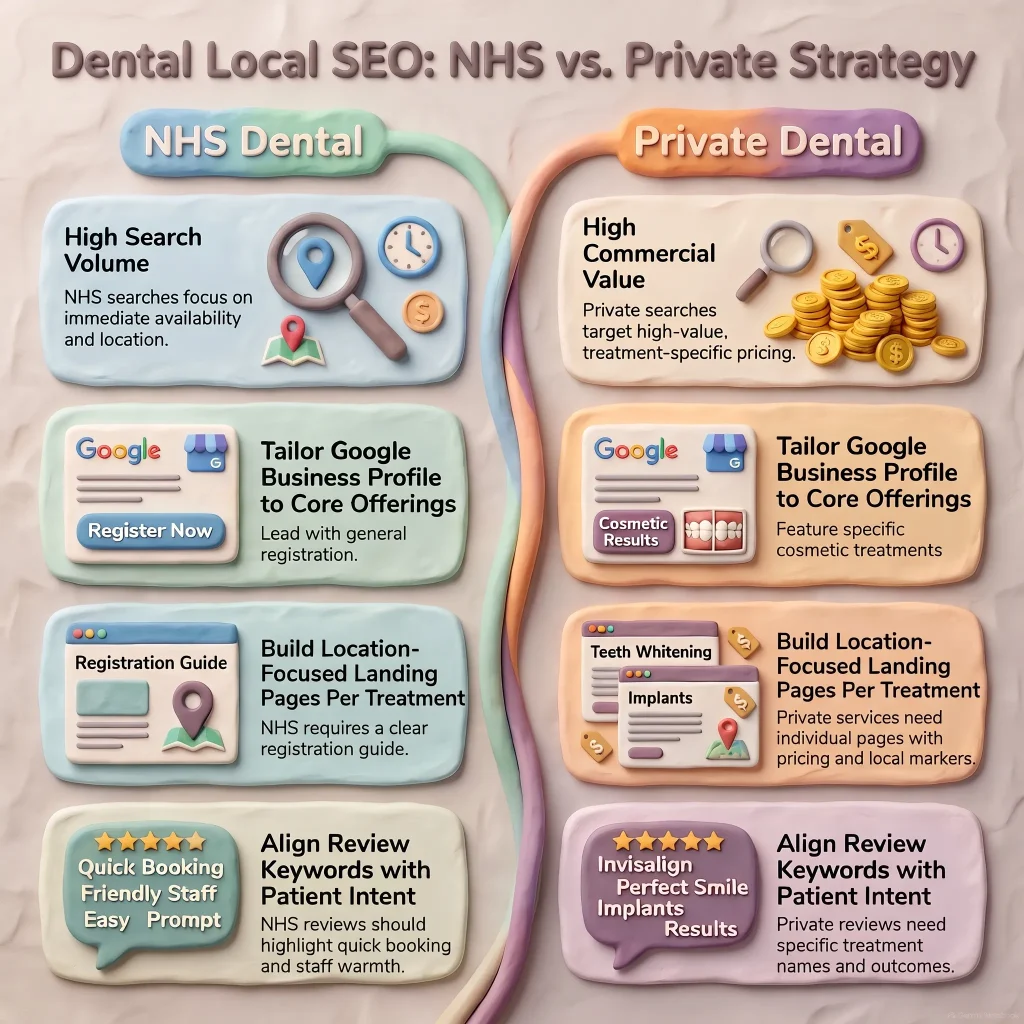
NHS-focused searches cluster around three dominant patterns: registration availability (“accepting NHS patients”), emergency access (“NHS emergency dentist”), and location (“NHS dentist [area]”). The commercial intent is low. The urgency is often high. The patient is looking for a yes-or-no answer: are you taking patients?
Private treatment searches are product-specific and price-conscious: “teeth whitening cost Liverpool,” “dental implants Leeds,” “Invisalign providers.” These searchers are in research mode, comparing providers, reading reviews about specific treatments, and looking for credibility markers.
If your practice offers both NHS and private, you’re competing in both search landscapes simultaneously — and that means your local SEO needs to serve two entirely different patient journeys without confusing Google about what you actually offer.
How to Structure Your Google Business Profile for the NHS/Private Reality
Your Google Business Profile is the single most important asset for dental local SEO, but the standard “fill in all the fields” advice doesn’t account for the NHS/private split.
If you’re NHS-focused: Your primary category should be “Dentist” and your business description needs to state NHS availability in the first sentence. “NHS dental practice in [area] accepting new patients for routine and emergency care.” Use Google Posts weekly to update NHS appointment availability — this is the information NHS searchers need immediately, and fresh posts signal active management to Google’s local algorithm.
If you’re primarily private: Lead with treatment categories. Your primary category is still “Dentist,” but your services list and business description should emphasise specific treatments: cosmetic dentistry, dental implants, Invisalign provider. Your Google Posts should focus on treatment-specific content: before-and-after results (within GDC guidelines), new technology, patient testimonials about specific procedures.
If you’re mixed: You need to be explicit about both. “NHS and private dental practice in [area]. Accepting NHS patients for routine care. Specialist private treatments include dental implants, cosmetic dentistry, and Invisalign.” This clarity helps Google serve your profile for both search types, but be prepared — you may rank more strongly in one than the other depending on your review content and website structure.
The services section in your GBP should reflect your strategic priority. If you’re pushing private work, list every treatment separately: teeth whitening, veneers, composite bonding, Invisalign, dental implants. Each becomes a potential search term Google associates with your profile. If you’re NHS-focused, keep it simple: general dentistry, emergency appointments, NHS registration.

The Landing Page Structure That Matches Search Intent
Most dental websites have a “Services” page listing everything they do. For local SEO, that’s leaving money on the table.
Every treatment-specific search term that has commercial value needs its own landing page. Not a paragraph on a general services page — a dedicated page optimised for that exact search.
For private practices or mixed practices pushing private work:
- Separate pages for: dental implants [city], teeth whitening [city], Invisalign [city], composite bonding [city], emergency dentist [city]
- Each page needs: pricing (even if it’s a range — “from £X” beats nothing), procedure explanation, before-and-after examples, local geographic markers (“serving patients in [area] and [surrounding areas]”), and booking CTA
- The local element matters. “Dental implants” is a national search. “Dental implants Leeds” is local intent. Your landing page title, H1, and first paragraph must include the location.
For NHS practices:
- A prominent NHS registration page explaining: whether you’re accepting patients, which areas you cover (NHS catchment areas matter), what the registration process involves, emergency appointment availability
- Location-specific pages if you serve multiple areas: “NHS dentist [specific neighbourhood]” — because NHS searchers often search hyperlocally
- An FAQ addressing the most common NHS patient questions: “Do you take on private patients from other practices for NHS treatment?” (no, not how it works, but it’s searched), “What NHS treatments do you offer?” (many people don’t know what’s covered)
The URL structure should be clean: yourpractice.co.uk/invisalign-manchester or yourpractice.co.uk/nhs-registration. Not buried under /services/cosmetic/invisalign. Google favours simple, topic-focused URLs for local searches.
The Review Content That Actually Converts Dental Patients
Every dental practice knows reviews matter. What most miss is that the content of your reviews determines which searches you rank for and which patients convert.
Google’s local algorithm looks at review text for topical relevance. If 15 of your reviews mention “nervous patient,” “gentle,” and “anxiety,” you’re more likely to rank for “dentist for nervous patients [area].” If your reviews consistently mention “Invisalign” and specific cosmetic treatments, Google associates your profile with those services.
For NHS practices: You want reviews that mention:
- Ease of getting appointments (“got me in quickly,” “emergency appointment same day”)
- Staff approachability and lack of pressure (NHS patients often fear being pushed toward private upsells)
- Routine care quality (“great with my kids,” “thorough check-up”)
For private practices: Target reviews that include:
- Specific treatment names (“so happy with my Invisalign results,” “dental implants look completely natural”)
- Outcome descriptions (this gives future patients confidence and provides Google with semantic context)
- Comparisons (“tried three other dentists,” “best teeth whitening in [area]”) — these signal authority
You can’t write reviews for patients, but you can influence what they mention. When you ask for a review (post-treatment email, text reminder), frame it: “We’d love to hear about your experience with [specific treatment]. What stood out?” That gentle prompt steers review content toward the terms that matter for your SEO.
The review velocity matters too, but differently for NHS versus private. NHS practices benefit from steady, consistent reviews — it signals ongoing capacity and active patient flow. Private practices benefit from treatment-clustered reviews: several Invisalign reviews in proximity signal specialisation and current expertise.

Why Local Citations Matter More for Multi-Location Practices
If you operate more than one location, local citation consistency becomes critical — and it’s where the NHS/private split creates practical problems.
Every directory listing (Yell, Thomson Local, healthcare directories, local business listings) needs identical NAP data (Name, Address, Phone) for each location. But here’s the complication: if one location is NHS-only and another is private-only, you need to differentiate them clearly in the business description across all citations, or you’ll attract the wrong patient enquiries to the wrong location.
For single-location practices, focus your citation efforts on:
- Healthcare-specific directories (Dentistry.co.uk, NHS.uk if you’re an NHS provider, WhatClinic)
- Local business directories (Google Business Profile, Bing Places, Apple Maps)
- Local Chamber of Commerce and business associations
The volume of citations matters less than the consistency and relevance. Ten accurate, consistent citations on relevant directories outperform 50 scattered, inconsistent listings.
The Keyword Targeting Reality: Volume vs Value
Local keyword research for dentists surfaces a harsh truth: the highest search volume terms are NHS-related, but the highest commercial value terms are treatment-specific private searches.
“NHS dentist [city]” might get 1,000 local searches per month. “Dental implants [city]” might get 150. But the latter converts at 10x the rate and at 20x the average patient value.
If you’re optimising for NHS registration searches, you’re chasing volume and availability-based conversion. Your SEO success metric is enquiry volume. If you’re targeting private treatment terms, you’re chasing value and expertise-based conversion. Your SEO success metric is enquiry quality and average treatment value.
Most mixed practices try to rank for both and end up ranking strongly for neither. The algorithmic reality is that Google wants topical clarity. A site that’s clearly about NHS dental access ranks for NHS terms. A site that’s clearly about cosmetic dentistry and private treatments ranks for those.
If you genuinely want to compete in both spaces, you need content volume and structure that clearly separates the two: distinct sections of your site, distinct blog content (NHS: “how to register,” “what’s covered”; Private: “treatment comparisons,” “cost guides”), and distinct conversion paths.

The Trust Signals UK Dental Patients Actually Care About
GDC registration is table stakes — every legitimate dentist has it. What separates practices in local search results is the next layer of trust signalling, and it differs by patient type.
NHS patients look for:
- Longevity (how long you’ve been in the area — this signals stability)
- Active NHS contract status (stated clearly, not buried in FAQs)
- Staff visibility (photos and bios of the team — NHS patients often see the same dentist for years)
Private patients look for:
- Professional credentials (postgraduate qualifications, specialist registrations, association memberships)
- Technology and technique (Invisalign provider status, digital scanning, same-day crowns)
- Before-and-after evidence (within GDC guidelines — this is critical for cosmetic work)
Both groups care about reviews, but they weight different aspects. NHS patients mention value, convenience, and staff manner. Private patients mention results, expertise, and outcome quality.
Your website and GBP should surface the trust signals that match your target patient. If you’re chasing private cosmetic work, lead with credentials and technology. If you’re positioning for NHS volume, lead with team stability and community presence.
The Content Strategy That Supports Local Visibility
Blog content for dental practices shouldn’t be generic health advice (“how to brush properly”). For local SEO, your content needs to serve two purposes: answer specific patient questions that include local intent, and establish topical authority for your target treatments.
NHS-focused content ideas:
- “How to Register with an NHS Dentist in [City]: What You Need to Know”
- “What Dental Treatments Are Free on the NHS in 2026?”
- “Finding an NHS Emergency Dentist in [Area]: Your Options”
Private treatment-focused content ideas:
- “Dental Implants vs Dentures in [City]: Cost Comparison and What to Expect”
- “How Much Does Invisalign Cost in [City]? Full Price Breakdown”
- “Teeth Whitening [City]: What Works and What Doesn’t”
The local modifier ([City], [Area]) is essential. It signals to Google that this content serves local search intent, and it increases the chance of ranking in the local pack.
Publish consistently but not excessively. One well-researched, genuinely useful piece per month outperforms four thin, generic posts. Google’s algorithm has become effective at identifying content written to satisfy SEO checklists versus content that actually answers patient questions.
Frequently Asked Questions
Q: Should I list both NHS and private services in my Google Business Profile, or focus on one?
A: List both if you genuinely offer both, but be explicit about which services fall under which. Vague positioning confuses Google and patients. If private work is your strategic priority, lead with private services in your business description and use the services list to emphasise treatments by name.
Q: How do I rank for NHS searches if I also do private work?
A: You need separate, substantial content for each. A single “We accept NHS patients” line won’t compete with practices that position entirely around NHS availability. Create a dedicated NHS registration page, publish content about NHS processes, and encourage reviews that mention NHS care. If NHS is secondary to your business model, accept that you may not rank as strongly for NHS terms.
Q: Do I need separate landing pages for every treatment I offer?
A: For treatments with meaningful search volume and commercial value, yes. Dental implants, Invisalign, teeth whitening, veneers, composite bonding — each warrants its own page if you want to rank locally for those searches. Routine treatments (check-ups, fillings) can live on a general services page.
Q: How important is Google Business Profile versus my website for dental local SEO?
A: Your GBP is the front door for most local searches — especially mobile users looking for immediate appointment availability. Your website is where you convert interest into bookings and establish expertise. Both are essential, but if forced to prioritise, an optimised, review-rich GBP with basic website beats a sophisticated website with a neglected GBP.
Q: Should I target surrounding towns and areas, or just my immediate location?
A: Target the areas patients realistically travel from. For routine NHS care, that’s typically a tight radius (2-3 miles in urban areas). For specialist private treatments, patients will travel further — 10-20 miles for implants or Invisalign isn’t unusual. Create location-specific pages or content only if you have something genuinely relevant to say about serving that area, not just to game local rankings.
If your dental practice’s local SEO hasn’t been built around the NHS versus private positioning reality, you’re likely competing with one hand tied. We work with UK dental practices to build local search strategies that match how patients actually search — and convert. Get in touch for a straightforward conversation about what’s working and what isn’t.