
How to Choose a PPC Agency in Oxford That Actually Understands Your Type of Business
Oxford isn’t a typical city for PPC agencies to navigate. Walk from the Covered Market to the Oxford Science Park and you’ve crossed from artisan food businesses running seasonal Google Shopping campaigns to quantum computing spin-outs generating leads for £2 million R&D contracts. The PPC structures, audience behaviours, and conversion paths are fundamentally different.
Most UK cities have a dominant commercial character. Oxford doesn’t. And that creates a specific problem when you’re choosing a PPC agency: the one that delivers brilliant results for a boutique hotel won’t necessarily know how to structure a campaign for a clinical diagnostics company selling to research institutions.
This guide helps you assess whether a PPC agency’s experience is actually relevant to your business before you commit budget.
Why Oxford Businesses Need Different PPC Approaches
The range of business types operating profitably in Oxford is unusually wide. That diversity is excellent for the local economy. It’s less helpful when you’re trying to evaluate whether an agency understands your sector.
A retail business targeting Oxford residents and tourists needs:
- Local geographic targeting (often within a 10-15 mile radius)
- Shopping campaigns with product feeds
- Peak spend around university terms, Christmas, and summer tourism
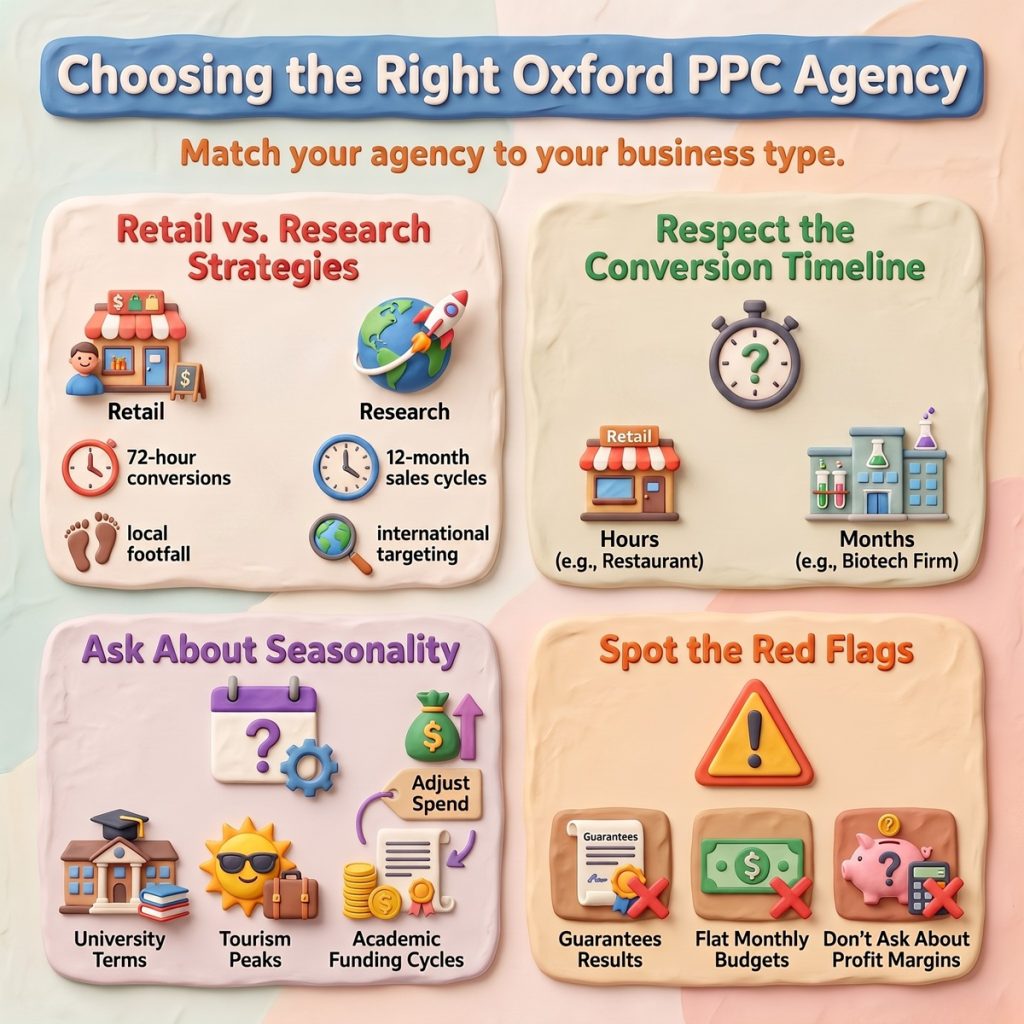
- Conversion typically happens same-day or within 72 hours
A life sciences business selling laboratory equipment or research services needs:
- International targeting, often focused on specific institutions
- Lead generation campaigns with multi-touch attribution
- Longer sales cycles (often 3-12 months from first click to contract)
- Remarketing strategies that nurture prospects across multiple site visits
An agency that excels at one won’t automatically be competent at the other. The platforms are the same. The strategic thinking is different.
The Evaluation Framework: Five Questions That Reveal Relevant Experience
1. What’s the typical conversion timeline for businesses they’ve worked with?
This question cuts through generic claims about “driving results.”
If you run a restaurant or retail shop, you need an agency comfortable optimising for conversions that happen within hours. Bid adjustments throughout the day matter. Local inventory ads matter. Weather can affect performance.
If you’re a B2B services business, consultancy, or research supplier, your conversion timeline is likely weeks or months. The agency needs to understand assisted conversions, how to value an email signup versus a phone call, and how to maintain visibility without burning budget on clicks that won’t convert for 90 days.
Ask directly: “What’s the longest sales cycle you’ve managed PPC for, and how did you structure attribution?”
If they look uncomfortable or give vague answers, their experience likely skews toward short-cycle retail.
2. Do they understand sector-specific search behaviour?
Oxford businesses often serve niche audiences with distinct search patterns.
Academic publishers and research services companies know their prospects search differently than retail customers. Queries are more specific, often technical, and frequently include journal names, methodology terms, or institutional affiliations. Search volume is lower. Cost per click can be higher. But conversion value per lead is often significantly higher.
A hospitality business targeting conference organisers has different search behaviour patterns than one targeting weekend tourists. The keywords overlap (“Oxford hotels”), but the intent signals are different, the booking windows are different, and the conversion value is different.
Ask: “Can you walk me through how search behaviour differs between [your sector] and typical retail campaigns?”
Their answer reveals whether they’ve actually worked in your space or are guessing.
3. How do they handle seasonality and budget pacing?
Oxford’s economy has pronounced seasonal patterns, but they’re different depending on what you sell.
University term times drive footfall for retailers, restaurants, and entertainment venues. The Christmas vacation period is quiet for student-facing businesses but busy for tourist attractions. Conference season (typically spring and autumn) matters for hotels and event suppliers.
Research and B2B businesses often follow different cycles: academic year funding, fiscal year-end procurement, conference schedules for specific sectors.
An agency that doesn’t ask about your seasonality during initial conversations doesn’t understand Oxford’s market structure.
Ask: “How would you adjust our PPC spend across the year, and what would you base that on?”
If they suggest a flat monthly budget without understanding your revenue cycles, walk away.
4. What’s their approach to local versus broader targeting?
This is where Oxford gets complicated.
Some businesses are purely local (tradespeople, salons, local retail). Some serve Oxford but draw from a wider catchment area (specialist medical practices, niche retail). Some are based in Oxford but serve national or international markets (software companies, research services, consultancies).
A retail-focused agency will default to local radius targeting. That’s correct for a café. It’s wrong for a biotech consultancy whose nearest relevant prospect might be in Cambridge or Munich.
Ask: “If our ideal customer isn’t primarily in Oxford, how would you structure geographic targeting?”
Their answer shows whether they can think beyond local service area campaigns.
5. Can they show you evidence of improving an underperforming account?
Most agencies show you their best case studies. That’s expected. But it doesn’t tell you how they handle the situation you’re actually in.
If you’re evaluating agencies because your current PPC isn’t working, you need to know they can diagnose and fix problems, not just run successful campaigns from scratch.
Ask: “Can you show me a campaign you inherited that wasn’t performing, explain what was wrong, and what you changed?”
Good agencies can do this without naming the client. They’ll reference specific structural issues: poor keyword match types, incorrect bid strategies for the sales cycle, shopping feed errors, geographic targeting too broad or too narrow.
If they can’t give you a specific before-and-after example with real metrics, they likely lack troubleshooting experience.
Warning Signs: When to Disqualify an Agency Quickly
Some red flags should end the conversation immediately:
They guarantee specific results. No credible agency guarantees rankings or conversion rates. Too many variables sit outside their control (your website, your pricing, your product, market conditions). They can commit to process, reporting standards, and ongoing optimisation. They cannot guarantee outcomes.
They don’t ask about your margins or conversion value. PPC is a margin game. An agency that doesn’t understand your unit economics can’t optimise effectively. If they haven’t asked what a conversion is worth to you, they’re not thinking strategically.
They propose campaigns before understanding your business. Any agency offering detailed proposals in a first meeting is guessing. Effective PPC strategy requires understanding your offer, your competitive position, your seasonality, and your capacity to handle increased enquiries. That takes time.
The account manager won’t be the person you’re talking to now. This isn’t always a dealbreaker, but it often is. If the senior person selling you the service won’t be the one managing your account, understand exactly who will and what their experience level is.
The Oxford-Specific Question You Must Ask
Here’s the single question that reveals whether an agency genuinely understands Oxford’s business landscape:
“What proportion of your Oxford clients are tourism and hospitality, versus research economy, versus local services and retail?”
An agency heavily weighted toward one sector will have deep expertise there. That’s excellent if you’re in that sector. It’s a risk if you’re not.
Oxford’s economy is roughly split between the visitor economy, the two universities and their commercial spin-outs, healthcare (including private medical services), and everything else (retail, professional services, creative industries). An agency that primarily serves hotels and restaurants thinks about PPC differently than one that serves laboratory equipment suppliers or academic publishers.
Neither is wrong. But you need the one whose existing experience maps to your business model.
When to Choose a Local Agency Versus a Specialist Remote One
Geography matters less than it used to for PPC management. The work happens online. Monthly face-to-face meetings rarely change outcomes.
But there are specific situations where a local Oxford agency has advantages:
You need someone who understands the physical geography. If you’re targeting Oxford residents, students, or visitors, an agency familiar with the colleges, neighbourhoods, parking challenges, and footfall patterns will make smarter decisions about ad copy, location targeting, and offer timing.
You serve multiple customer types with different Oxford relationships. A conference venue might target academic conference organisers, corporate training providers, and wedding planners. Those groups interact with Oxford differently. Local knowledge helps.
Your business is unusual enough that face-to-face briefing saves time. Complex service businesses, especially in research or regulated sectors, often communicate requirements more effectively in person initially.
For most B2B businesses selling outside Oxford, especially those with longer sales cycles, agency location matters less than sector experience.
How Much Relevant Case Study Evidence Do You Actually Need?
One detailed, relevant case study is worth more than five vaguely related ones.
If you’re a boutique hotel, you don’t need to see ten hospitality case studies. You need one that demonstrates the agency understands:
- Seasonal booking patterns
- Revenue management and how PPC integrates with direct booking strategy
- The difference between leisure and business travellers in search behaviour
- How to compete against OTAs without just bidding on your own brand terms
If you’re a medical devices distributor, you need one case study showing they understand:
- Lead quality over lead volume
- Multi-stakeholder buying processes
- Regulatory constraints on advertising claims
- How to target procurement professionals versus clinical users
Ask for the most relevant case study. Then ask detailed questions about it. That conversation reveals more than a portfolio of fifteen generic success stories.
The Budget Conversation: How They Handle It Matters
How an agency discusses budget tells you a lot about how they’ll manage your account.
Poor approach: “What’s your budget?” (Then they’ll design a campaign that spends exactly that amount, regardless of whether it’s right for your goals.)
Better approach: “What are you trying to achieve, what’s a conversion worth to you, and how many do you need?” (Then they’ll estimate what budget would be required to make PPC viable.)
Best approach: “Let’s look at search volume for your key terms, estimate competition levels and likely CPCs, and model what different budget levels might deliver.” (This is strategic planning, not just spending what you’ve allocated.)
If an agency doesn’t push back when you mention your budget, they’re order-takers, not strategists.
What “Oxford PPC Experience” Should Actually Mean
Don’t be impressed by an agency simply claiming “Oxford experience.” That’s geographic, not strategic.
What matters is whether they understand the specific commercial dynamics of Oxford businesses like yours:
- Student economy businesses (accommodation, food, entertainment): How term dates affect search volume, the difference between undergraduate and postgraduate targeting, international student recruitment if relevant.
- Tourism and visitor businesses: How to compete during peak periods without overspending, the balance between brand and generic terms when competing with aggregators, managing budget across UK school holidays.
- Research economy businesses (lab suppliers, research services, academic publishers): Institutional targeting, academic year cycles, how researchers search differently than procurement, international targeting when relevant.
- Professional services: Local versus regional targeting, how to value initial consultations, managing cost per lead when conversion takes weeks or months.
- Retail with Oxford character (independents, specialists): Competing against national chains and Amazon, local radius targeting, how to use Google Shopping effectively as an independent.
The agency needs to demonstrate they understand the commercial calendar, customer behaviour, and competitive dynamics specific to your type of business in this city.
Frequently Asked Questions
Q: Should I choose an agency that specialises in my sector or one with broad experience?
A: Sector specialisation matters more for complex B2B businesses, regulated industries, or unusual business models. For straightforward retail or local services, an agency with solid fundamentals and some relevant local experience is often sufficient. If your sales cycle is longer than 30 days or your product requires explanation, lean toward sector specialists.
Q: How long should I expect to wait before seeing whether a PPC campaign is working?
A: It depends entirely on your conversion timeline. Retail and hospitality should see meaningful data within 4-6 weeks. B2B service businesses often need 12 weeks minimum to gather enough conversion data to optimise effectively. Be suspicious of any agency that promises conclusions faster than your typical customer decision cycle.
Q: What monthly budget makes PPC viable for an Oxford small business?
A: There’s no universal minimum, but as a rough guide: local services often see results from £500-800/month, retail and hospitality from £1,000-1,500/month, and B2B services typically need £1,500-3,000/month minimum. Below these levels, you’re often spending most of your budget learning rather than converting, especially in competitive sectors. The right agency will tell you honestly if your budget is too small to deliver meaningful results.
Q: Should the agency also manage my social media advertising?
A: Only if they have genuinely separate expertise in both. PPC (search advertising) and paid social are different disciplines with different strategic approaches. Some agencies excel at both. Many are better at one and offer the other because clients ask for it. If paid social matters to your business, evaluate that capability separately and specifically.
If you’re an Oxford business trying to make sense of PPC agency options, we’ve been doing this for over 25 years, long enough to know that the right agency fit matters more than the slickest pitch. Have a look at our Oxford PPC agency services, or get in touch for a straightforward conversation about whether we’re the right match for what you’re trying to achieve.