

How to Choose a PPC Agency in Brighton That Actually Understands Your Seasonal Reality
Brighton businesses don’t operate on a flat calendar. You’ve got the summer tourist surge, stag parties, day trippers, festival crowds, driving one type of search behaviour, then the quieter months when you’re relying on locals, students, and the city’s year-round independent scene. A PPC agency running the same campaign structure through both periods is leaving money on the table, either overspending when demand drops or missing the peak when it matters most.
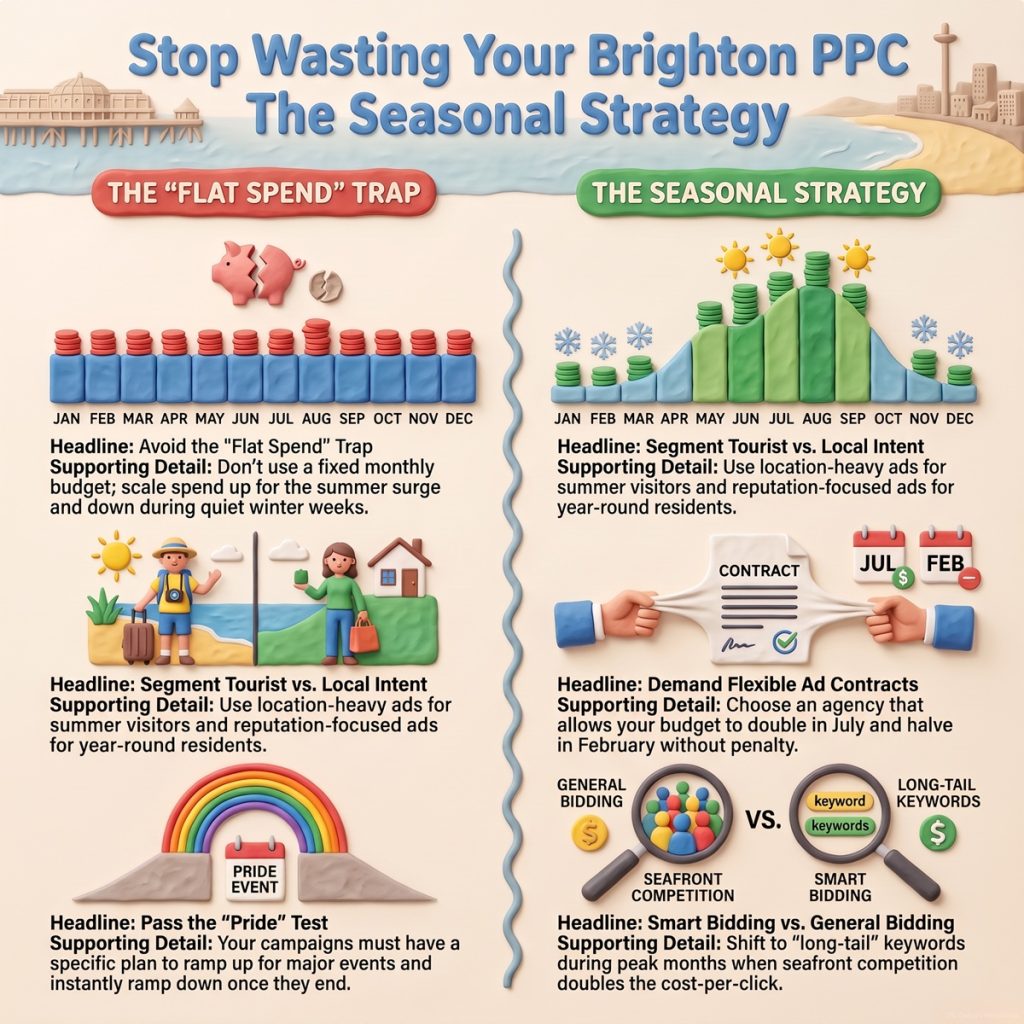
The difference between a competent PPC agency and one that understands Brighton’s economy is this: they don’t treat your budget as a constant monthly spend. They flex campaigns, audiences, and messaging based on which version of Brighton is searching that week.
Here’s how to evaluate whether an agency actually gets that seasonal dimension, or whether they’re just running generic Google Ads and hoping for the best.
The Business Problem: Two Economies, One Budget
If you run a Brighton business in hospitality, retail, leisure, or anything visitor-facing, you’re managing two distinct revenue patterns. July and August might account for 40% of your annual turnover. December brings the Christmas market crowd. Then you’ve got February half-term, Easter, Pride, and the quiet weeks in between when it’s locals keeping the lights on.
A flat PPC campaign doesn’t match that reality. Running the same daily budget, same keywords, same ad copy across the year means you’re either:
- Underinvesting during peak demand, capping your daily spend just when tourists are searching “Brighton restaurants near seafront” and you could be filling tables at full price
- Overinvesting during quiet periods, paying for clicks from people who aren’t ready to book, or targeting audiences that don’t convert outside the summer window
The question isn’t whether you need PPC. It’s whether your agency structures campaigns that mirror your actual trading calendar.
What Seasonal PPC Intelligence Looks Like for a Brighton Business
A PPC agency that understands Brighton’s economy will talk about these things in the first conversation:
Campaign Structures That Separate Tourist and Local Intent
This isn’t about running two identical campaigns and calling it strategy. It’s about recognising that “Brighton brunch” searches in August are coming from people who don’t know the city and want something Instagrammable near the beach. The same search in November is a local looking for their regular spot or trying somewhere new.
An agency with seasonal intelligence builds separate campaigns with different keyword lists, different ad copy, and different landing pages for each audience. Tourist campaigns emphasise location, convenience, and experience. Local campaigns lean on reputation, community, and repeat value.
Ask a prospective agency: “How would you structure campaigns for my business to handle both tourist peaks and year-round local trade?”
If the answer is just “we’ll optimise based on performance,” they’re not thinking structurally. You want to hear about audience segmentation, geographic layering, and how they’d schedule budget shifts before the data comes in, not after.
Budget Flexibility Built into the Contract
Most PPC agencies want a fixed monthly retainer and a consistent ad spend. That model works for businesses with predictable demand. It doesn’t work for Brighton.
You need an agency that’s comfortable with your budget doubling in July and halving in February. That means contract terms that allow seasonal budget variation without penalty, and a team that’s planned for the workload spikes when you’re scaling campaigns up for Pride or the Brighton Festival.
Ask: “Can I adjust my ad spend month-to-month based on my trading calendar, or are you expecting a flat annual budget?”
The wrong answer is anything that sounds like “we recommend consistency for long-term optimisation.” You’re not a SaaS company with predictable monthly revenue. You’re a Brighton business with seasonal peaks, and your PPC needs to match.
Proof They’ve Managed Campaigns Through a Full Brighton Year
An agency might have hospitality clients. They might have retail clients. But have they managed a Brighton business through a full twelve-month cycle, including the January slump, the Easter uptick, and the August chaos?
Ask for a case study or client example that covers a full year, with month-by-month spend and performance data. You’re looking for evidence that they:
- Scaled budget up ahead of known peaks (not just reactively after demand spiked)
- Shifted keyword focus between tourist and local intent as the season changed
- Adjusted bidding strategies when competition intensified during summer (every Brighton business with a basic understanding of Google Ads cranks up spend in July, your agency needs to account for that)
If they can’t show you this, they’re learning on your budget.
The Decision Framework: Four Questions That Reveal Seasonal Competence
1. Do They Ask About Your Revenue Curve Before Proposing a Strategy?
A competent agency will ask about your busiest months, your margin differences between peak and off-peak, and when you’re willing to sacrifice margin for volume. They should be mapping their campaign calendar to your P&L, not the other way around.
If an agency proposes a strategy before understanding your revenue curve, they’re guessing.
2. Can They Explain How They’d Handle the Three Weeks After Brighton Pride?
Pride is one of the biggest weekends in Brighton’s calendar. The search volume spike is predictable. What happens after is equally predictable: a sharp drop, then a return to baseline local demand.
An agency that understands this will talk about ramping down tourist-focused campaigns immediately after the event, shifting budget back to year-round local keywords, and not wasting spend on transient audiences who’ve already left the city.
Ask them specifically: “How would you adjust my campaigns in the week after a major Brighton event like Pride or the Festival?”
You’re testing whether they think in event cycles or just monthly averages.
3. What’s Their Approach to Geographic Targeting During Peak vs Off-Peak?
During summer, you might want to target a 50-mile radius, people planning day trips from London, Surrey, Kent. During winter, you might narrow that to 10 miles, focusing on Brighton and Hove residents and the student population.
Geographic targeting isn’t a set-it-and-forget-it decision. A seasonal PPC strategy adjusts radius, location-specific ad copy, and even bid adjustments based on whether you’re chasing tourist volume or local frequency.
If an agency hasn’t mentioned this, they’re not thinking about how search behaviour changes with the audience mix.
4. How Do They Manage Your Competitor Context?
Brighton’s PPC landscape gets significantly more expensive in summer because every coastal hospitality and leisure business is competing for the same tourist searches. Your cost-per-click for “Brighton seafront hotel” or “things to do in Brighton” can double between May and August.
An agency with seasonal intelligence will either:
- Shift budget toward less competitive long-tail keywords during peak periods when broad terms get prohibitively expensive
- Increase budget to maintain position, but only if your margin supports it
- Focus on retargeting and branded search during peaks, using off-peak months to build audience and capture new traffic when CPCs are lower
Ask: “How do you adjust bidding strategy when competition intensifies seasonally?”
The wrong answer is “we optimise for the best ROI year-round.” That’s not a strategy; that’s an algorithm. You want a plan that acknowledges competitive pressure changes and adapts to it.
What a Seasonal Campaign Structure Actually Looks Like
Here’s a simplified version of how a PPC agency that understands Brighton might structure campaigns for, say, a restaurant in the Lanes:
Campaign A: Tourist Audience (May–September, scaled up for events)
- Keywords: “Brighton restaurants near beach,” “where to eat in Brighton,” “best brunch Brighton seafront”
- Ad copy: Emphasises location, atmosphere, Instagram appeal, walk-in availability
- Landing page: Tourist-focused, visual-heavy, clear location info and booking CTA
- Geographic targeting: 50-mile radius, heavy weighting on London postcodes
- Budget: 60–70% of total PPC spend during active months
Campaign B: Local Audience (Year-Round, higher weighting October–April)
- Keywords: “Brighton restaurant booking,” “[neighbourhood] restaurants,” “Sunday roast Brighton”
- Ad copy: Emphasises menu, reviews, loyalty, community reputation
- Landing page: Menu-focused, emphasises repeat visits, email sign-up for locals
- Geographic targeting: 10-mile radius, Brighton and Hove postcodes, plus university areas during term time
- Budget: 30–40% during summer, 80–90% during off-peak
Campaign C: Event-Specific (Pride, Festival, Christmas Market, etc.)
- Short-burst campaigns with high daily budgets, timed exactly to the event window
- Keywords tied to the specific event + your service
- Paused immediately after the event ends, budget reallocated to A or B
This isn’t revolutionary. It’s just structured to match how Brighton actually works. If an agency isn’t proposing something that at least resembles this level of segmentation, they’re treating you like every other client, regardless of location.
The Red Flags: What Agencies Say When They Don’t Understand Seasonal Trade
“We’ll run a three-month test period and optimise from there.”
Three months might cover one seasonal context. You need an agency that’s planning for the full cycle from day one.
“We recommend a consistent monthly ad spend for better long-term data.”
Consistent spend is useful for businesses with consistent demand. You don’t have that. This is a template answer that doesn’t fit your reality.
“We use automated bidding strategies that adjust to performance in real time.”
Automated bidding is useful. It’s not a substitute for strategic campaign structure. Google’s algorithms optimise for the data they’re fed. If your campaigns aren’t segmented properly, automation just optimises a poorly designed setup.
“PPC is best for direct response, not brand awareness.”
True in general, but in Brighton’s tourist economy, there’s a case for running upper-funnel PPC during shoulder seasons to stay visible when organic and word-of-mouth drop off. An agency that rigidly separates brand and performance doesn’t understand how seasonal businesses maintain presence year-round.
What This Means for Your Agency Decision
You’re not looking for the biggest agency or the one with the flashiest case studies. You’re looking for one that asks the right questions about your trading calendar before they propose anything.
The evaluation process should feel like this:
1. Initial conversation focuses on your revenue curve, not their capabilities. They should be asking when you’re busiest, when margin is highest, and when you’re willing to invest for future return vs immediate conversion.
2. Proposal includes a month-by-month campaign outline, not a flat annual plan. You should see budget recommendations that vary across the year, mapped to your known demand patterns.
3. Contract terms allow budget flexibility. You need the ability to scale spend up and down without renegotiating every time.
4. Reporting is structured around your seasons, not calendar months. A good agency will track performance against “summer tourist period” and “off-peak local trade,” not just January, February, March.
5. They talk about opportunity cost, not just ROI. The question isn’t just “did this campaign return more than it cost?” It’s “did we capture the peak demand when it was available, and did we avoid wasting budget when it wasn’t?”
If an agency can’t deliver that level of seasonal thinking, they might still run competent PPC campaigns. They just won’t run campaigns optimised for Brighton’s specific trading reality.
Frequently Asked Questions
Q: Should I work with a Brighton-based PPC agency, or does location not matter?
A: Location matters less than sectoral experience. A London agency that’s managed coastal hospitality clients through seasonal peaks will understand your business better than a Brighton agency that’s only worked with year-round B2B clients. That said, an agency with other Brighton clients brings competitive intelligence, they’ll know when CPCs spike, which events drive search volume, and how local competitors structure their campaigns.
Q: How much should I expect to spend on PPC as a Brighton business with seasonal peaks?
A: Budget should map to revenue opportunity, not a fixed percentage. If summer represents 40% of your annual revenue, it should command closer to 50–60% of your annual PPC budget, because you’re compressing opportunity into a shorter window. Expect to spend 2–3 times your off-peak monthly budget during July and August if you’re visitor-facing. For a business turning over £300K–£500K annually, that might mean £1,500–£3,000/month in ad spend during peak, dropping to £500–£1,000 off-peak.
Q: Can I run PPC myself and just adjust budgets seasonally, or do I actually need an agency?
A: You can, if you’ve got the time to build separate campaign structures, write targeted ad copy for different audiences, manage keyword lists, adjust bids based on competitive pressure, and analyse performance data weekly. Most time-poor business owners don’t. The value of an agency isn’t just execution, it’s strategic structure and the time saved. If you’re spending 10+ hours a month managing PPC when you could be running the business, the agency cost usually justifies itself.
Q: What’s a reasonable timeline to see results from a seasonally structured PPC campaign?
A: If you start mid-season (say, launch in June for the summer peak), you should see improved conversion rates and better cost-per-acquisition within 3–4 weeks as the campaigns optimise. If you start off-peak, the real test is how the campaigns perform when you scale into the next seasonal high. Ideally, onboard an agency at least two months before your next major trading period so there’s time to build, test, and refine before the volume hits.
Q: How do I know if my current PPC agency is underperforming because they don’t understand Brighton’s seasonality?
A: Check your month-by-month ad spend and conversion data. If your spend is flat across the year but your revenue isn’t, that’s the first sign. Second: look at your cost-per-acquisition in July vs February. If it’s roughly the same, you’re either overpaying off-peak or underinvesting during peak. Third: ask your agency why your budget is structured the way it is. If the answer is “consistency” rather than “mapped to your revenue calendar,” they’re not thinking seasonally.
If you’re a Brighton business operating across both the tourist economy and the year-round local trade, your PPC campaigns need to reflect that reality, not run on a one-size-fits-all model borrowed from businesses with flat demand. We work with Brighton clients to build campaign structures that flex across your trading calendar, so you’re capturing peak demand when it’s there and not wasting budget when it isn’t. [Get in touch for a free PPC audit](https://www.thickrope.com/contact) and we’ll show you exactly how your current setup compares to a seasonally structured approach.