

Marketing Strategy Brighton: Why the City’s Independent Spirit Changes What Works
Brighton isn’t Manchester. It isn’t Bristol. And if you approach marketing there the same way you would in Derby or Slough, you’ll waste money.
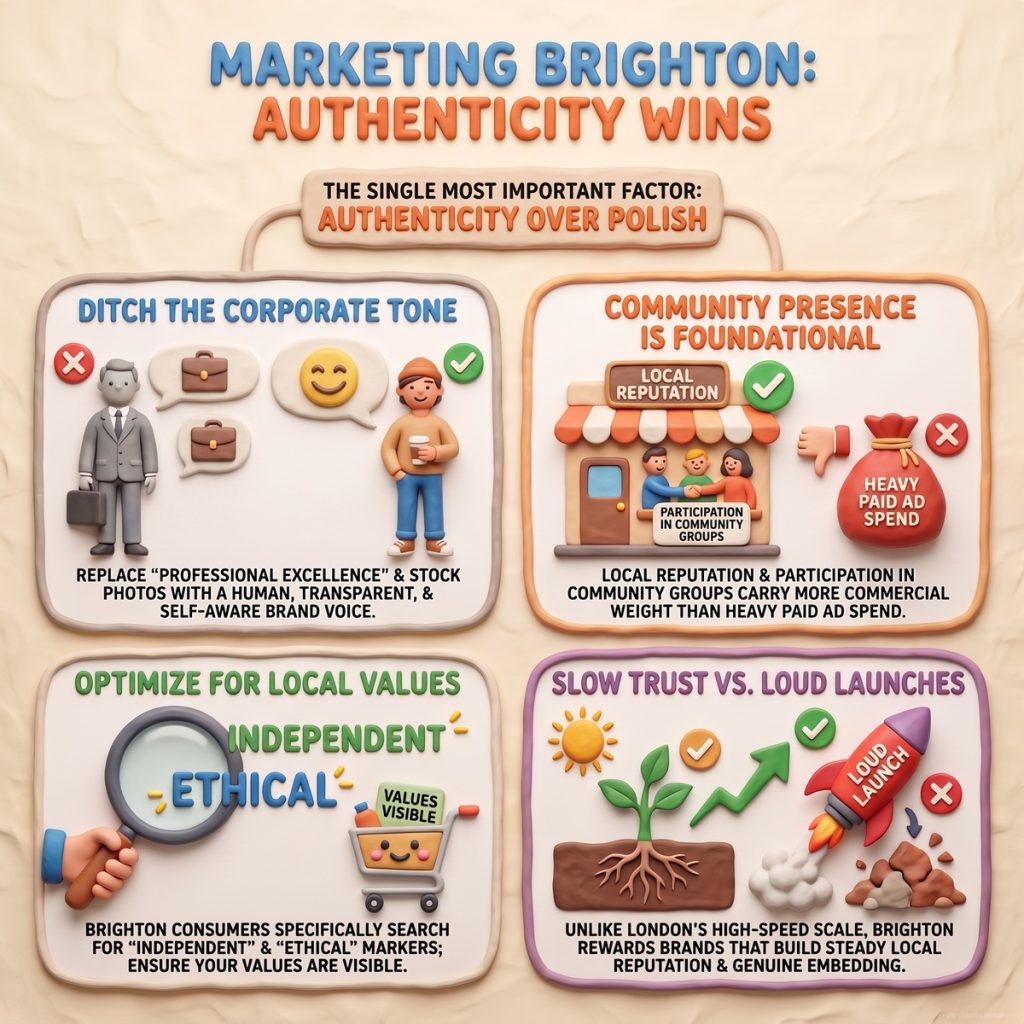
The city has a consumer culture shaped by decades of bohemianism, digital early adoption, and active resistance to corporate homogenisation. That culture creates specific patterns in how people respond to advertising, which brand voices get ignored, and which businesses thrive. A marketing strategy that doesn’t account for those patterns will consistently underperform, regardless of how much you spend.
This matters commercially because channel selection, messaging, and even the businesses you choose to emulate all need adjusting when your market is Brighton. What works in most UK towns often fails there. What seems too niche or unconventional elsewhere frequently succeeds.
How Brighton’s Consumer Identity Actually Formed
The city’s reputation as Britain’s creative and alternative capital didn’t emerge by accident. It began with Victorian health tourism, accelerated through post-war bohemian migration, and solidified in the 1980s and 90s as London overspill brought young, educated, politically progressive populations who actively chose Brighton for its difference.
That created a self-selecting consumer base: people who moved there specifically because they didn’t want what Reading or Crawley offered. The identity became self-reinforcing. Chains struggled. Independent coffee shops, vintage clothing stores, and artisan bakeries flourished not just because they were good, but because supporting them became an identity marker.
By the early 2000s, Brighton also had one of the UK’s highest concentrations of digital workers and early tech adopters. The combination, cultural progressivism plus digital sophistication, created a market unusually resistant to traditional advertising and unusually sensitive to inauthenticity.
For businesses operating there, this history has a direct commercial consequence: your marketing cannot look or sound like it was built for everywhere. Generic brand messaging gets filtered out. Corporate tone gets penalised, often visibly in reviews and social media responses. Businesses that succeed are the ones whose marketing acknowledges they’re operating in Brighton specifically, not “the UK market.”
What This Means for Channel Selection
The standard SME marketing mix, a bit of Facebook, some Google Ads, maybe a monthly email, works less well in Brighton than in most UK markets. Not because the platforms don’t function, but because the audience behaviour differs.
Search intent skews heavily local and qualitative. People in Brighton search “independent coffee roasters Brighton” not “coffee shop near me.” They search “zero waste shop Brighton” not “eco shop.” They’re filtering for business type and values before they even see your ad. If your paid search strategy assumes generic product/service terms will convert, you’ll burn budget on clicks that don’t match intent.
Organic social reach matters more than paid. Brighton consumers actively follow local businesses, share recommendations, and participate in community Facebook groups and Instagram tags. A business with 400 engaged local followers will often outperform one spending £500/month on poorly targeted Facebook ads. The culture rewards grassroots visibility. Paid social works, but only when the creative and targeting reflect local identity rather than templates.
Email performs if the voice is right. Brighton audiences expect personality, not corporate newsletters. A monthly email written like a conversation, “we’re trying a new supplier,” “here’s what didn’t work last week”, will get higher open and click rates than polished campaign copy. The market punishes formality and rewards transparency.
Google Business Profile and local directories are commercially critical. This market searches locally first. If your GBP isn’t optimised with local language, recent reviews, and accurate categories, you’re invisible to high-intent searchers. Businesses consistently underestimate how many Brighton customers begin purchase journeys with “best [category] Brighton” searches.
The strategic adjustment: assume lower tolerance for interruption advertising and higher rewards for being findable when intent already exists. Build visibility where the local conversation happens, not where the marketing playbook says to advertise.
Messaging and Brand Voice: What Actually Resonates
Brighton consumers have a finely tuned ear for inauthenticity. Marketing that works in Swindon or Nottingham, enthusiastic, benefit-driven, slightly corporate, often alienates here.
Authenticity is not optional. This doesn’t mean quirky for the sake of it. It means your brand voice must sound like actual humans who care about the thing you’re selling. Stock photography of models in suits gets mocked. Mission statements about “exceeding customer expectations” get ignored. Businesses that succeed talk about what they actually do, why they started, and what they care about. The more it sounds like templated agency copy, the worse it performs.
Political and ethical positioning is visible. In most UK markets, brands can remain neutral on sustainability, inclusivity, or social issues. In Brighton, silence is interpreted as a position. Businesses don’t need to be activists, but they do need to be clear about their values. A café that doesn’t mention whether its coffee is Fairtrade or its milk ethically sourced will lose customers to one that does. This isn’t performative, the market genuinely selects based on these factors.
Local references work; generic “we’re local” claims don’t. Saying “Brighton’s leading [service]” means nothing. Mentioning that you’re supplier to three Lanes businesses, or that you source from a Lewes farm, or that your founder has lived in Hanover for 15 years, that signals genuine locality. The audience can tell the difference.
Humour and self-awareness perform. Brighton audiences respond well to brands that don’t take themselves too seriously. A plumber who writes “we’ve seen some absolute horrors in Kemptown basements” will outperform one who promises “professional 24/7 service excellence.” The city rewards personality.
The strategic adjustment: spend more time on tone and less on polish. A slightly rough, obviously genuine brand voice will outperform a slick, generic one every time.
Why Copying London Strategies Usually Fails
Brighton sits 50 miles from London, shares much of its demographic profile, and attracts many former Londoners. That leads businesses to assume what works in Shoreditch or Peckham will work in Brighton. It usually doesn’t.
London marketing succeeds on scale, speed, and newness. Brands can launch with heavy paid spend, create buzz through influencer partnerships, and rely on sheer population density to find their audience. Brighton is too small for that approach to work economically. The city has roughly 290,000 residents. Heavy paid acquisition costs don’t pencil when your addressable market is that contained.
Brighton also resists trends faster than London adopts them. A new concept that’s fashionable in East London will often be treated with scepticism in Brighton until it’s proven locally. The city’s independent culture means it wants to discover things itself, not import them.
The businesses that succeed are usually those that build slowly, prioritise local reputation, and earn visibility through being genuinely embedded rather than loudly launched. That requires patience and a different budget allocation, more into content, community presence, and organic reach; less into paid acquisition and influencer spend.
The Role of Community Presence in Marketing Strategy
In most UK markets, “community marketing” is a nice-to-have. In Brighton, it’s foundational.
This is a city where the Facebook group “Bore Off Brighton Sell Your Stuff” has real commercial influence. Where the “Brighton Restaurant Reviews” group shapes which businesses survive. Where North Laine Traders and Kemptown business associations actively drive footfall. If you’re not visible in these spaces, you’re missing a significant portion of your market.
Community presence doesn’t mean sponsoring events or posting in every local group. It means participating authentically. Answering questions when your expertise is relevant. Supporting other local businesses publicly. Showing up in ways that add value rather than extract attention.
This takes time. It’s not a campaign you run; it’s how you operate. But businesses that do it see referral rates and word-of-mouth acquisition that dwarf what paid channels deliver. In a market this size, reputation compounds quickly. Being known as helpful, competent, and genuinely local generates more commercial return than being visible through ads.
The strategic adjustment: allocate time and resource to being present where your market actually congregates, and train your team to participate usefully rather than promotionally.
What a Brighton-Appropriate Marketing Strategy Actually Looks Like
If you’re building a marketing strategy for a business operating in Brighton, the foundational structure differs from a generic UK SME approach.
Start with local SEO and organic visibility. Most commercial intent in this market begins with local search. Your Google Business Profile, local directory presence, and on-site content optimised for “Brighton + [category]” terms will drive more qualified traffic than most paid channels. Invest here first.
Build your brand voice before you scale spend. Don’t launch paid campaigns until you’ve tested messaging with your actual local audience. Run organic content, monitor what resonates, and refine your tone based on response. Brighton audiences will tell you quickly when something feels off. Listen.
Prioritise channels where the local conversation happens. This varies by sector, but generally: Instagram for lifestyle and food businesses, Facebook groups for services and retail, LinkedIn for B2B only if your audience is actually there. Email for everyone, but only if your content is worth reading.
Invest in content that demonstrates expertise and locality. A café that blogs about Brighton coffee culture, or a solicitor who writes about local property law changes, or a plumber who explains why Brighton’s Victorian plumbing needs specific approaches, this content builds trust and rankings simultaneously. It works because it’s useful to the local market specifically.
Measure community engagement as seriously as conversion. Track shares, comments, and local mentions alongside leads and sales. In this market, engaged audiences convert later and refer more. A strategy optimised purely for immediate ROI will underspend on community building and cap long-term growth.
Common Mistakes Businesses Make in This Market
Assuming digital sophistication means high ad tolerance. Brighton consumers are digitally literate, which means they recognise and ignore most display ads, skip pre-rolls, and use ad blockers at higher rates than national averages. Relying on interruption advertising without building organic presence wastes budget.
Treating “quirky” as a strategy. Some businesses assume Brighton wants eccentricity for its own sake. What the market actually wants is authenticity. A business that’s genuinely unusual and owns it will succeed. One that performs quirkiness as a marketing tactic will be ignored or mocked.
Underestimating the reputational cost of missteps. In a market this size and this connected, poor customer experiences spread fast. One bad review in a popular local group can cost you dozens of potential customers. The marketing strategy must include reputation monitoring and rapid, genuine response to issues.
Copying what works for London-based competitors. If your competitor has a London presence and a Brighton branch, don’t assume their marketing approach is optimised for Brighton specifically. Often it’s not. They may be succeeding despite their marketing, not because of it.
Neglecting the areas outside the city centre. Marketing strategies often focus on North Laine, the Lanes, and the seafront. But Hanover, Kemptown, Hove, and the outer areas have distinct sub-cultures and spending patterns. A strategy that treats Brighton as homogeneous will miss significant market segments.
When to Prioritise Paid Channels
Paid advertising isn’t ineffective in Brighton; it just requires more precision than in other markets.
Google Ads work when search intent is specific and commercial. Someone searching “emergency plumber Brighton” or “wedding photographer Brighton and Hove” has high intent. Paid search captures that efficiently. Generic awareness campaigns rarely justify their cost.
Paid social works for retargeting and specific offers. If someone has visited your site or engaged with your content, retargeting them with a specific offer (a time-limited menu, a seasonal service, a local event) performs well. Cold prospecting to broad audiences doesn’t.
Local Services Ads (for eligible categories) perform strongly. The Google Guarantee badge carries weight with Brighton consumers, who value trust signals. If your business qualifies, LSAs often deliver better ROI than standard search ads.
Paid campaigns should run after you’ve validated messaging organically. Don’t use paid spend to test what resonates. Use organic content and community engagement to find the messages and offers that work, then amplify those through paid channels.
The strategic principle: paid channels accelerate what already works. They don’t substitute for product-market fit, brand voice, or local reputation.
Measuring What Actually Matters
Standard marketing metrics, impressions, reach, click-through rate, tell you almost nothing about whether your strategy suits Brighton’s market specifically.
Track local brand search volume. Are more people searching for your business name over time? That indicates your community presence and reputation are building. It’s a leading indicator of sustainable growth.
Monitor direct traffic and returning visitors. In a market where word-of-mouth and community recommendation drive decisions, you should see increasing direct traffic (people typing your URL or clicking saved links) and high returning visitor rates. If all your traffic is paid or comes from generic search terms, your local presence isn’t strong enough.
Measure referral sources from local platforms. Traffic from Brighton-specific Facebook groups, local blogs, or community sites indicates you’re becoming embedded. Track these separately from generic social referrals.
Review qualitative feedback and sentiment. What are people saying in reviews, comments, and local discussions? Are they recommending you for the reasons you think they should be? Sentiment analysis in this market often predicts growth better than traffic metrics.
Calculate customer lifetime value and referral rate. Brighton customers who connect with your brand tend to stay loyal and refer actively. If your LTV is low or referrals are minimal, your strategy isn’t resonating with the local culture regardless of what your traffic numbers show.
How This Differs If You’re B2B
Most of the above assumes consumer-facing businesses, but Brighton’s B2B market has its own characteristics.
The city has a large creative, digital, and professional services sector. B2B marketing here still rewards authenticity and penalises corporate tone, but the community dynamics work differently.
LinkedIn becomes more relevant, but voice still matters. Brighton B2B buyers still filter for authenticity. A LinkedIn presence that sounds like every other agency or consultancy gets ignored. One that demonstrates specific local expertise and genuine viewpoint performs.
Networking is more effective than in corporate-heavy cities. Brighton’s business community is relatively small and interconnected. Regular attendance at sector-specific events, genuine participation in business groups, and building real relationships delivers more pipeline than cold outreach.
Case studies and local references carry more weight. When selling to Brighton businesses, being able to reference other local clients (with permission) or demonstrating understanding of the specific challenges Brighton businesses face, recruitment, property costs, seasonal tourism fluctuations, builds credibility faster than generic capability decks.
The strategic adjustment for B2B: invest more in relationship building and less in volume outreach. Quality of connection matters more than reach in a market this size.
Why Local Market Character Matters as Much as Channel Selection
You can run a technically perfect marketing campaign, correct targeting, optimised ad creative, conversion-focused landing pages, and still underperform if the strategy doesn’t account for local market character.
Brighton demonstrates this more visibly than most UK markets because its consumer culture diverges further from the national average. But the principle applies everywhere: who your audience is, what they value, and how they make decisions matters as much as which channels you use to reach them.
A marketing strategy built without understanding those factors treats the market as generic. It assumes people in Brighton respond the same way people in Basingstoke or Birmingham do. They don’t.
The businesses that thrive in Brighton are those whose marketing reflects genuine understanding of the city’s independent spirit, digital sophistication, and cultural values. That understanding shapes everything: which channels you prioritise, how you allocate budget, what your brand sounds like, and how you measure success.
It’s not about being quirky or alternative for its own sake. It’s about being genuinely appropriate to the market you’re operating in. That requires research, attention, and the willingness to build a strategy that’s specific rather than templated.
Frequently Asked Questions
Q: Does marketing in Brighton cost more than other UK markets because of the competition?
A: Channel costs are similar, but you’ll likely spend more on content quality and less on volume. The market rewards depth over reach. Expect to invest more in messaging development and community presence than you would in less culturally distinct markets.
Q: Can a chain or franchise succeed in Brighton, or is it only viable for independents?
A: Chains can succeed if they adapt their marketing locally. A national brand that operates in Brighton exactly as it does in Milton Keynes will struggle. Those that acknowledge local culture, adjust their tone, and participate in the community can perform well. The brand structure matters less than whether the marketing feels locally appropriate.
Q: How long does it take to build traction with a Brighton-focused marketing strategy?
A: Organic visibility and community reputation typically take 6-12 months to build meaningfully. Paid channels can deliver faster results if your messaging and offer are already validated. Most businesses see early traction within three months but don’t hit stride until they’ve been present and consistent for at least two seasonal cycles.
Q: Is it worth targeting tourists and visitors or should marketing focus purely on residents?
A: Depends entirely on your business model. If you’re tourism-dependent (hospitality, attractions, seafront retail), visitor marketing is essential but requires different channels and messaging. If you’re a local service business, focusing on residents and workers delivers better LTV. Many businesses benefit from a split strategy: resident-focused for core revenue, visitor-focused for volume during peak seasons.
Q: Should I hire a Brighton-based agency or can a national agency deliver the same results?
A: Local knowledge matters more in culturally distinct markets. A national agency can deliver technically competent work, but they’ll need time to understand what makes Brighton different. An agency with established local experience starts with that understanding already embedded. The question is whether you’re paying them to learn the market or to apply existing knowledge.
If you’re operating in Brighton and your current marketing feels like it’s not quite connecting, good traffic but poor conversion, decent reach but low engagement, the issue is often strategy-market fit rather than channel execution. We’ve built marketing strategies for Brighton businesses across sectors for over two decades, and we’re still based here. If you’d like a second opinion on whether your current approach suits this market specifically, we’re happy to talk.