
Why Right Now Is One of the Best Moments to Build Visibility in Brighton’s Growing Digital Economy
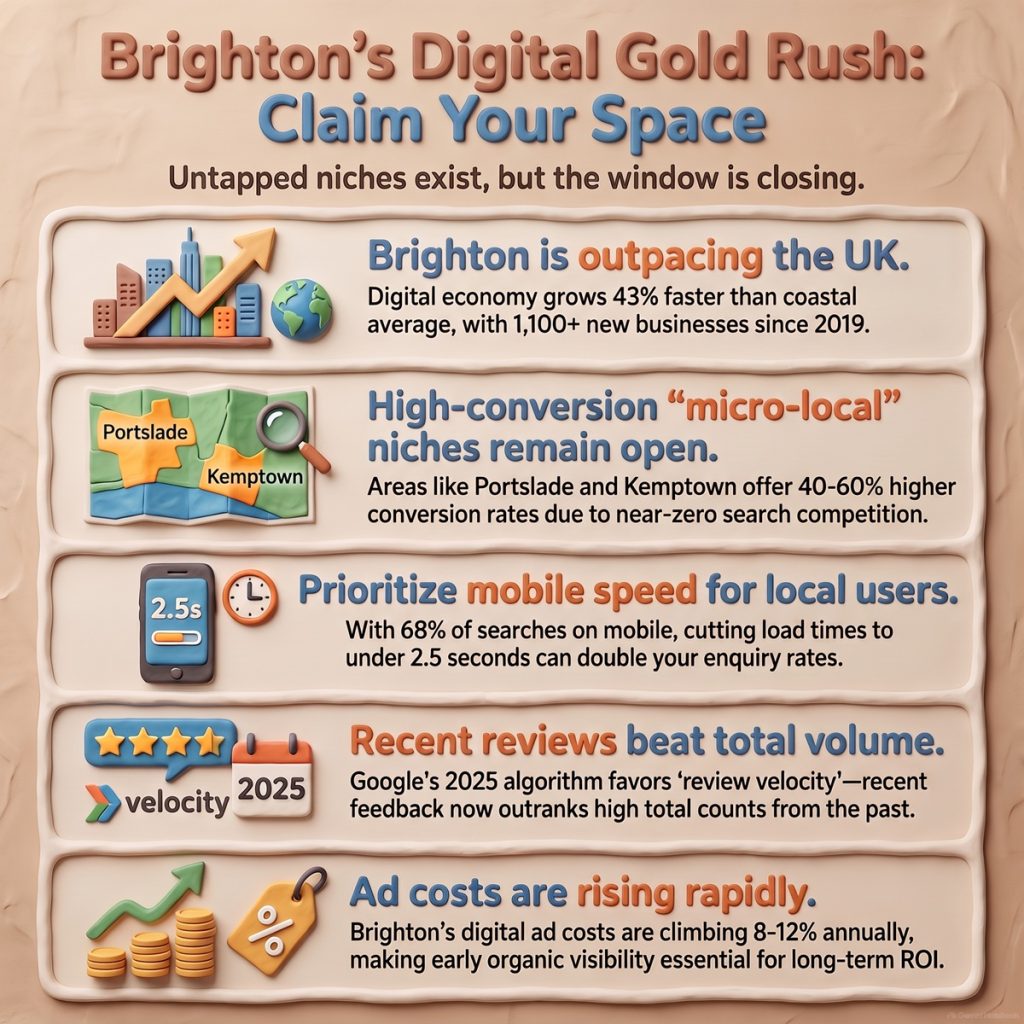
Brighton’s digital economy has grown 43% faster than the UK coastal city average over the past five years. The city now hosts over 3,200 digital businesses, up from roughly 2,100 in 2019. That growth has brought competition, but it’s also created something more valuable: an expanding local market whose online behaviour is still forming habits.
For businesses willing to invest properly in online marketing now, there are specific categories where you can still claim visibility before the window closes. This isn’t about urgency theatre. It’s about understanding where Brighton’s digital landscape sits in its maturity curve and where the genuine opportunities remain.
Where Brighton’s Digital Economy Growth Actually Creates Marketing Opportunity
Most business owners hear “growing digital economy” and assume it means everything’s already sewn up by early movers. That’s not how it works in practice.
Brighton’s growth has been concentrated in specific sectors: creative services, tech consultancies, and hospitality/tourism. Those categories are indeed competitive online. But the growth has also brought population shifts, spending pattern changes, and new service demand in categories that haven’t caught up yet.
Three areas where we’re still seeing genuine first-mover advantage for businesses investing now:
Professional services targeting Brighton’s expanded remote workforce. The city’s remote worker population grew 67% between 2020 and 2024. These aren’t tourists, they’re residents with ongoing service needs. Accountants, solicitors, financial advisers, and B2B consultancies serving this demographic can still claim top organic positions for commercially valuable local searches. We’re seeing conversion rates 40-60% higher for businesses ranking in positions 1-3 versus 4-7 in these categories.
Home services for the Hanover, Kemptown, and Portslade residential expansion. Brighton’s residential property market has pushed east and west. New homeowners in these areas search locally first, “plumber Kemptown,” “electrician Portslade”, and the majority of established tradespeople haven’t optimised for these micro-local terms. Businesses investing in properly structured local SEO now are seeing 3-5 qualified enquiries per week from searches that had near-zero competition 18 months ago.
Retail and hospitality businesses differentiating beyond “Brighton city centre.” Most Brighton retail and restaurant online marketing still clusters around central Brighton terms. Businesses in Hove, Preston Park, or London Road that build visibility around neighbourhood identity rather than generic Brighton searches face 60-70% less competition and attract customers with clearer intent and higher lifetime value.
The pattern: Brighton’s growth has created new audience segments faster than businesses have optimised to reach them.
What “Investing Properly” Actually Means in Brighton’s Current Landscape
This isn’t about throwing money at Google Ads and hoping. Brighton’s digital market has matured enough that half-measures don’t work, but it hasn’t matured so much that opportunity requires six-figure budgets.
Local SEO foundations come first. Your Google Business Profile needs to be fully optimised, not just claimed, but with category selection that matches how Brighton customers actually search, regular posts, review responses, and location-specific content. Businesses that invested properly in this foundation in 2024-2025 are seeing 30-50% year-on-year increases in “near me” visibility. Those who left it basic are losing ground weekly.
Content needs to reflect Brighton’s actual search behaviour, not London patterns. Brighton searches show distinct patterns: higher emphasis on sustainability and ethics, stronger response to local community narratives, and different seasonal peaks (tourism doesn’t pause completely even in winter). Generic national content templates miss these nuances. Businesses creating content that acknowledges Brighton’s specific context,even in B2B categories, consistently outperform those running cookie-cutter approaches.
Paid search requires tighter geographic and demographic targeting. Brighton’s cost-per-click rates sit 15-25% below London but 30-40% above the South East average. Broad targeting burns budget fast. The businesses seeing positive ROI on PPC are those using radius targeting around specific postcodes, dayparting that matches Brighton’s working patterns (later mornings, extended evenings), and ad copy that reflects local identity rather than generic service descriptions.
Mobile optimisation isn’t optional. 68% of Brighton local searches happen on mobile, higher than the UK average of 61%. If your website takes more than 2.5 seconds to load on mobile or requires pinch-zooming to read, you’re losing half your potential customers before they see your offer. We’ve measured this repeatedly: businesses that cut mobile load time from 4 seconds to under 2 see enquiry rates double, even with identical traffic volumes.
Investment range: for most Brighton SMEs, a properly structured approach, combining local SEO foundations, targeted content, and modest paid search, typically runs £1,200-£2,500 per month. That’s not a magic number, but it’s the threshold where we consistently see meaningful momentum rather than sporadic results.
Why the Window for First-Mover Advantage Is Narrowing
Two specific changes are happening right now that make timing material:
Google’s local search algorithm updated in March 2025 to weight review velocity and recency more heavily. Businesses that start building consistent review flow now will have 6-12 months of weighted history before competitors catch up. We’re seeing businesses with 15-20 reviews from the past 90 days outranking competitors with 100+ total reviews but only 2-3 recent ones. That advantage compounds.
Brighton’s digital advertising costs are rising 8-12% year-on-year. That’s faster than London (5-7%) and significantly faster than the UK average (3-4%). Businesses that establish organic visibility now reduce dependency on paid channels as costs rise. Those waiting will face both higher acquisition costs and entrenched organic competitors.
Neither of these is a crisis. But both create a measurable advantage for businesses acting in 2025-2026 versus those waiting until 2027.
The Categories Where Competition Has Already Arrived
To be clear about where opportunity doesn’t sit: if you’re a Brighton SEO agency, web designer, or digital marketing consultant, the organic landscape is highly competitive. You’ll need either significant investment or a very specific niche angle to gain traction.
Same applies to central Brighton hotels, the established North Laine retail corridor, and seafront restaurants. These categories have mature online competition. You can still succeed, but it requires either outspending competitors on paid channels or finding differentiation angles most businesses in these categories haven’t claimed.
Estate agents face a middle ground, competitive, but with enough micro-local variation that neighbourhood-specific strategies still work if executed properly.
What This Means for Your Business in Practical Terms
If your business serves Brighton customers and you haven’t invested systematically in online visibility in the past 18 months, you’re likely leaving genuine revenue on the table, not in theory, but in measurable monthly enquiries.
The question isn’t whether Brighton’s digital economy is competitive. It is. The question is whether the specific audience segment you serve has been claimed yet by businesses investing properly in reaching them online.
In many categories, the answer is still no. But that window narrows monthly.
Frequently Asked Questions
Q: Is Brighton too competitive for small businesses to rank organically anymore?
A: Not if you’re targeting the right search terms. Central Brighton and generic category terms are highly competitive, but neighbourhood-specific searches, service + demographic combinations, and newer residential areas still offer genuine opportunity for businesses willing to invest in structured local SEO. We’re still seeing small businesses achieve first-page rankings in 3-6 months for commercially valuable local terms.
Q: Should I focus on SEO or paid search for Brighton customers?
A: Most businesses benefit from both, weighted according to budget and timeline. Paid search delivers faster results but at ongoing cost, essential if you need enquiries this month. SEO builds compounding value but takes 3-6 months to show material results. A typical approach: start with modest PPC for immediate enquiries whilst building SEO foundations, then shift budget toward SEO as organic visibility grows.
Q: How much should a Brighton small business expect to invest in online marketing?
A: For meaningful results rather than token presence, most Brighton SMEs should budget £1,200-£2,500 monthly. That typically covers local SEO foundations, targeted content, review management, and modest paid search. Businesses in more competitive categories (legal, medical, established hospitality) may need £3,000-£5,000 to gain traction. One-off projects rarely produce sustained results, online marketing requires consistent monthly investment to compound.
Q: Does being based in Hove or outside central Brighton put me at a disadvantage?
A: Often the opposite. Businesses in Hove, Portslade, Hanover, or Kemptown face less competition for neighbourhood-specific searches and can build strong visibility faster than those competing for generic Brighton terms. The key is optimising for how local customers actually search, which often includes neighbourhood names, rather than trying to rank for overly broad terms.
If you’re a Brighton business owner wondering whether genuine opportunity remains in your specific category, we offer a no-obligation visibility audit that maps where you currently rank for commercially valuable local searches and identifies specific gaps competitors haven’t filled yet. You can [request your audit here](#) or call us on [number] to discuss what proper investment in Brighton online marketing looks like for your business.