

Why Slough’s Geographic Position Makes PPC Management More Complex Than Most UK Towns
Most businesses in Slough draw customers from at least three distinct catchment areas simultaneously: central London commuters, Heathrow’s massive employment and passenger base, and the Thames Valley tech corridor stretching west through Reading to Oxford. Each of these audiences searches differently, converts at different rates, and values different things. Managing PPC campaigns that work across all three, without wasting half your budget on the wrong geography, requires thinking that goes well beyond standard local PPC.
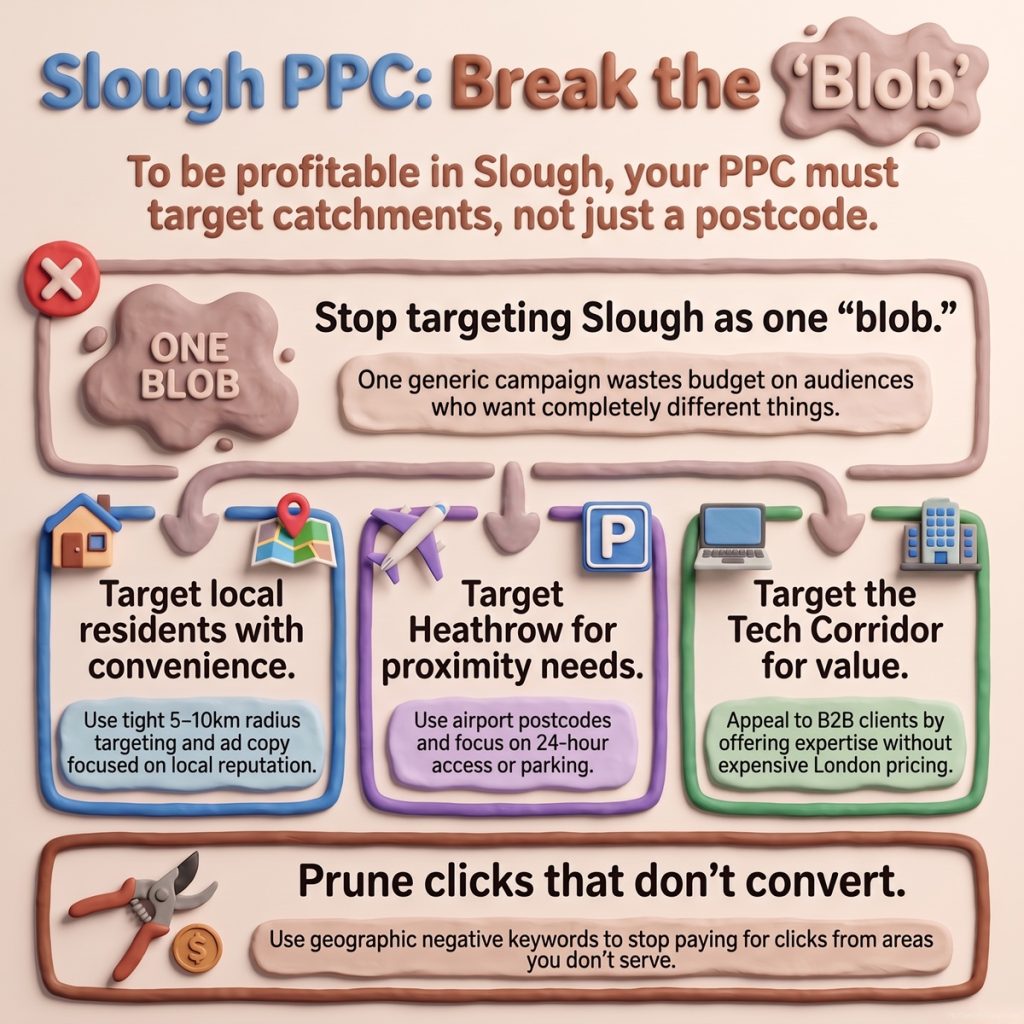
If you’re running Google Ads in Slough and treating it like any other UK town, you’re either overspending on clicks that never convert or missing the most profitable segments of your market entirely.
The Geographic Challenge Most Slough Businesses Don’t Account For
Slough sits at SL1, but your customers don’t think in postcodes. They think in travel time, familiarity, and whether you’re “on the way” to somewhere else. The M4, M40, and M25 converge nearby. Heathrow is fifteen minutes away. London Paddington is seventeen minutes by train. That accessibility is brilliant for business, until you try to define who your customer actually is in a PPC campaign.
A restaurant in Slough town centre might serve three completely different audiences on the same day: local residents, business travellers staying near Heathrow, and London-based workers who’ve driven out for a meeting at one of the tech firms in the Trading Estate. Each group searches differently. The local resident searches “restaurants near me.” The business traveller searches “restaurants near Heathrow Terminal 5.” The London worker might not search at all, they’re relying on Google Maps whilst already in the car.
If your PPC campaign targets “Slough” as a single geographic blob with one set of ad copy and one landing page, you’re treating these three groups as if they want the same thing. They don’t. The business traveller cares about proximity to their hotel and whether you’re open late. The local resident cares about value and whether you do takeaway. The London worker cares about parking and whether you take bookings.
Most PPC agencies build Slough campaigns the same way they’d build campaigns for Basingstoke or Swindon. one location target, one audience, generic ad copy. That approach leaves money on the table in a town where your actual market is fragmented across multiple high-value segments.
What “Geographic Complexity” Actually Means in PPC Terms
It’s not just about where people are. It’s about where they think they are, where they’re trying to go, and what mental map they’re using when they search.
London overspill. Slough is inside the M25 effect zone. People who work in central London but live west of the city will see Slough as part of their extended catchment. If you’re a B2B service, accountants, solicitors, IT support, you’re competing with London agencies for the same search terms, but those London agencies are bidding on a completely different cost-per-click because their customer lifetime value is higher. You’ll get outbid unless you carve out a defensible geographic niche and write ad copy that explicitly appeals to businesses who don’t want to pay London rates.
Heathrow proximity. Heathrow employs over 76,000 people directly and supports another 100,000+ jobs in the surrounding area. If your business serves airport workers, corporate clients near the airport, or passengers in transit, you’re competing in a hyper-commercial PPC environment where hotels, car parks, and airport services dominate the ad auction. You need to either bid high enough to compete or find search terms where you’re not fighting Hilton and Holiday Inn for every click.
Thames Valley tech corridor. The stretch from Slough through Maidenhead, Reading, and out towards Oxford is one of the densest concentrations of tech and pharmaceutical companies outside London. Microsoft, Amazon, Dell, Reckitt, they’re all here. If you serve B2B clients, your audience isn’t searching for “Slough” anything. They’re searching for the service itself, and your geographic targeting needs to be wide enough to cover the corridor but tight enough that you’re not paying for clicks from Birmingham or Southampton.
The mistake most businesses make is trying to target all three audiences in one campaign. You end up with ad copy that’s too generic to appeal to anyone and a landing page that tries to be everything to everyone. Conversion rates suffer. Cost per acquisition climbs. The campaign “doesn’t work,” so you turn it off and assume PPC isn’t right for your business.
The real issue is that Slough demands segmentation. You need separate campaigns, or at minimum, separate ad groups with distinct copy and landing pages, for each audience segment. That’s more work, more structure, and more ongoing management than a standard local campaign. It’s also the only way to make PPC profitable in a town where your market is split across such diverse catchments.
How to Structure PPC Campaigns for Slough’s Fragmented Geography
Start by defining your actual customer catchment, not the one you’d like to have. Look at your existing customer data. Where do they come from? If you don’t have that data, look at your Google Analytics, where is your website traffic originating? If you’re getting traffic from Uxbridge, Maidenhead, Windsor, and West London all at once, you’re not serving “Slough”, you’re serving a corridor.
Campaign structure should mirror audience segments, not geography. Create separate campaigns for:
Local Slough residents, tight radius targeting (5–10km), ad copy focused on convenience, familiarity, local reputation. Bid modifiers to increase bids during times when local residents are most likely to search (evenings, weekends). Landing page should feel local, mention Slough explicitly, show local landmarks or areas, use testimonials from local customers.
Heathrow catchment, targeting postcodes around the airport (TW6, UB3, UB7) plus search terms that include “near Heathrow” or “Heathrow area.” Ad copy focused on proximity to the airport, ease of access, and whether you’re open outside standard hours. If you offer parking, lead with it. Landing page should include a map showing how close you are to each terminal and clear directions from the M4 or M25.
Thames Valley B2B corridor, wider geographic targeting (15–20km radius or postcode targeting from Uxbridge to Reading), search terms focused on the service itself rather than location. Ad copy focused on expertise, sector experience, and avoiding London pricing. Landing page should feature case studies or clients from recognisable companies in the corridor, and make it clear you’re not a London agency charging London rates.
Each campaign needs its own budget, its own set of negative keywords, and its own conversion tracking. If you’re not separating these out, you’re flying blind. You won’t know which audience segment is profitable and which is draining your budget.
Bid strategy gets complicated fast. If you’re using automated bidding (Target CPA or Maximise Conversions), Google’s algorithm will optimise across all your targeting. That’s fine if all your segments convert at similar rates. But if Heathrow-area clicks convert at 6% and local Slough clicks convert at 3%, automated bidding will shift budget towards Heathrow and starve your local campaign. You need to either run manual bidding with separate strategies for each campaign or accept that automated bidding will favour your highest-converting segment and plan accordingly.
Search terms bleed across geography. Someone in Windsor searching for “accountants near me” might see your ad if you’re targeting a 15km radius from Slough. That click costs you money, but if your practice is in Slough town centre and the searcher never drives east of Windsor, it’s a wasted click. You need location-specific negative keywords and regular search term reviews to prune out areas that click but don’t convert. Most agencies don’t do this level of geographic hygiene because it’s time-consuming and requires local knowledge. But in Slough, it’s the difference between a profitable campaign and one that bleeds budget.
The Audience Segmentation Problem: Commuters, Residents, and Business Travellers
Slough’s population swells during working hours. The town’s working-age population is around 110,000, but daytime footfall is much higher because of commuters and business visitors. If you’re a cafe, gym, or retail business, your customer base changes depending on the time of day. Morning and lunchtime customers are likely office workers. Evening and weekend customers are residents.
That means your PPC campaigns need dayparting, adjusting bids based on time of day. If you run a coffee shop near Slough station, you want higher bids during morning commute hours (7–9am) when office workers are searching for “coffee near Slough station.” You want lower bids at weekends when search volume drops. If you’re bidding the same amount 24/7, you’re overpaying during low-intent periods and potentially losing out during high-intent windows.
Most PPC agencies set up dayparting at a basic level, “increase bids during business hours”, but that’s too blunt for Slough. You need to layer dayparting with audience segmentation. Office workers searching at 8am on a Tuesday are a different audience from families searching at 11am on a Saturday. The former wants speed and convenience. The latter wants value and experience. Your ad copy and landing page should reflect that.
Why “Near Heathrow” Search Terms Are Both an Opportunity and a Trap
Heathrow proximity is a double-edged sword. If your business genuinely serves airport passengers or airport workers, it’s a goldmine. Hotels, car parks, luggage storage, airport transfers, these are all high-intent, high-value searches. But the competition is brutal and the cost-per-click reflects that. Budget hotels are bidding £3–5 per click on “hotels near Heathrow.” If you’re a small independent trying to compete on the same terms, you’ll burn through budget fast.
The smarter play is to target the periphery of Heathrow-related searches, terms that indicate airport proximity but aren’t dominated by the big chains. “Meeting rooms near Heathrow” instead of “hotels near Heathrow.” “Business lunch Slough” instead of “restaurants Heathrow.” “Airport parking Slough” instead of “Heathrow parking.” You’re still capturing the airport catchment, but you’re avoiding the most expensive, most competitive terms.
Another trap: people searching “near Heathrow” are often looking for something immediately near the terminals, not fifteen minutes away in Slough. Your ad copy needs to set expectations. If you say “near Heathrow” but you’re actually in Slough town centre, you’ll get clicks from people who bounce when they realise you’re not within walking distance of Terminal 5. Be specific: “15 minutes from Heathrow” or “easy access from M4 Junction 6” filters out unrealistic expectations and improves conversion rates.
The M4 Corridor Effect: When Your Competitors Aren’t Local
The M4 runs straight through Slough. That’s brilliant for logistics, warehousing, and B2B services, you can serve clients from West London to Bristol without anyone thinking twice about your location. But it also means your PPC competitors aren’t just Slough businesses. You’re competing with agencies, consultants, and service providers from Reading, Maidenhead, Uxbridge, even Oxford.
If you’re bidding on broad service terms — “IT support,” “commercial solicitors,” “marketing agency”, without tight geographic constraints, you’re competing in a regional auction, not a local one. That drives up costs and reduces relevance. The solution is to layer location into your keywords and ad copy even when you’re targeting a wide area. “IT support Thames Valley” or “commercial solicitors Berkshire” signals that you’re local to the corridor without limiting yourself to Slough postcode.
You also need to think about where clicks are coming from versus where conversions come from. If you’re getting lots of clicks from West London but they never convert, it might be because London-based businesses assume you’re too far away or because they’re just browsing. Add London postcodes as a location exclusion or reduce bids for that area. If Reading-based clicks convert well, increase bids there. Most businesses don’t separate click geography from conversion geography, so they keep pouring budget into areas that look busy but don’t deliver customers.
What Good Slough PPC Management Actually Looks Like
It’s not about spending more. It’s about spending smarter across a fragmented market. A well-structured Slough PPC campaign should have:
- Three to five separate campaigns targeting distinct audience segments (local, Heathrow, Thames Valley B2B, London overspill, etc.), each with its own budget and bid strategy.
- Location-specific ad copy that speaks directly to where the searcher is and what they care about in that context.
- Dayparting and device bid adjustments that reflect when and how each audience segment searches.
- Regular search term reviews to prune out geographic bleed, clicks from areas that don’t convert.
- Conversion tracking by geography so you know which areas deliver customers and which just deliver clicks.
- Landing pages tailored to each segment not one generic homepage for everyone.
That’s more complex than a standard local campaign. It requires more setup time, more ongoing management, and a deeper understanding of Slough’s commercial geography. But it’s also the difference between PPC that pays for itself and PPC that feels like pouring money into a black hole.
Most PPC agencies don’t build this level of segmentation because it doesn’t scale. They’d rather run the same template across fifty towns than customise for Slough’s specific challenges. That’s fine for them, but it’s expensive for you.
Frequently Asked Questions
Q: Should I target London in my Slough PPC campaigns?
A: Only if your existing customers include London-based businesses or you’re confident you can compete on price and service with London providers. London clicks are expensive and London-based searchers often filter out non-London businesses. If you do target London, use ad copy that explicitly addresses why a London business should choose a Slough provider, usually lower cost or easier access from West London.
Q: How much should I expect to spend on PPC in Slough?
A: It depends entirely on your industry and which audience segments you’re targeting. Local service businesses (plumbers, electricians, cafes) might spend £500–1,500/month and see results. B2B businesses targeting the Thames Valley corridor often need £2,000–5,000/month to reach meaningful volume, especially if you’re competing with Reading or London-based agencies. Heathrow-adjacent businesses (hotels, parking, transport) face the highest CPCs and may need £3,000+ just to stay visible.
Q: Can I just target “Slough” as one location and let Google handle the rest?
A: You can, but you’ll waste budget. Google’s location targeting doesn’t understand that “Slough” means different things to different audiences. You’ll serve ads to people searching from Heathrow who’ll never travel into Slough town centre, or people in Windsor who consider Slough too far. Manual segmentation by postcode or radius targeting gives you much tighter control over who sees your ads and when.
Q: Is PPC worth it for a small Slough business competing with London agencies?
A: Yes, if you carve out a clear niche. Don’t try to outbid London agencies on generic terms. Instead, target long-tail keywords that include “Berkshire,” “Thames Valley,” or “without London prices.” Use ad copy that explicitly appeals to businesses tired of paying London rates. Your conversion rate will be lower but your cost-per-click will be much cheaper, and the customers you do win will be more loyal because you’re solving a specific frustration.
If your Slough PPC campaigns are structured like any other town’s, one location, one audience, generic ad copy, you’re likely overspending on the wrong clicks and missing the segments that would actually convert. Thickrope Marketing builds PPC campaigns around Slough’s specific geographic complexity, with segmentation and targeting designed for businesses operating across multiple catchments. If you’d like a free audit of your current campaign structure and where budget’s being wasted, get in touch.