
Why Windsor’s SEO Landscape Demands Two Strategies Running in Parallel
Most agencies treat Windsor like any other Thames Valley tourist destination. They optimise for the Castle, Legoland, and peak summer traffic, then wonder why their clients struggle to convert year-round revenue.
The reality is more complex. Windsor sits at the intersection of two distinct economies: one of Britain’s most visited tourist destinations (attracting over 6 million visitors annually to Windsor Castle alone), and one of the country’s most affluent residential postcodes. The SL4 postcode area consistently ranks in the UK’s top 20 for household income, with median property values exceeding £650,000.
These two audiences search differently, convert differently, and require fundamentally different SEO approaches. Yet they overlap in ways that create commercial opportunity, if you know where to look.
The Dual Search Demand Most Windsor Businesses Misunderstand
A Windsor restaurant, hotel, or retail business isn’t serving one market. It’s serving two that operate on different calendars entirely.
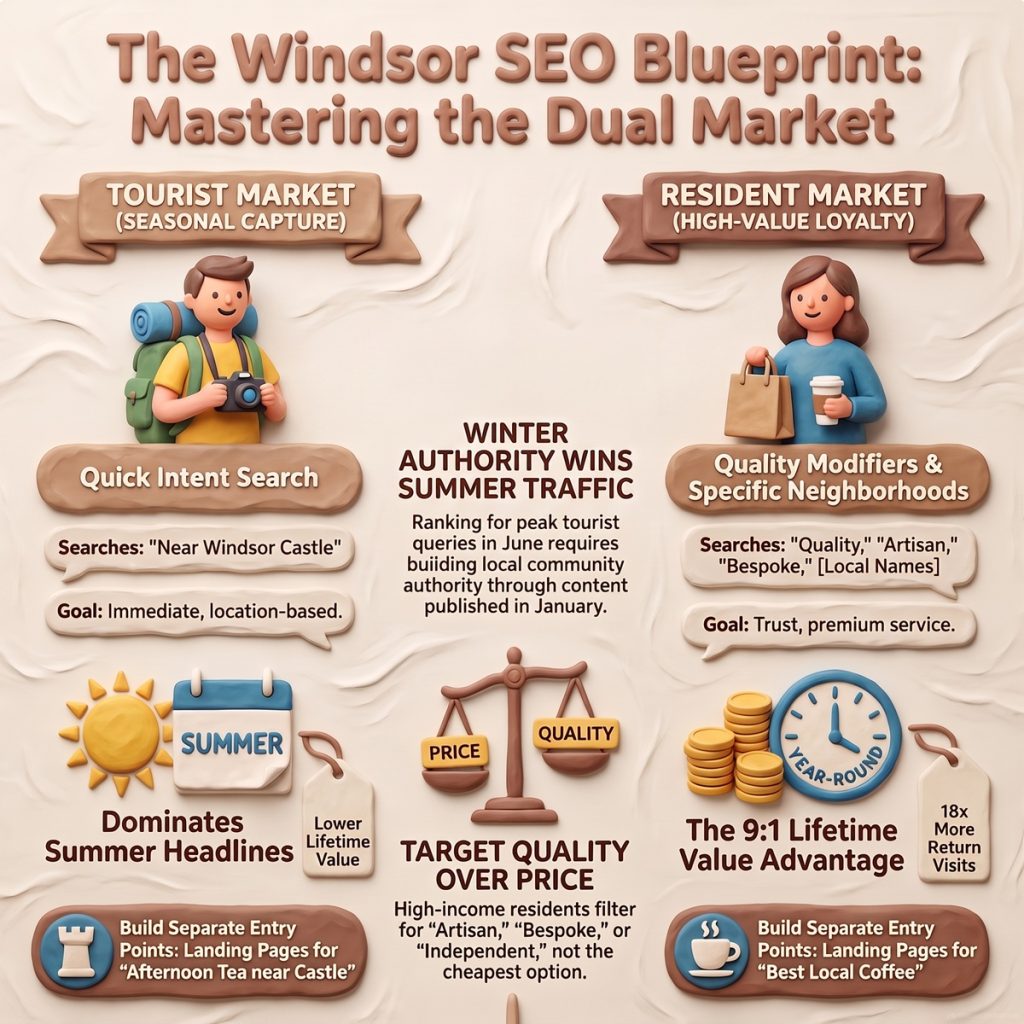
Tourist search demand spikes between April and September, peaks around royal events, and clusters around branded landmarks. Queries include location qualifiers (“near Windsor Castle”), time constraints (“open Sunday”), and transactional intent compressed into short visit windows. Conversion happens quickly or not at all.
Residential search demand runs year-round, favours branded searches and direct navigation, and demonstrates repeat behaviour. Local residents search for “best Italian Windsor” without geographic qualifiers because they already know where they are. They book midweek, return monthly, and generate the revenue that keeps businesses solvent through January and February.
The mistake most businesses make: optimising purely for the tourist surge and treating local residents as an afterthought. This works brilliantly for three months, then collapses when school term starts and visitor numbers drop 60%.
Why Generic Thames Valley SEO Consistently Underdelivers in Windsor
Windsor shares the Thames Valley postcode prefix with Slough, Maidenhead, and Bracknell, but grouping them together for SEO purposes ignores everything that makes Windsor commercially distinct.
The royal connection changes search behaviour fundamentally. Windsor doesn’t compete with other Thames Valley towns for tourist attention, it competes with Bath, Oxford, and Cambridge. Someone searching “luxury hotel Thames Valley” isn’t your customer. Someone searching “boutique hotel Windsor walking distance castle” is.
This means your keyword strategy must account for:
- Branded landmark proximity as a primary qualifier. “Near Windsor Castle” generates more qualified traffic than “Windsor town centre” because it signals tourist intent and willingness to pay premium prices for location.
- Royal event amplification. Search volume for Windsor-related queries doubles during Ascot week, spikes again for Trooping the Colour, and sees sustained lifts around royal anniversaries. Businesses that pre-optimise for these events capture traffic when competition is searching for scraps.
- Affluent residential search patterns. High-income consumers search differently. They use longer, more specific queries (“organic farm shop Windsor delivery”), favour quality signals over price comparisons, and convert on mobile at higher rates because they’re not price shopping across twenty tabs.
A generic Thames Valley approach treats Windsor like Bracknell with better architecture. It optimises for “near me” queries and assumes price sensitivity. It misses the entire point.
The Commercial Opportunity Hiding in Off-Peak Local Search
Here’s what most Windsor businesses don’t realise: whilst tourist traffic dominates headline numbers, local residential search generates disproportionate lifetime value.

A tourist visits once, spends £120, and never returns. A local resident discovers you through search, spends £60 on a first visit, then returns 18 times over three years. The lifetime value difference is 9:1, yet most Windsor SEO strategies allocate 80% of effort toward the one-time visitor.
The businesses that thrive year-round do three things differently:
They maintain separate landing pages for tourist and local intent. A landing page optimised for “afternoon tea Windsor Castle” shouldn’t be the same page targeting “best coffee shop Windsor locals”. The former needs opening hours, parking, and castle proximity. The latter needs Instagram-worthy interiors, loyalty schemes, and neighbourhood recognition.
They own hyperlocal queries. Whilst competitors fight over “Windsor restaurants”, profitable businesses dominate “Clewer restaurants”, “Eton dining”, and “Old Windsor gastro pub”. These searches signal residential intent and generate the bookings that fill Tuesday lunchtimes.
They optimise Google Business Profiles for repeat behaviour, not discovery. Tourist-focused profiles highlight “near Windsor Castle” and post photos of the exterior. Local-focused profiles encourage reviews from recognisable names, post midweek specials, and answer questions about parking for residents who already know where you are.
Why Seasonal Content Strategies Fail Without Year-Round Local Foundation
Most Windsor businesses panic in March and start publishing “things to do in Windsor” content to capture summer traffic. By the time Google indexes and ranks it, peak season is half over.
The businesses that rank for high-value tourist queries in May are the ones that spent October through February building topical authority with local content.
Here’s why this works: Google’s algorithm interprets consistent publishing about Windsor-specific topics as a signal of local expertise. A business that publishes nothing for eight months, then floods the site with tourist content, looks like exactly what it is, a seasonal opportunist.
But a business that publishes monthly content about Windsor residential life (local school events, community news, neighbourhood guides) builds the domain authority that makes tourist content rank faster when you need it to.
This doesn’t mean ignoring commercial priorities. It means recognising that the path to ranking for “Windsor Castle hotel” in June starts with ranking for “best primary schools Windsor” in January, even if the latter generates no direct revenue. You’re building the authority that makes the former possible.
The High-Intent Queries That Separate Windsor from Everywhere Else
Windsor’s unique combination of royal heritage and residential affluence creates search queries that simply don’t exist in other tourist towns.
These are the queries that generate the highest conversion rates and the least competition:
“[Service] walking distance Windsor Castle”, Premium location searches with immediate transactional intent. Someone searching this way has already decided to visit Windsor and is now allocating budget. Your competition isn’t other Windsor businesses; it’s London hotels charging £400/night.
“Best [category] Eton/Clewer/Old Windsor”, Hyperlocal residential searches that signal neighbourhood loyalty and repeat behaviour. Competition is minimal because most businesses ignore micro-geographic targeting.
“[Luxury modifier] + [service] Windsor”, Affluent consumer searches that filter for quality, not price. “Artisan bakery Windsor”, “independent wine merchant Windsor”, “bespoke tailor Windsor”. These queries convert at 3-4x the rate of generic equivalents because they signal intent to pay for quality.
“Windsor [service] not touristy”, The holy grail of dual-market search. This query comes from affluent visitors who want Windsor’s prestige without the coach tour crowds. They spend like tourists but behave like locals. Optimising for this requires proof of local authenticity, resident reviews, neighbourhood context, insider knowledge.
Most agencies never surface these queries because they rely on keyword tools that aggregate search volume nationally. Windsor-specific SEO requires understanding the microeconomics of the Royal Borough, not just running Ahrefs reports.
What Windsor-Specific Technical SEO Actually Looks Like
The technical layer matters more in Windsor than in generic Thames Valley markets because you’re managing two distinct user journeys on the same domain.
Schema markup must differentiate tourist and local offerings. A restaurant should deploy LocalBusiness schema with multiple locations (including “near Windsor Castle” as a landmark reference) whilst simultaneously marking up events, menus, and reservations that signal local appeal. Google needs explicit signals about who you serve and when.
Mobile optimisation must account for in-destination search behaviour. Tourists searching “near me” whilst standing on the Long Walk need instant loading times, click-to-call, and embedded maps. Desktop optimisation is secondary.
Internal linking must create separate content paths. A visitor landing on “Windsor Castle hotels” shouldn’t be funneled toward “our regulars say…” content. A visitor landing on “best coffee Windsor locals” shouldn’t see “near tourist attractions” in the navigation. Each audience needs a contained journey.
Local citations must emphasise dual positioning. Your NAP (Name, Address, Phone) should appear in both tourist directories (VisitBritain, TripAdvisor, Timeout) and residential platforms (Nextdoor, local Facebook groups, Thames Valley business directories). Inconsistency here confuses Google’s entity recognition and dilutes local pack rankings.
This isn’t advanced technical SEO. It’s Windsor-specific application of standard practice, something most agencies miss because they’re working from a template built for single-market towns.
The Royal Event Calendar as a Predictable SEO Multiplier
Windsor’s royal calendar creates search volume spikes you can set your watch by. Yet most businesses treat these as random traffic surges rather than predictable commercial opportunities.
Ascot week (June) drives searches for “luxury accommodation Windsor”, “Windsor restaurants Ascot”, and “Windsor spa Ascot week”. Businesses that pre-optimise content 8-12 weeks ahead rank when search volume explodes. Those that wait until May watch competitors capture the traffic.
Trooping the Colour (June) spikes “Windsor day trip from London” and “Windsor Castle June”. Again, the window to rank opens weeks before the event, not during it.
Royal anniversaries and weddings create unpredictable but massive search surges. Businesses with existing topical authority on royal Windsor history rank by default. Those without it don’t rank at all, regardless of budget.
The SEO advantage here isn’t complicated: publish royal-related content consistently, build topical clusters around Windsor’s heritage, and harvest the traffic multipliers when events occur. This costs time, not money, something most agencies won’t invest because it doesn’t fit their quarterly deliverables schedule.
Why Most Windsor Businesses Are Optimising for the Wrong Competitor Set
If you’re a Windsor hotel optimising to outrank Premier Inn and Travelodge, you’ve already lost.
Your actual competitors are:
- London hotels marketing day-trip packages. Someone searching “visit Windsor Castle” is weighing a Windsor hotel against a London base plus a train ticket. If your SEO strategy isn’t addressing “why stay in Windsor not London”, you’re invisible to this decision-making process.
- Airbnb properties within walking distance of the Castle. These dominate “accommodation near Windsor Castle” because they’re optimised for exactly that query. Your hotel website probably isn’t.
- Eton businesses capturing Windsor search intent. Eton is technically a separate town but appears in Windsor search results constantly. If you’re ignoring Eton-related keywords, you’re surrendering traffic to businesses 400 meters away.
Understanding your actual competitor set changes everything about keyword targeting, content strategy, and commercial positioning. Most Windsor businesses are fighting battles they’ve already won whilst losing the ones that matter.
Frequently Asked Questions
Q: Does optimising for tourist search hurt my local rankings?
A: Not if you structure it correctly. Google ranks pages, not websites. A tourist-focused landing page targets different queries than a locals-focused page. The mistake is trying to make one page serve both audiences, it serves neither well. Separate pages, separate keyword targeting, separate conversion paths.
Q: How far in advance should I optimise for Royal Ascot and other Windsor events?
A: Start 10-12 weeks ahead. Google needs time to index new content, assess topical relevance, and adjust rankings. Publishing event content in May for a June event means you’re competing when volume peaks and competition is fiercest. Publish in March and you rank by default when volume arrives.
Q: Should I target “Windsor” or “Royal Borough of Windsor and Maidenhead” in my SEO?
A: Always Windsor. No one searches “Royal Borough of Windsor and Maidenhead restaurants”. The official administrative name is irrelevant to commercial search behaviour. Use Windsor in all customer-facing content. Use the full borough name only in citations where official records require it.
Q: How do I rank for Windsor searches if my business is technically in Eton or Old Windsor?
A: Lead with proximity to Windsor landmarks in your content and schema markup. “5-minute walk to Windsor Castle” matters more than technical postcode boundaries. Use Windsor as the primary geographic identifier and your actual location as a hyperlocal qualifier. Google understands landmark-based proximity better than administrative boundaries.
Q: Do I need separate Google Business Profiles for tourist and local audiences?
A: No, Google prohibits multiple profiles for a single location. Instead, use posts, photos, and Q&A strategically. Post tourist content April-September (opening hours, Castle proximity, day-trip logistics). Post local content October-March (regular events, neighbourhood news, loyalty offers). Your review strategy should cultivate both tourist and resident testimonials.
If you’re running a Windsor business and your current SEO strategy treats tourist and residential demand as the same challenge, you’re leaving revenue on the table nine months of the year. Thickrope’s Windsor SEO service accounts for the Royal Borough’s specific dual-market dynamics, because template approaches built for single-audience towns don’t work here. [Get in touch for a Windsor-specific SEO audit](https://thickrope.com/contact) and we’ll show you exactly where the gaps are.