

How Middlesbrough’s Economic Reinvention Changes What Digital Marketing Needs to Do for Your Business
Middlesbrough’s identity is in flux, and that matters more to your digital marketing strategy than you might think.
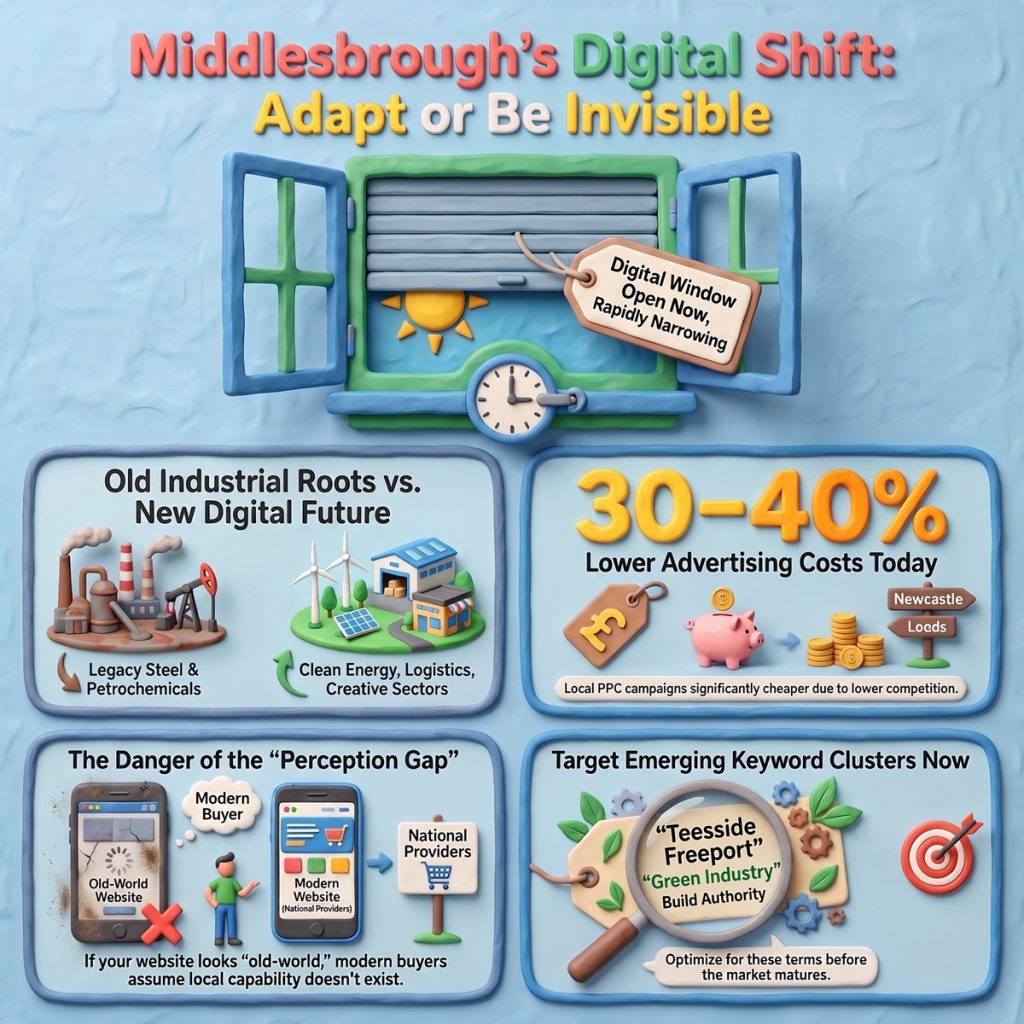
For most of the 20th century, if someone searched for Middlesbrough-related terms, they found steel, petrochemicals, and industrial heritage. The town’s digital footprint reflected its physical economy. Today, between the Teesside Freeport designation, £450m of government investment in clean energy infrastructure, and a growing creative sector, Middlesbrough is repositioning itself, and search behaviour is slowly catching up.
That creates both opportunity and risk. Businesses that build visibility around Middlesbrough’s emerging economy now will own that territory as search volume grows. Those that wait will find themselves competing against established players with stronger domain authority and years of indexed content.
This isn’t about civic pride. It’s about understanding what people are searching for when they look for Middlesbrough businesses, what they expect to find, and how that’s changing as the local economy shifts.
The Search Behaviour Gap Between Old and New Middlesbrough
Here’s the problem: most national perceptions of Middlesbrough still skew industrial and post-industrial. That’s what dominates the SERPs for broad informational queries. Meanwhile, commercial intent searches, people looking to buy, hire, or engage with Middlesbrough businesses, increasingly reflect a different economy.
Someone searching “Middlesbrough business services” in 2026 might be a renewable energy contractor needing legal support, a Freeport logistics firm looking for accountancy, or a digital agency hunting office space. They’re not searching with the same assumptions someone had in 2015.
If your website, Google Business Profile, and content still position you within the old Middlesbrough narrative, or worse, ignore local context entirely, you’re mismatched to the audience that’s actually arriving with budget and intent.
The businesses we’ve worked with in the Northeast that have adapted fastest have done two things:
1. Audited their on-site content and metadata to remove outdated positioning (or acknowledge the transition explicitly where heritage is relevant)
2. Targeted emerging keyword clusters around Freeport activity, green industry supply chains, and regional levelling-up funding, searches with lower volume but dramatically higher commercial intent
Why the Teesside Freeport Creates a Digital Marketing Window
The Teesside Freeport designation in 2021 fundamentally changed the opportunity set for local businesses. It brought inward investment, government focus, and a wave of companies evaluating Middlesbrough as a base for the first time.
Many of those companies are searching. They’re looking for suppliers, partners, and service providers who understand the local landscape. Right now, in mid-2026, the SERPs for those searches are still thin. There’s limited high-quality content, few businesses have optimised for these terms, and paid search competition is modest.
That won’t last. As more businesses establish operations and the Freeport matures, competition for visibility will intensify. The cost-per-click for commercial terms around “Teesside,” “Middlesbrough,” and sector-specific phrases will rise. Organic rankings will consolidate around sites with strong backlink profiles and content depth.
If you’re a Middlesbrough business targeting B2B clients, whether you’re in professional services, logistics, manufacturing supply, or facilities management, the window to build affordable visibility around this economic transition is open now, but it’s narrowing.
From a PPC perspective, we’re seeing Middlesbrough businesses achieve 30–40% lower cost-per-click on localised campaigns compared to Newcastle or Leeds equivalents, partly because fewer advertisers are competing in the auction. That cost advantage compresses as the market matures.
What “Emerging Economy” Positioning Actually Means in Practice
This isn’t about rewriting your homepage to mention the Freeport in every paragraph. It’s about ensuring your digital presence reflects who you serve and what problems you solve for businesses operating in Middlesbrough’s current economy.
Practically, that means:
- Location pages and service pages that acknowledge sector-specific demand (e.g., if you’re a recruiter, are you targeting the skills gap in offshore wind? If you’re in commercial property, are you speaking to businesses evaluating Freeport sites?)
- Blog content or case studies that demonstrate understanding of the challenges businesses face when entering or scaling in the region
- Google Business Profile optimisation that uses categories and attributes reflecting your actual customer base, not legacy assumptions about who operates in Middlesbrough
One manufacturing supplier we worked with in 2024 had positioned themselves almost entirely around legacy industries. Their traffic was stable but flat, and enquiries were declining. We restructured their content around renewable energy supply chains and Freeport-related logistics, built out landing pages targeting those verticals, and ran a targeted PPC campaign. Within six months, enquiry volume doubled, and average contract value increased by 35% because they were attracting newer, better-capitalised clients.
The work wasn’t revolutionary. We just aligned their digital presence with the economy their prospects were actually operating in.
The Risk of Being Invisible During Transition
There’s a second-mover disadvantage in local search that doesn’t get discussed enough.
When someone searches for “Middlesbrough [your service]” and finds nothing relevant, they broaden their search, often to Newcastle, Leeds, or even national providers. Once they’ve engaged a non-local supplier, you’ve lost that client for the contract duration and possibly longer if the relationship works.
Middlesbrough businesses face this constantly. The perception gap between the town’s emerging economy and its legacy reputation means buyers sometimes assume local capability doesn’t exist. If your digital presence doesn’t actively counter that assumption, you’re conceding enquiries by default.
The worst position is to be good at what you do, appropriately priced, and locally based, but invisible at the point someone makes a buying decision.
That’s where organic visibility and a well-optimised Google Business Profile become essential. You’re not trying to outrank national competitors for broad terms. You’re ensuring that when someone adds “Middlesbrough” or “Teesside” to their search, you’re present, credible, and clearly relevant.
What This Means for Local vs. Regional Targeting
Middlesbrough businesses often face a targeting dilemma: do you position as a Middlesbrough specialist or aim for broader Tees Valley, Northeast, or even national reach?
There’s no single answer, but the economic transition influences the decision.
If your clients are predominantly local SMEs or consumers, strong Middlesbrough visibility and community positioning matter. You’re serving an audience that values proximity, local knowledge, and connection to the town’s identity.
If you’re targeting B2B clients, larger contracts, or Freeport-adjacent opportunities, you may benefit from broader regional positioning. Many inward investors and larger firms search at the “Teesside” or “Northeast” level, not specifically Middlesbrough.
The businesses getting this right often do both: they own Middlesbrough-specific search terms (lower volume, lower competition, high relevance) whilst also competing for regional terms where budget allows. That requires segmented landing pages, localised content, and separate PPC campaigns, but it matches how different buyer types actually search.
Don’t Wait for Search Volume to Catch Up
One objection we hear: “There’s not enough search volume around these new sectors to justify investment.”
That’s half true. Monthly search volume for niche Freeport or green energy terms in Middlesbrough is modest today. But those searches convert at dramatically higher rates than generic terms, and volume is growing as the economy develops.
More importantly, by the time search volume is substantial enough to show up clearly in keyword tools, you’re no longer early. You’re competing against established content, higher CPCs, and businesses that already own those SERPs.
The businesses that win in transitional economies are those willing to build visibility before demand is obvious. You’re creating assets, indexed content, backlinks, domain authority, brand recognition, that appreciate as the market matures.
This is particularly true for organic search. A well-optimised page published today can rank for years. The cost is mostly upfront; the return compounds. Waiting until competition intensifies means you’re paying more (in time, money, or both) for worse positions.
Frequently Asked Questions
Q: Does focusing on Middlesbrough limit our reach to larger regional clients?
A: Not if your site structure allows for both. You can own Middlesbrough-specific terms whilst also targeting broader Tees Valley or Northeast searches through separate landing pages and campaigns. Many businesses find Middlesbrough terms convert better locally whilst regional terms drive volume.
Q: Should we mention the Freeport or economic transition explicitly in our content?
A: Only if it’s genuinely relevant to your clients. Forced references damage credibility. But if you serve businesses benefiting from Freeport incentives, green energy investment, or regional development funding, acknowledging that context demonstrates you understand their operating environment, and helps you appear in related searches.
Q: How much does digital marketing cost for a Middlesbrough business compared to larger cities?
A: PPC is typically 30–40% cheaper for localised campaigns because competition is lower. SEO costs depend on competitiveness of your sector and target keywords, but local search optimisation (Google Business Profile, local citations, localised content) is often more cost-effective than competing nationally. The key is moving before that cost advantage erodes.
If your business is positioned for Middlesbrough’s emerging economy but your digital presence still reflects the old one, you’re losing enquiries to competitors who’ve adapted, or to businesses outside the region entirely. We’ve spent 25 years helping UK businesses build visibility in transitional markets, and the pattern is consistent: early movers gain compounding advantages that become expensive to displace. If you’d like a frank assessment of where your Middlesbrough digital marketing stands today and what the opportunity looks like, we offer a no-obligation audit that takes about a week to complete, [get in touch](https://thickrope.com/contact) and we’ll walk you through what we find.