
How to Do Local SEO Marketing for a UK Business: The Foundations Any Business Owner Can Lay — and What Changes When You Bring in Expertise
Most UK business owners searching for local SEO advice want to know two things: what can I actually do myself that will move the needle, and when does paying someone become worth it?
Fair questions. Local SEO isn’t mysterious — the foundational work is genuinely within reach of any business owner willing to invest a few hours. But the gap between “done” and “done well enough to outrank competitors in Nottingham, Bristol, or your corner of London” is where commercial return separates sharply.
This guide gives you both: the actionable steps you can take today, and the honest point at which professional investment starts compounding faster than your own time will allow.
What Local SEO Actually Delivers (and Why UK Businesses Can’t Ignore It)
Local SEO makes your business visible when someone in your area searches for what you offer. That’s it. No mystery.
When someone types “solicitor near me” or “plumber in Reading” or “accountant Harrogate,” Google decides which businesses to show based on three things: relevance (do you actually do what they’re searching for?), distance (how close are you?), and prominence (how well-known and trusted does Google think you are?).
You control relevance and prominence more than you think. Distance is geography — you can’t fake that, and Google’s good at sniffing out attempts.
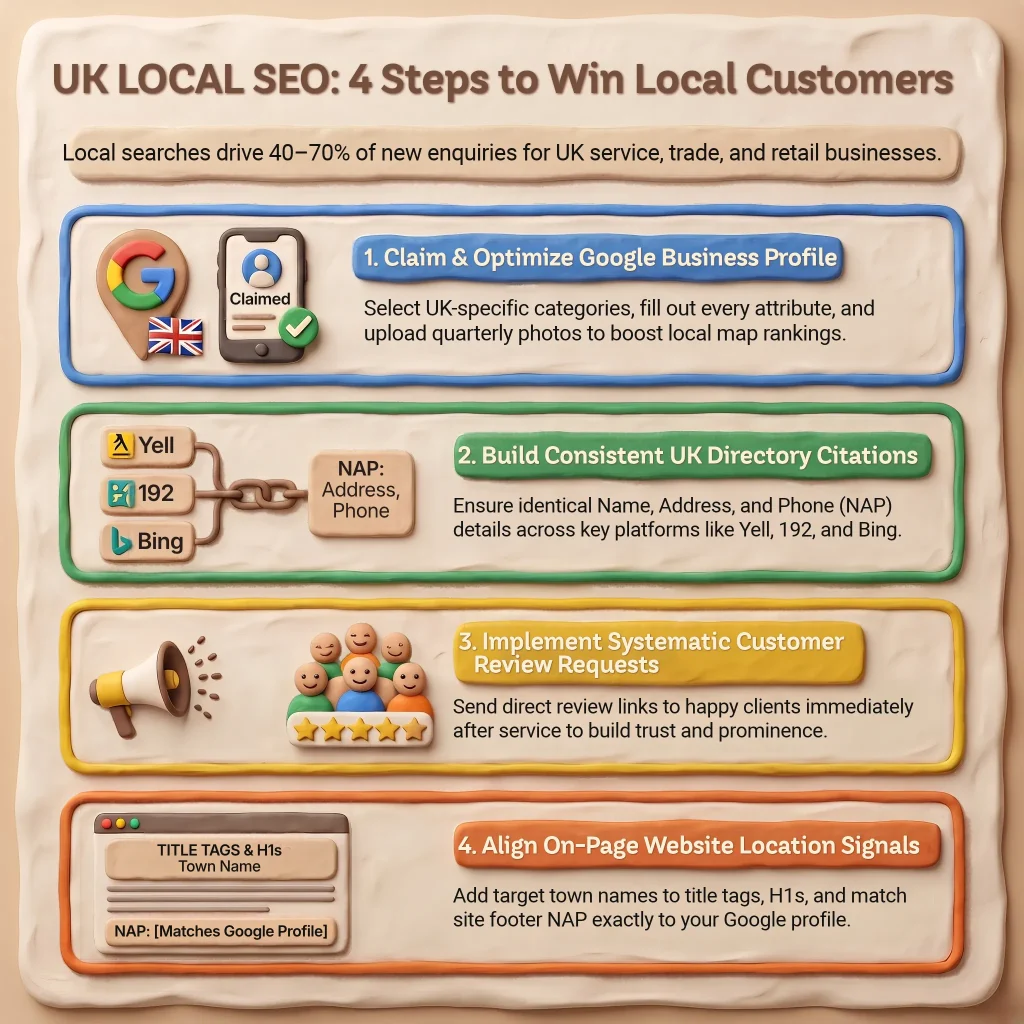
For UK SMEs, local search matters commercially because intent is high. Someone searching “emergency electrician South London” isn’t browsing — they’re buying. Local searches convert at materially higher rates than generic searches, and for service businesses, trades, hospitality, and retail with physical premises, this is often where 40–70% of new enquiries originate.
If you’re not deliberately managing your local presence, you’re leaving that revenue to competitors who are.
The Foundations: What Any UK Business Owner Can Do Themselves
These steps cost nothing but time. If you’ve never touched local SEO before, start here. Each one directly improves how Google assesses your business.
1. Claim and Complete Your Google Business Profile Properly
Your Google Business Profile (GBP) is the single highest-leverage thing you control. When someone searches locally, your GBP listing is what appears in Google Maps and the local pack (those three businesses that show above organic results).
What to do:
- Claim it if you haven’t. Search your business name on Google Maps. If it’s unclaimed, follow the verification process (usually postcard to your business address).
- Choose the right primary category. This matters more than most people realise. Google uses this to decide which searches you’re eligible for. If you’re a personal injury solicitor, “Personal Injury Attorney” is better than generic “Solicitor.” Browse categories carefully — they’re UK-specific and granular.
- Add secondary categories that genuinely reflect services you offer, but don’t stuff irrelevant ones. Google’s wise to it.
- Complete every attribute and field. Opening hours (including special hours for bank holidays), service areas if you’re mobile, attributes like “wheelchair accessible” or “free Wi-Fi” — Google rewards completeness, and customers filter by these.
- Write a proper business description (750 characters max). Lead with what you do and where. “Family-run plumbing and heating service covering Bristol and North Somerset since 1998. Gas Safe registered, emergency callouts, boiler installations and repairs.”
- Add photos. Businesses with photos get more clicks. Exterior, interior, team, work in progress if relevant. Update quarterly if you can — recency signals activity.
Time investment: 2–3 hours to do it properly the first time.
2. Build Citations on UK-Priority Directories
A citation is any online mention of your business name, address, and phone number (NAP). Google uses these to verify you’re real and where you say you are.
The important bit: consistency. If your GBP says “St.” and your Yell listing says “Street,” that’s a signal problem. If your phone number varies, worse.
Where to start (UK-specific priorities):
- Yell.com — still matters for UK local search
- Thomson Local
- Scoot (UK business directory)
- 192.com
- Bing Places (less traffic than Google, but free and helps corroborate NAP)
- Industry-specific directories — Checkatrade or Trustatrader for trades, Solicitors Regulation Authority directory for law firms, etc.
What to do:
- Use identical NAP formatting everywhere. Exactly as it appears on your GBP.
- Don’t pay for upgraded listings yet — free listings are sufficient at this stage.
- Add your website URL where allowed.
Time investment: 4–6 hours spread over a week or two.
3. Implement a Review Request Process (Not Just Hope)
Reviews are the third pillar of prominence. Businesses with more reviews, posted more recently, and with higher average ratings rank better and convert better.
You can’t buy reviews (it’s against Google’s terms and they catch it). You can’t incentivise them. But you can ask.
What works:
- Ask happy customers directly, soon after the job’s done. “We’d be grateful if you’d leave us a Google review — here’s the link.” Text or email, depending on relationship.
- Make it easy. Create a short link to your GBP review page (Google “Google review link generator” — multiple free tools will create one from your Place ID).
- Don’t script what people should say. Google can detect patterns. Let customers use their own words.
- Respond to every review — positive and negative. It shows you’re active and care. Keep it professional, never defensive.
- Realistic expectation: If you’re starting from zero, getting to 15–20 genuine reviews over 3–6 months is solid progress and makes a visible difference.
- Time investment: 15 minutes per week once the process is in place.
4. Get Your On-Page Basics Right
Your website needs to clearly signal location and service to Google.
What to check:
- Title tags and H1s mention your town/city and primary service. “Expert Family Solicitors in Cambridge | [Your Firm Name]”
- Footer NAP matches your GBP exactly.
- Location page if you serve multiple areas — one page per major location, genuinely useful content (not ten identical pages with town names swapped).
- Embed your Google Map on your contact page (minor signal, but it connects the dots).
If your website is ancient or truly broken, this might require a developer. But if it’s modern and you have basic CMS access (WordPress, Wix, Squarespace), you can likely handle this yourself.
Time investment: 2–4 hours depending on your site.
If you stop here, you’ve done more than 60% of UK small businesses. You’ll see some movement — probably not page one in a competitive city for a competitive term, but movement.

Where Professional Expertise Changes the Return Curve
The work above is foundational. It’s necessary. But it’s also where everyone starts.
The businesses ranking first, second, third in your local pack? They’ve done all of that — and then layered on work that’s harder to do well without experience, tools, and time you probably don’t have.
Here’s what changes when you bring in someone who does this daily:
1. Competitive Diagnosis and Prioritisation
A professional audits what your competitors have that you don’t. How many citations do they have? What categories are they using? How deep is their review velocity? What’s their DA (domain authority), and where are their backlinks coming from?
You could do this manually. It would take days. And without context — what’s normal for a Derby accountant vs. a Manchester dentist vs. a Bath boutique hotel — you won’t know which gaps matter most.
We prioritise the 20% of work that closes 80% of the gap. That’s the return.
2. Citation Building at Scale (and Cleanup)
Building 5–10 citations manually is doable. Building 40–60, ensuring perfect NAP consistency, finding niche directories Google actually values, and cleaning up old wrong listings (previous address, disconnected phone number, duplicate profiles)?
That’s where professional tools and process make the difference. We use citation platforms that check consistency across hundreds of sources simultaneously and flag conflicts you’d never find manually.
3. Review Generation Systems That Actually Work
Asking for reviews manually works. Automating the ask — timing it right, integrating it with your CRM or job management system, A/B testing the message, tracking who’s been asked and when so you’re not pestering — works better and doesn’t rely on you remembering.
We build systems that run whether you’re thinking about them or not. Review velocity stays consistent, which Google rewards.
4. Content That Targets Local Intent Specifically
Most business websites have a “Services” page and a “Contact” page. That’s fine, but it doesn’t capture the range of ways people search locally.
We build content around the questions your prospects actually type: “How much does conveyancing cost in Leeds?” or “Best Italian restaurant Cheltenham town centre” or “Emergency 24-hour locksmith Croydon.”
That’s not blog padding — it’s commercial content that ranks for buying-intent searches your competitors aren’t targeting.
5. Link Building That Google Trusts (Local and Beyond)
Backlinks still matter for local SEO. A link from a local news site, a Chamber of Commerce, a relevant .ac.uk if you’ve spoken at an event, or a well-regarded industry blog — these build the prominence signal.
Getting them requires outreach, relationships, and often content worth linking to. It’s the slowest part of SEO and the part where expertise compounds most visibly. We know which links move the needle and which are wasted effort.
6. Ongoing Optimisation and Monitoring
Google’s local algorithm shifts. Competitors launch. Your category gets more saturated (or a few players drop off). New review platforms emerge.
Professional local SEO isn’t a one-time setup — it’s managed optimisation. We track rankings weekly, monitor GBP insights (how many people saw your profile, how many clicked for directions or called), and adjust when something stops working.
You could do this yourself. But will you, consistently, when you’re running the business?

The Honest Cost-Benefit Question: When Does Paying Someone Make Sense?
If your local market isn’t competitive — you’re a niche trade in a small town with two competitors — doing the foundational work yourself might be enough.
If you’re in a city, or a competitive service category (legal, dental, hospitality, home services), or you’re trying to rank in multiple locations, professional investment pays back faster.
Rough guideline from 25 years watching UK SMEs:
- Revenue under £100k/year, low competition: DIY foundations first, revisit in 12 months.
- Revenue £100k–£500k, moderate competition Foundations yourself, then 3–6 months of professional work to build momentum, then maintain yourself or on a light retainer.
- Revenue £500k+, or high competition regardless of revenue: Professional from the start. Your time is worth more elsewhere, and the cost of not ranking is measurable in lost enquiries every week.
- Local SEO for a competitive UK market typically costs £600–£1,500/month depending on scope. If ranking first in your local pack would generate even two extra customers a month, the maths usually works.
What to Expect Timewise (Reality, Not Sales Pitch)
Local SEO is faster than national organic SEO, but it’s not instant.
Realistic timeline:
- 4–6 weeks: GBP optimisation and citation cleanup starts showing in impressions (how often you appear in search).
- 8–12 weeks: You start appearing in the local pack for less competitive terms.
- 3–6 months: Meaningful movement for your core competitive terms, assuming consistent effort and no major site issues.
- 6–12 months: Top 3 local pack positions in a competitive market, if the work’s been done properly.
Anyone promising page one in 30 days is either lying or targeting terms no one searches.
Common Mistakes UK Business Owners Make (That Quietly Cost You Rankings)
1. Using a PO box or virtual office address on GBP
Google wants your real business location. If you’re home-based and don’t want your home address public, you can hide it and show service area only — but you still need to verify a real address.
2. Changing NAP details without updating everywhere
Moved office? New phone system? If you update GBP but not your citations, you’ve just created inconsistency. Google doesn’t know which to trust.
3. Keyword stuffing the business name
Naming your GBP “Joe’s Plumbing Best Plumber London Emergency Plumber” violates Google’s guidelines and risks suspension. Use your actual business name.
4. Ignoring negative reviews (or responding emotionally)
A one-star review hurts, but ignoring it signals you don’t care. Responding defensively makes it worse. Acknowledge, apologise if warranted, offer to resolve offline. Future customers read your response more than the review itself.
5. Building citations on spammy directories for volume
Ten citations on trusted UK directories beat 100 on low-quality scraper sites. Quality matters. We’ve seen businesses penalised for bad citation sources.
Frequently Asked Questions
Q: Can I do local SEO if I don’t have a physical shopfront — I’m mobile or home-based?
A: Yes. Google allows service-area businesses (SABs) to hide their address and define the areas they serve. You still need a real address to verify, but customers won’t see it. Just make sure you accurately set your service radius or specific towns.
Q: How many reviews do I actually need to rank well?
A: There’s no magic number — it’s relative to competitors. If the top three businesses in your local pack have 30, 45, and 60 reviews, you need to be in that range to compete. Start with a goal of matching the median in your niche and location, then surpass it. Velocity (how recently reviews were posted) matters as much as volume.
Q: Does paying for Google Ads help my local SEO rankings?
A: No. Google has confirmed repeatedly that ad spend doesn’t influence organic or local pack rankings. That said, running Local Services Ads or location-targeted Search Ads alongside local SEO can improve overall visibility and give you data on what converts whilst SEO builds momentum.
Q: I’ve done all the basics — why am I still not ranking?
A: Most common reasons: your competitors have done more (more citations, more reviews, stronger website, better backlinks), your website has technical issues Google’s flagged (slow load speed, mobile problems, broken pages), or your category/service isn’t well-matched to what you’ve optimised for. A professional audit usually surfaces the blocker quickly.
Q: Can I rank in multiple UK towns or cities from one location?
A: Yes, but it’s harder. Google prioritises proximity, so ranking in a town 30 miles away when competitors are physically there is an uphill fight. You can build location pages, earn citations in those areas, and create locally-relevant content — but expect diminishing returns the further you get from your actual address. Multiple physical locations rank more easily than one location trying to cover a region.
If you’ve laid the foundations yourself and want a professional view on where the next investment should go — or if you’d rather hand the whole process to someone who’ll get it done properly from the start — we’ve been doing this for UK businesses for over 25 years. Get in touch for a free local SEO audit and we’ll show you exactly where you stand against competitors and what’ll move the needle fastest.