

Local SEO Optimisation Services in the UK: What a Properly Structured Engagement Covers — and What Most Don’t
You’re looking at local SEO optimisation services because you need customers from your area to find you when they search. Simple goal. But what you actually get varies wildly depending on who you hire.
Most UK businesses investing in local SEO receive a generic package built for the US market with a few tweaks. The directories are wrong. The citation strategy ignores UK-specific platforms. The content doesn’t account for how British searchers actually phrase queries or how Google treats UK postcodes differently from American ZIP codes.
After 25 years optimising local visibility for UK businesses, we’ve seen what works—and we’ve cleaned up after agencies that charged good money whilst missing the fundamentals. This guide shows you exactly what a properly structured local SEO engagement should cover, what most services skip, and how to tell the difference before you sign a contract.
What Local SEO Actually Delivers (When Done Properly)
Local SEO optimisation services exist to solve one business problem: getting you visible in Google’s Map Pack and local organic results when someone in your area searches for what you do.
The commercial outcome you’re paying for is straightforward:
- Enquiries from people searching “plumber in Croydon” or “solicitor near me” whilst standing in your town centre
- Visibility in the Map Pack (those three businesses Google shows with map pins)
- Clicks from searchers who already want your service and are choosing between you and two competitors
When it works, you see measurable increases in phone calls, direction requests, and form submissions from local searchers. When it doesn’t, you’re paying monthly retainers with no clear connection to revenue.
The difference usually comes down to whether your provider understands UK-specific ranking signals or is following an American playbook.
What a UK-Focused Local SEO Service Must Include
Google Business Profile Management Built for UK Signals
Your Google Business Profile (formerly Google My Business) is the single most important asset in local SEO. But managing it properly for a UK business requires understanding signals that don’t apply elsewhere.
What you should be getting:
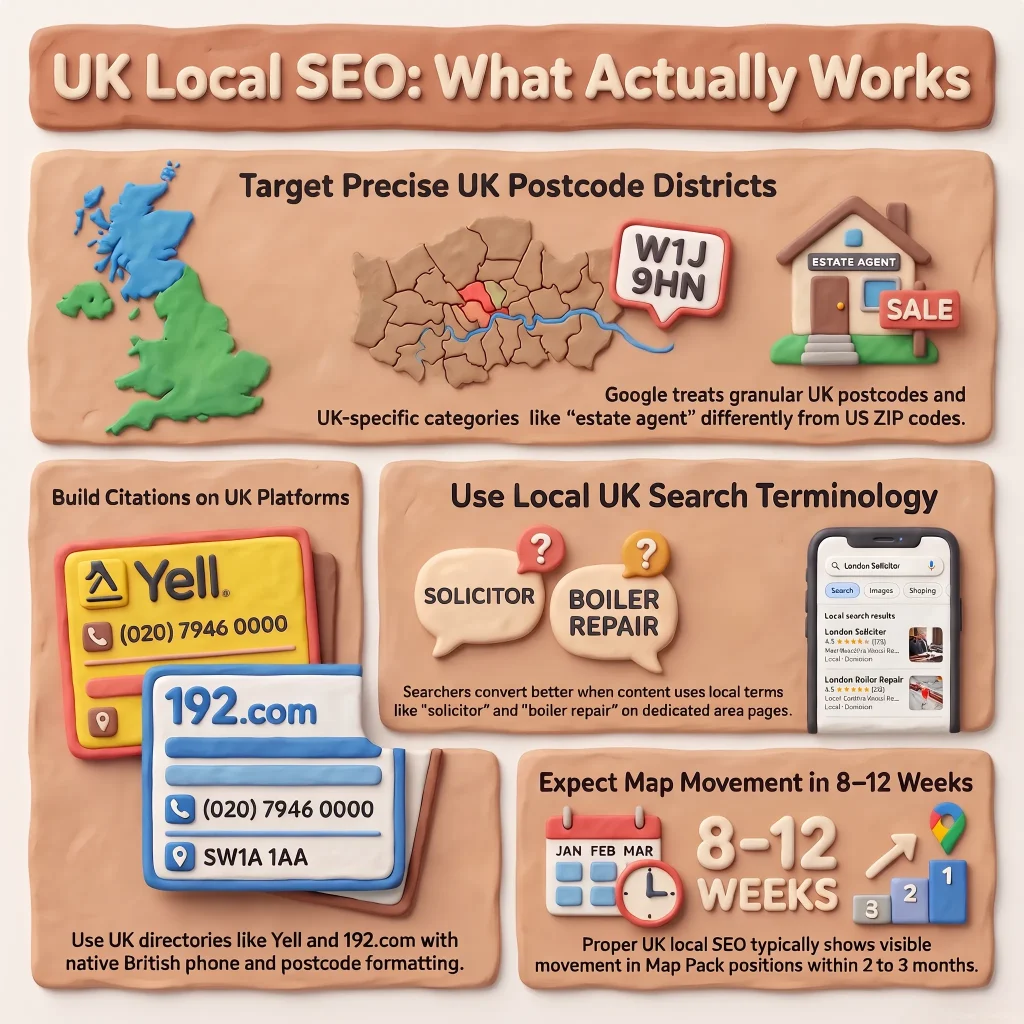
Postcode and service area precision. UK postcodes are granular—SW1A 1AA covers a smaller area than most US ZIP codes. Your provider should set service areas using actual UK postcode districts, not drawing circles on a map. Google treats “we serve SW19” differently from “we serve Wimbledon,” and both differently from “we serve London.”
UK-relevant category selection. Google offers different business categories depending on your country. An agency working from US category lists will miss UK-specific options that affect your visibility. “Estate agent” exists as a category in the UK. “Realtor” doesn’t.
Posting schedules that match UK search behaviour. Regular Google Posts signal activity, but timing matters. Posting at 3pm GMT reaches lunchtime searchers in New York—not your local audience. Your provider should schedule posts for UK business hours and reference UK events, bank holidays, and seasonal patterns.
What most services actually do: Set up your profile once, pick three categories, and leave it. No ongoing optimisation. No testing of business description variations. No tracking of how category changes affect impressions.
Citation Building Across UK-Relevant Directories (Not Just the Usual Suspects)
Citations—mentions of your business name, address, and phone number across the web—remain a confirmed ranking factor for local search. But most citation-building services use American-centric directory lists.
What you should be getting:
UK-specific directories that Google actually uses. Yell, Thomson Local, Scoot, 192.com, Touch Local—these matter for UK local rankings. Yelp barely registers in the UK market. An agency building citations on US directories whilst ignoring Yell is wasting your money.
Industry-specific UK platforms. If you’re a solicitor, you should be on The Law Society’s directory. If you’re a tradesperson, Checkatrade and Rated People matter. If you’re a restaurant, presence on SquareMeal and Harden’s affects local visibility differently than TripAdvisor.
NAP consistency using UK formatting. Your phone number should appear as “020 1234 5678” or “01234 567890″—not “(020) 1234-5678” or other American formatting. Postcodes should include the space: “SW1A 1AA” not “SW1A1AA.” Inconsistent formatting across citations confuses Google’s entity matching and dilutes ranking signals.
What most services actually do: Submit to 50-100 directories from a bulk list, half of which are irrelevant to UK searchers, with automated NAP formatting that doesn’t match British conventions.
Local Content That Speaks to Specific Postcodes and Boroughs
Content built for local SEO isn’t about stuffing “London” into your homepage fifteen times. It’s about creating pages that serve specific local search queries whilst genuinely helping users.
What you should be getting
Location pages for each service area you actually serve. If you’re a roofer covering five London boroughs, you need five properly built location pages—not one page listing all five with duplicate content. Each page should address that area’s specific characteristics: “Roof repairs in Islington” should mention the prevalence of Victorian terraces with original slate tiles, because that’s what Islington searchers are dealing with.
Content that matches UK search language. British searchers say “solicitor,” not “attorney.” “Estate agent,” not “realtor.” “Boiler repair,” not “furnace repair.” Your content needs to use the terms your actual customers type into Google.
Local signals beyond just location names. Mentioning nearby landmarks, local councils, and area-specific problems helps. A page about “drain clearance in Bristol” that references Clifton’s period properties or Temple Meads station gives Google—and users—clearer geographic context.
What most services actually do: Add your town name to existing service pages and call it “localised content.” Or worse, create template-driven location pages that read identically except for swapping out the place name.
Review Management Strategy That Actually Affects Map Pack Rankings
Google has confirmed that review quantity, velocity, and recency affect local rankings. But most “review management” services are box-ticking exercises.
What you should be getting:
A systematic process for requesting reviews from UK customers. This means timing review requests appropriately (after service completion, not immediately), using language that feels British (not “Hey, would love if you could leave us a review!”), and making it dead simple—direct link to your Google Business Profile review page.
Active review monitoring and response. Every review should get a response—positive ones to reinforce good feelings, negative ones to show you care about resolution. Your provider should write responses that sound like your business, not like a corporate PR team.
Tracking of review impact on rankings and clicks. You should see reports connecting review acquisition to Map Pack position changes and click-through rates. If your provider isn’t tracking this, they’re not managing reviews strategically—they’re just pestering customers.
What most services actually do: Send automated email templates asking for reviews, with no follow-up, no response management, and no measurement of impact.

What Most Local SEO Services Leave Out (And Why It Matters)
Even agencies that get the basics right often miss elements that separate acceptable results from genuinely strong local visibility.
Technical Audits for Location-Specific Issues
Your website’s technical foundation affects local rankings differently than general organic SEO. Most audits miss UK-specific technical factors:
- hreflang tags for UK English vs. US English. If you have both .co.uk and .com versions of your site, or if you serve both UK and international customers, improper hreflang implementation confuses Google about which version to show UK searchers.
- Structured data using UK address formats. LocalBusiness schema should include UK-formatted addresses and phone numbers. We regularly see schema implemented with US conventions on UK business websites.
- Mobile performance for UK networks. Page speed testing should reflect UK mobile network conditions, not US WiFi speeds. A site that loads quickly on your office broadband might struggle on EE’s 4G network in rural Somerset.
Competitor Analysis Specific to Your Local Market
Generic local SEO competitor analysis looks at who ranks nationally. Useful local analysis looks at who actually takes customers from you in your service area.
Your provider should identify:
- Which businesses appear in the Map Pack for your core local keywords
- What they’re doing differently (categories, review count, content depth)
- Where their citations differ from yours
- How their Google Business Profile optimisation compares
This isn’t about copying competitors. It’s about understanding what Google considers relevant signals in your specific local market.
Tracking That Connects Local Visibility to Actual Revenue
Most local SEO reporting shows rankings and impressions. That’s not enough.
You need to see:
- Google Business Profile actions: calls, direction requests, website clicks
- Which local keywords drive phone calls (using call tracking with UK numbers)
- Which location pages convert visitors to enquiries
- Cost per acquisition from local search compared to PPC or other channels
If your provider can’t connect their optimisation work to enquiries and revenue, you’re paying for vanity metrics.
How to Evaluate a Local SEO Optimisation Service Before You Commit
When you’re comparing providers, here’s what to ask:
“Which UK-specific directories will you build citations on, and why those specifically?”
If they mention Yelp but not Yell, or if they can’t explain why certain directories matter for your industry, they’re using an American template.
“How will you determine which location pages we need?”
The right answer involves analysing your actual service areas, search volume for location-specific queries, and competition in each area. The wrong answer is “we’ll create pages for all your service areas”—that leads to thin content that doesn’t rank.
“What does your Google Business Profile optimisation involve after initial setup?”
You want to hear about ongoing category testing, post scheduling, Q&A monitoring, photo updates, and tracking of profile performance metrics. If the answer is just “we’ll set it up and monitor it,” that’s not active management.
“How do you measure success, and when should I expect to see results?”
Local SEO typically shows movement within 2-4 months—faster than general organic SEO because the competitive set is smaller. If someone promises page one rankings in 30 days, they’re overselling. If they can’t articulate specific KPIs beyond “improved rankings,” they’re not thinking commercially.

What You Should Expect to Pay
Local SEO optimisation services for UK businesses typically range from £500 to £2,500 per month, depending on:
- Geographic competition. Ranking a solicitor in Manchester costs more than ranking one in Malvern because competition is fiercer.
- Number of locations. If you operate from multiple offices or serve distinct service areas, costs increase.
- Scope of work. Google Business Profile management alone sits at the lower end. Full-service local SEO including content, citations, technical optimisation, and review management costs more.
One-time setup projects (citation building, initial Google Business Profile optimisation, location page creation) typically run £1,500 to £5,000.
If someone quotes £200/month for comprehensive local SEO, they’re either automating everything with minimal strategic input or they won’t deliver what they’re promising.
The Most Common Reason UK Businesses Don’t See Results
It’s not usually that the agency is incompetent. It’s that they’re optimising for the wrong goal.
Many local SEO services focus on general organic rankings—getting you to rank for “roofer” nationally—instead of local visibility. Those are different objectives requiring different strategies.
If your provider reports on where you rank in general organic results but doesn’t track Map Pack positions, Google Business Profile impressions, or local keyword performance, they’re measuring the wrong thing.
You don’t need to rank nationally for broad keywords. You need to dominate local results in your service area. That’s where the commercial value lives.
Frequently Asked Questions
Q: How long does local SEO take to show results?
A: You should see movement in Map Pack positions and Google Business Profile impressions within 8-12 weeks of proper optimisation. Significant ranking improvements typically take 3-6 months, depending on competition in your area. If you’re not seeing any positive signals within three months, something’s wrong with the approach.
Q: Can I do local SEO myself, or do I need to hire someone?
A: Google Business Profile setup and basic optimisation are manageable in-house if you’re comfortable with technology. Citation building, technical SEO elements, and ongoing strategic optimisation usually benefit from professional help—not because they’re impossible, but because doing them properly requires dedicated time you probably don’t have whilst running a business.
Q: Do I need different local SEO if I serve multiple towns or cities?
A: Yes. Multi-location businesses need individual Google Business Profiles for each physical location, distinct location pages with unique content, and citation building for each address. Trying to rank one profile for multiple cities usually results in poor performance everywhere.
Q: Does advertising on Google affect my local SEO rankings?
A: No. Your ad spend doesn’t influence organic local rankings or Map Pack positions. However, running Local Services Ads or Google Ads can provide valuable data about which keywords convert best in your area, which can inform your organic local SEO strategy.
Q: What’s the difference between local SEO and Google Ads for local visibility?
A: Google Ads delivers immediate visibility but stops when you stop paying. Local SEO builds compounding visibility over time—once you rank well in the Map Pack, you maintain that position with ongoing optimisation. Most profitable local businesses use both: ads for immediate leads whilst building long-term organic local visibility.
If you’re evaluating local SEO optimisation services and want to understand what proper UK-focused work looks like for your specific business, we offer a straightforward local visibility audit that shows exactly where you stand and what needs fixing. No obligation, no sales pitch—just an honest assessment from people who’ve been doing this since before Google Business Profile existed.