

What Oxford Local Businesses Get Wrong About Digital Marketing (And Why the University City Context Makes It Harder)
If you run a café, accountancy practice, or independent shop in Oxford, you’ve probably noticed something frustrating: your business barely shows up in local search results, whilst the university, national chains, and tourist attractions dominate the first page.
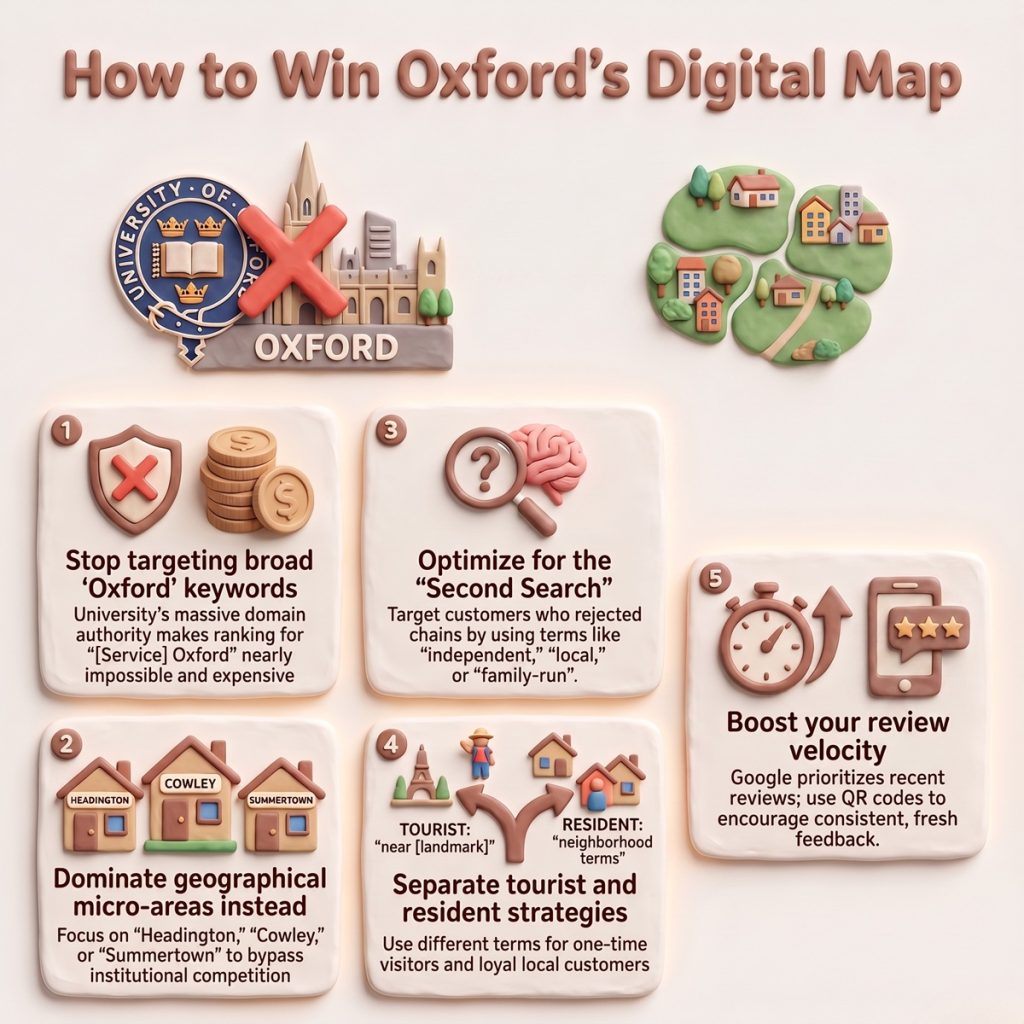
This isn’t an accident. Oxford presents a digital marketing challenge that doesn’t exist in comparable cities like Cambridge, Bath, or York. The issue isn’t your website or your Google Business Profile settings. It’s that you’re competing for local visibility in a search landscape where globally recognised institutions command disproportionate authority, and most local business digital marketing advice completely fails to account for this.
Here’s what Oxford businesses get wrong most often, and what a realistic strategy for local visibility actually looks like in a city where “Oxford” itself is one of the world’s most recognised brand names.
The University Authority Problem (And Why “Local SEO Best Practice” Doesn’t Apply)
Standard local SEO advice tells you to optimise for “[service] Oxford” keywords. For most businesses, that’s sensible. In Oxford, it’s often counterproductive.
Search for “printing Oxford” and you’ll see the university’s printing services, the Bodleian’s reprographic department, and college-specific providers before you reach a single independent print shop. Try “catering Oxford” and you’ll wade through college catering pages and university hospitality services.
The problem is domain authority. Oxford University’s website (ox.ac.uk) and its constituent college sites have been accumulating backlinks, citations, and trust signals since the early days of the internet. Some college websites have link profiles older than most businesses’ directors. When Google sees a page on that domain mentioning “Oxford” and a service keyword, it assumes relevance and authority that a local business simply cannot match head-on.
What most Oxford businesses get wrong: They try to outrank the university on broad “[service] Oxford” terms. This burns budget on unwinnable PPC battles and SEO efforts that move you from position 47 to position 23, still invisible.
What works instead: Targeting geographical micro-areas within Oxford that don’t trigger the university’s authority advantage. “Headington electrician,” “Summertown accountant,” “Cowley plumber”, these terms carry commercial intent from local residents, not prospective students or academic researchers. The university doesn’t have location-specific college pages for every Oxford neighbourhood, which finally levels the playing field.
The Tourist Search Volume Trap
Oxford receives roughly 7 million visitors annually, many of whom search for services whilst they’re here. This creates a peculiar distortion in search volume data that catches out businesses and agencies alike.
Keywords like “restaurant Oxford,” “hotel Oxford,” and “things to do Oxford” show impressive monthly search volumes in keyword research tools. What those tools don’t show is that 80-90% of that volume comes from tourists who’ll never become repeat customers, don’t know Oxford’s geography, and often search from outside the city before they arrive.
What most Oxford businesses get wrong: They optimise for high-volume tourist terms, then wonder why their website traffic doesn’t convert. A Jericho restaurant spending £2,000 monthly on Google Ads for “restaurant Oxford” is paying to reach coach tour groups and day-trippers who want something near the city centre, not locals who’ll book for birthdays and become regulars.
What works instead: Separate your tourist and resident strategies entirely. If you genuinely want tourist trade, optimise for “near [landmark]” terms where visitors actually are when they search, “restaurant near Ashmolean,” “parking near Christ Church.” For resident custom, ignore search volume figures and focus on neighbourhood terms and services that only locals search for: “restaurant delivery Headington,” “Sunday lunch Summertown,” “table booking Jericho.”
The Commuter vs. Resident Disconnect
Oxford has approximately 152,000 residents but an estimated 80,000 daily commuters who work in the city. This creates a split market that most local businesses fail to address in their digital marketing.
A coffee shop on Cowley Road serves a fundamentally different customer at 8am (commuters grabbing takeaway en route to the university or hospitals) than at 2pm (local residents, parents, retirees). Yet most Oxford businesses create one Google Business Profile description, one set of opening hours emphasis, one website message, and wonder why it resonates with neither group.
What most Oxford businesses get wrong: They don’t segment their audience geographically beyond “Oxford.” A physio practice might rank well for “physiotherapy Oxford” but miss that their actual customers are largely Headington and Cowley residents (who’d search more specifically) or hospital staff (who search on their break, often for “near me” terms, and need evening appointments).
What works instead: Create location-specific landing pages for the neighbourhoods where you know customers live, not just where your business is located. If your Botley garage knows that 60% of customers actually come from Cumnor, Farmoor, and Eynsham, build pages for those villages. They’re outside Oxford proper, face less competition, and searchers there are actively looking for “nearest” options, which you might well be.
The College Commercial Confusion
Many Oxford colleges run commercial operations, conference facilities, holiday accommodation, gift shops, even wedding venues. These appear in local search results alongside independent businesses, but with two crushing advantages: the college brand name and zero commercial pressure to achieve ROI.
An independent venue spending £500 monthly on Google Ads for “wedding venue Oxford” is competing against colleges whose conference managers might dabble in paid search with no particular budget constraint, knowing their primary function is academic, not commercial.
What most Oxford businesses get wrong: They view colleges as competitors and try to outbid them in paid search or outrank them organically. This is financially unsustainable. A college can afford to pay £8 per click for brand prestige. You cannot.
What works instead: Emphasise what colleges can’t offer or won’t. Colleges largely market to corporate conferences and alumni events, not small private functions. Terms like “private dining Oxford small groups,” “exclusive hire restaurant Oxford,” or “intimate wedding venue Oxfordshire” (note the county, not city) attract customers who’ve already ruled out colleges. Your unique selling points, flexibility, personalisation, non-institutional atmosphere, are what converts this audience.
The National Retailer Stranglehold on “Near Me”
Cornmarket and the Westgate Centre ensure that national retail chains dominate “near me” searches for product categories. When someone in central Oxford searches “coffee shop near me,” they’ll see Caffè Nero, Pret, and Costa before your independent café, because those brands have sophisticated multi-location SEO, aggressive Google Business Profile optimisation, and review volume you cannot match.
What most Oxford businesses get wrong: They assume a well-optimised Google Business Profile will win “near me” searches. It won’t, not against national operators with dedicated agencies managing hundreds of locations.
What works instead: Win the second search. The customer who searches “independent coffee Oxford,” “best coffee Summertown,” or “local bakery Jericho” has already rejected the chains. These lower-volume, higher-intent searches are where independents win, but only if you’ve seeded those specific keywords in your Google Business Profile description, website content, and review responses. When someone writes a Google review mentioning “best independent café,” respond with “thank you for supporting local independent businesses in Jericho”, you’ve just reinforced the keywords that differentiate you from Pret.
The Postcode Sector Strategy Nobody Uses
Oxford’s postcode sectors (OX1, OX2, OX3, OX4) represent genuinely distinct communities with different demographics and search behaviour, yet almost no local businesses optimise for them.
OX1 (city centre) searches come largely from students and tourists. OX2 (North Oxford, Summertown) skews affluent and residential. OX3 (Headington, Marston) includes hospital staff and families. OX4 (Cowley, Littlemore) is more price-sensitive and practical.
What most Oxford businesses get wrong: They create one “serving Oxford” message. A locksmith offering the same website content and ad copy to OX1 and OX4 searchers is missing that one group wants “emergency locksmith 24/7” and the other wants “security upgrade” and “lock installation.”
What works instead: Build postcode-specific landing pages with genuinely different content reflecting what those communities actually search for. Not just “Locksmith OX3” as a heading with identical body copy, but pages that address “Headington hospital staff,” “student accommodation lock changes,” “Marston residential security.” Google is sophisticated enough now to recognise when you’ve simply repeated the same content with location names swapped.
Why Oxford Businesses Need Different PPC Strategies
Google Ads in Oxford costs more per click than in comparable cities for one reason: competition from institutions with essentially unlimited budgets. The university, colleges, language schools, and tutorial colleges bid on thousands of keywords related to education, accommodation, and services, and they’re not optimising for cost-per-acquisition because they’re not selling products.
This inflates costs across the board. A driving instructor in Oxford might pay £4.50 per click for “driving lessons Oxford” compared to £2.80 in Reading, not because there’s more demand, but because educational institutions bidding on broad keyword sets have pushed up the auction floor.
What most Oxford businesses get wrong: They run city-wide PPC campaigns and watch their budget evaporate by lunchtime, often to clicks from students, academics, and tourists who were never potential customers.
What works instead: Ruthlessly negative keyword management, excluding university-related terms even if they seem irrelevant. If you’re a driving instructor, add negative keywords for “university,” “student accommodation,” “college,” “course,” and “degree”, because Google’s broad match will show your ad to someone searching “colleges Oxford” if you’re bidding on “Oxford” as a keyword. Then geofence your campaigns to exclude the city centre entirely and focus on residential postcodes. You’ll get a third of the clicks and five times the conversion rate.
The Review Velocity Problem
National chains encourage reviews systematically, email follow-ups, QR codes on receipts, staff incentives. An Oxford Pret might generate 15-20 Google reviews monthly. An independent café with better coffee, better food, and better service generates three.
Google’s local ranking algorithm weighs review velocity (how recently and frequently you receive reviews) heavily. This means even excellent independent businesses with 4.9-star ratings slip down local pack results if their last review was six weeks ago, whilst chains with 4.2 stars but daily reviews rank higher.
What most Oxford businesses get wrong: They assume quality speaks for itself. It doesn’t, not in algorithmic ranking.
What works instead: Systematic review generation, not aggressive or annoying, but consistent. A simple postcard at the till: “If you enjoyed your visit, we’d be grateful for a Google review” with a QR code linking directly to your review page. One independent Summertown restaurant implemented this and went from four reviews monthly to eighteen, moving from position seven to position two in the local pack within eight weeks. The food didn’t change. The visibility did.
What an Oxford-Specific Digital Marketing Strategy Actually Looks Like
If you’re an Oxford local business competing for visibility, here’s the realistic approach:
Stop competing on “Oxford” alone. You will not outrank the university, the colleges, or national chains on broad city-level terms. Accept this and move on.
Dominate your neighbourhood. Build genuinely useful content for Headington, Summertown, Jericho, Cowley, Iffley, wherever your actual customers live. Not keyword-stuffed landing pages, but content that answers the specific questions those communities search for.
Separate tourist and resident strategies. If you want both, run separate campaigns with separate budgets and separate success metrics. A visitor who buys once and a resident who returns monthly are not the same customer.
Use the university context to your advantage. Terms like “family-friendly restaurant Oxford” implicitly exclude student venues. “Professional [service]” excludes student-focused providers. “Local independent” excludes chains. These qualifiers reduce search volume but increase relevance dramatically.
Optimise for the second search. The customer who searches generically will find chains and institutions. The customer who searches specifically, with neighbourhood names, “independent,” “local,” “family-run”, is looking for you. Be findable for that second, more valuable search.
Track what actually converts, not what ranks. A keyword that brings 200 visitors monthly but zero sales is worthless. A neighbourhood term that brings twelve visitors and four conversions is gold. Oxford’s unusual competitive landscape means standard metrics mislead you.
Frequently Asked Questions
Q: Should Oxford businesses even bother with SEO given the university’s dominance?
A: Yes, but not for the keywords you’d target in a normal city. SEO for neighbourhood terms, specific service combinations, and “independent” or “local” qualifiers works extremely well in Oxford because those searches filter out institutional results. Broad city-level terms are largely unwinnable and not worth the investment.
Q: Is Google Ads worth it for Oxford local businesses with the higher costs per click?
A: It can be, but only with aggressive geographic and negative keyword targeting. City-wide campaigns in Oxford burn budget quickly with poor conversion. Campaigns geofenced to residential postcodes, excluding the city centre and university-related terms, typically achieve 60-70% lower cost-per-acquisition despite the competitive landscape.
Q: How long does it take to see results from neighbourhood-focused digital marketing in Oxford?
A: Faster than city-level SEO, typically. We’ve seen businesses move from invisible to top three in local pack results for their specific neighbourhood within 8-12 weeks with dedicated location pages and consistent review generation. The lower competition at neighbourhood level means meaningful movement happens relatively quickly once the strategy is properly targeted.
Q: Should my Oxford business target the colleges as B2B customers through digital marketing?
A: Colleges rarely procure services through web search, they use established suppliers and tender processes. If college contracts are genuinely part of your business model, LinkedIn and direct relationship-building work better than SEO or PPC. Digital marketing should focus on the customers who actually use search to find and evaluate suppliers.
If your Oxford business has been following standard local SEO advice and wondering why it’s not working, the problem isn’t your execution, it’s that Oxford doesn’t follow standard rules. We’ve spent years developing digital marketing strategies specifically for businesses competing in university cities, and we’d be happy to review what might work for your particular situation. [Get in touch for a straightforward conversation](https://www.thickrope.com/contact) about what’s realistic for your sector and location.