

Why Treating Poole and Bournemouth as One Market Is Costing You Customers
Stand at the border on Wessex Way and you’d struggle to tell where Bournemouth ends and Poole begins. Three miles, one continuous sprawl of development, broadly similar postcodes. Most marketing agencies working across the conurbation treat them as interchangeable, “Bournemouth/Poole” rolls off the tongue in every proposal deck.
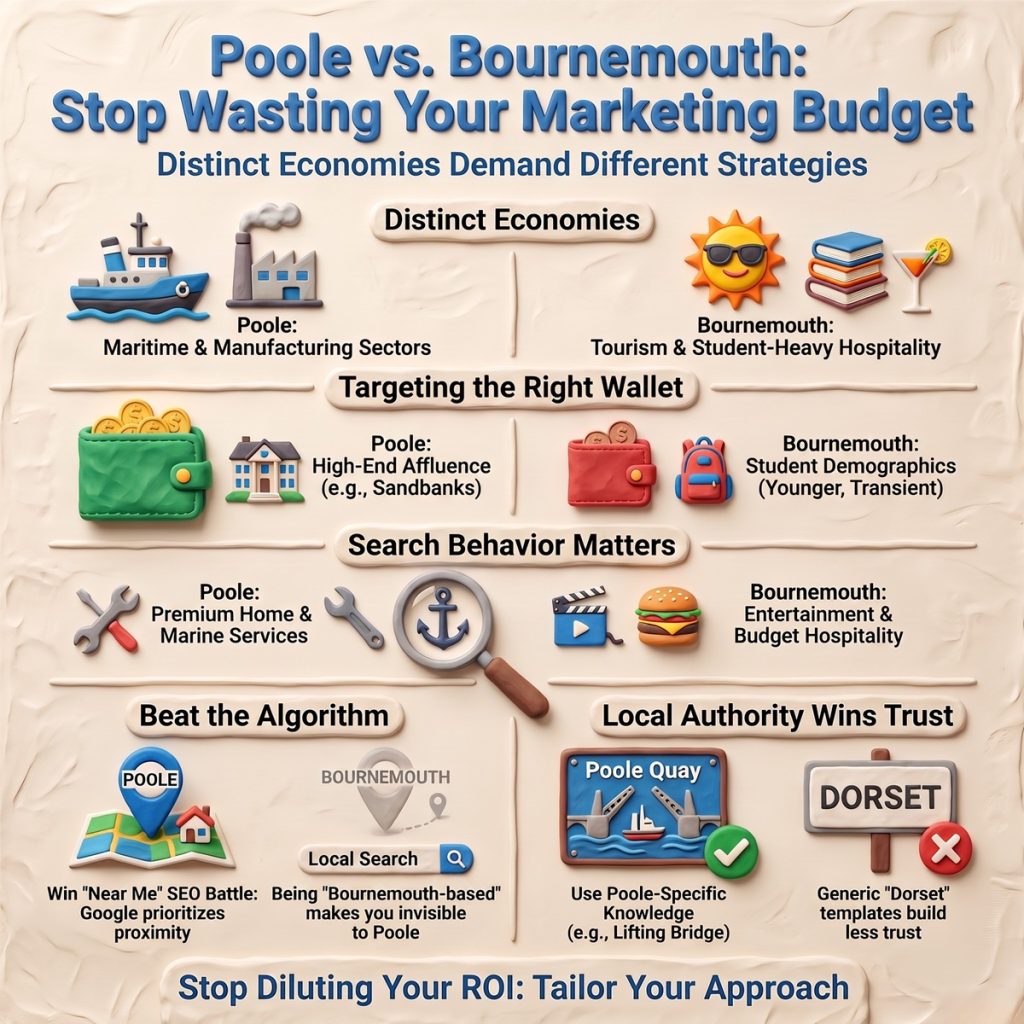
But if you’re a business trying to win customers specifically in Poole, that bundled approach is a strategic mistake. Not because one town is better than the other, but because the two places have genuinely different business identities, different customer demographics, and different competitive landscapes. Marketing that works in Bournemouth’s hospitality-heavy town centre won’t necessarily land in Poole’s affluent harbour villages or its established manufacturing zones.
This isn’t about civic pride. It’s about whether your marketing budget is aligned with where your actual customers are and what they’re searching for.
The Business Composition Gap
Poole’s economy was built on its harbour, Europe’s largest natural harbour, if local pride needs stating. That heritage created a maritime and logistics sector that still employs thousands. Sunseeker yachts manufactures in Poole, not Bournemouth. The harbour supports boat builders, marine engineers, chandlers, and a cluster of businesses serving the sailing community. There’s also a significant advanced manufacturing base around aerospace and defence.
Bournemouth, by contrast, developed as a Victorian resort town and that DNA persists. Its economy leans heavily on hospitality, tourism, and conferences. It also has a substantial financial services presence, JPMorgan Chase, LV=, and Nationwide all have significant operations there. The two universities bring 30,000+ students, skewing the demographic young and transient.
Neither profile is superior, but they demand different marketing strategies. If you’re a B2B engineering firm in Poole trying to reach procurement managers in the marine sector, carpet-bombing “Bournemouth and Poole” with generic ads wastes half your budget reaching students looking for part-time bar work.
The Affluence and Search Intent Divide
Poole contains some of the wealthiest postcodes in the UK. Sandbanks, Canford Cliffs, and Lilliput consistently rank among the highest property values outside London. BH13 and BH14 postcodes have median household incomes substantially above the national average. The demographic skews older, established, home-owning.
That creates a specific local search pattern. Poole residents search for premium home services, landscape architects, interior designers, bespoke builders. They’re looking for marine services, boat maintenance, waterfront dining. The search volume for “luxury [service] Poole” consistently outperforms Bournemouth equivalents.
Bournemouth’s demographic is broader and younger. Student accommodation dominates certain wards. The town centre sees high footfall but less residential affluence in the core. Search intent skews toward entertainment, nightlife, budget hospitality, and transient services.
If you’re a high-end kitchen installer and your Google Ads campaign targets “Bournemouth and Poole” equally, you’re bidding on clicks from student bedsits in Winton when you should be laser-focused on homeowners in Sandbanks refurbishing their £2m properties.
Local SEO and the “Near Me” Problem
When someone in Poole searches “plumber near me” or “accountant Poole,” Google’s local algorithm prioritises businesses physically located in or strongly associated with Poole. If your Google Business Profile lists you as “Bournemouth-based serving the local area,” you’re swimming against the current.
This isn’t trivial. Local pack rankings, those three map results at the top of mobile searches, drive the majority of phone calls for local service businesses. Being five miles away in Bournemouth when someone in Poole needs urgent help means you’re often invisible, even if you’d happily serve that customer.
The converse is also true, which is why we’re not suggesting Bournemouth businesses should pretend to be in Poole. But if your actual customer base is concentrated in Poole, your location signals, content, and local citations need to reflect that specificity. “Serving Dorset” is too vague. “Poole-based serving BH13–17” is strategically precise.
Content That Reflects Local Knowledge
Generic content about “things to do in Bournemouth and Poole” ranks poorly because it competes with tourist boards and national publishers. But content that demonstrates genuine Poole-specific knowledge, “Where Sandbanks Homeowners Source Italian Marble” or “Marine Engineers We Work With Around Poole Quay”, signals local authority to both Google and potential customers.
This requires actual local insight, not postcode stuffing. Referencing Poole-specific landmarks (the Lifting Bridge, Baiter Park, Holes Bay), local events (Poole Harbour Boat Show), and neighbourhood names that residents use (not just pulling postcodes from a list) builds trust. It tells a Poole homeowner that you understand their market, not that you’ve applied a search-and-replace to a Bournemouth template.
Businesses that genuinely operate across both towns can certainly say so, but the marketing needs to reflect that you understand the distinction. A hospitality marketing campaign for Bournemouth hotels should emphasise nightlife, beach proximity, and student events. A campaign for Poole waterfront restaurants should lean into the harbour views, sailing community, and family affluence.
The Competitive Landscape Isn’t Identical
Your competitors in Poole aren’t always the same as your competitors in Bournemouth. The marine sector competition is concentrated in Poole. Financial services recruitment firms cluster in Bournemouth. Estate agents, while operating across both, have different specialisms and reputations depending on which town they’re associated with.
If you’re benchmarking your marketing performance, you need to know who you’re actually competing against for visibility. A Poole-based solicitor specialising in marine law isn’t competing with Bournemouth conveyancers serving first-time student buyers. The keyword targets, the content strategy, and the paid search competitors are completely different.
Running a single campaign and assuming both towns respond identically means you never learn what’s actually working where. Split your analytics by location. Track which town drives higher conversion rates for which services. If Poole customers convert at 8% but Bournemouth traffic converts at 2%, that’s actionable intelligence, but only if you’re measuring them separately.
When Lumping Them Together Does Make Sense
Not every business needs to split hairs between Poole and Bournemouth. If you’re a national brand with a regional branch, “serving Dorset” is perfectly sensible. If your service is truly location-agnostic, online-only, or something customers will travel for regardless, optimising for both towns under one umbrella can work.
The mistake is assuming they’re interchangeable when your customer base, search volume data, and conversion patterns tell you otherwise. Many agencies bundle them because it’s administratively easier, not because it’s strategically sound. If half your customers come from Poole and they’re worth twice as much as Bournemouth customers, your marketing spend should reflect that ratio.
What Poole-Specific Marketing Actually Looks Like
Practically, this means:
- Separate landing pages for Poole-specific services, not one page listing ten towns
- Local citations that emphasise your Poole address if you’re Poole-based, not diluted across both
- Google Ads campaigns with location targeting split by town, so you can bid more aggressively where conversion rates justify it
- Content that references Poole landmarks, businesses, and community knowledge authentically
- Google Business Profile optimised for Poole search terms, with Poole-specific posts and updates
- Analytics and reporting that track Poole performance separately, so you know what’s delivering ROI
None of this is complicated, but it does require an agency that understands the distinction matters and has the local knowledge to execute it properly. Template approaches designed to scale across hundreds of towns won’t get you there.
Frequently Asked Questions
Q: Should my business only market in Poole if I’m based there?
A: Not necessarily, if you genuinely serve both towns well, say so. But your marketing should demonstrate you understand the difference between them, not treat them as one generic market. Location-specific landing pages and targeted campaigns will outperform a single “both towns” approach.
Q: Does Google actually rank Poole businesses differently from Bournemouth ones?
A: Yes, for local searches especially. Google’s local algorithm prioritises proximity and location signals. A Bournemouth-based business can rank in Poole searches, but you’ll need stronger signals (reviews, content, citations) to overcome the distance penalty compared to actual Poole-based competitors.
Q: How do I know if splitting my marketing between the two towns is worth the extra effort?
A: Look at your customer data. If one town consistently delivers higher-value customers or better conversion rates, that’s your answer. Track enquiries and sales by postcode for three months, if the pattern is skewed, your marketing should reflect that reality rather than assume both towns are equal.
If you’re a Poole business that’s been lumped into generic “Bournemouth and Poole” campaigns and haven’t seen the results you expected, it might be time for a more targeted approach. We’ve worked with businesses across both towns for over 25 years, long enough to know the difference matters. Let’s talk about what Poole-specific marketing could do for you.