
Why UK Businesses That Get On-Page Search Engine Optimisation Right First Consistently Outrank Those That Don’t
There’s a common sequence error costing UK businesses thousands in wasted SEO investment every month.
They commission content. They buy links. They fix site speed issues. All sensible activities. All completely undermined by on-page search engine optimisation foundations that were never properly set.
The result: rankings that plateau early, traffic that never converts the way projections suggested it would, and a nagging sense that the agency can’t explain why the competitor down the road, with worse content and fewer backlinks, is sitting in position three whilst you’re stuck on page two.
The mistake isn’t in the tactics themselves. It’s in the order.
The Foundations That Gate Everything Else
On-page SEO is the layer that tells Google what your pages are about, why they matter, and which queries they should rank for. When this layer is weak or confused, every pound you spend on content production and link acquisition is working against unnecessary resistance.
The core elements:
Title tags and meta descriptions that match commercial intent and include the terms your customers actually search for (not the ones you wish they’d search for).
Header structure that guides both users and crawlers through your content hierarchy without ambiguity.
Internal linking that distributes authority to the pages that drive revenue, not just the ones that were easy to link to.
Content structure and semantic relevance, ensuring your pages cover the topic comprehensively enough that Google recognises them as legitimate answers to the query.
URL structure and page organisation that reflects how your business categories and services actually relate to each other.
When these elements are right, content performs better. Links carry more weight. Technical improvements compound faster.
When they’re wrong, even slightly wrong, everything else underperforms.
What Getting the Sequence Wrong Actually Costs
Here’s what it looks like in practice:
A Midlands manufacturing firm spent £18,000 over six months on content and outreach. They commissioned twenty articles, earned a dozen decent backlinks, and saw rankings improve modestly. But revenue didn’t move.
The problem wasn’t the content quality. It was that their product category pages had title tags like “Products | Company Name” and header structures that didn’t signal which specific product types they manufactured. Google couldn’t confidently match those pages to commercial queries. The blog content ranked fine, but for informational searches that didn’t convert. The pages that could actually drive enquiries never gained traction because the on-page signals were too weak to compete, regardless of how many links pointed at them.
They spent three weeks fixing on-page fundamentals. Within eight weeks, three product pages moved from page three to page one. Enquiries doubled. The content they’d already commissioned started performing because it was now linked internally to pages Google understood.
Or the Surrey consultancy that invested in technical SEO, migrated to a faster host, implemented schema markup, fixed crawl errors. All good hygiene. But their service pages targeted multiple overlapping keywords per page, with thin content that didn’t differentiate between adjacent services. Google couldn’t work out which page should rank for which query. The technical improvements made the site faster, but didn’t resolve the relevance confusion. Traffic stayed flat.
Two months of on-page restructuring, consolidating some pages, splitting others, clarifying the focus of each, and organic traffic climbed 60% without a single new backlink.
Why Agencies Sell the Sequence Backwards
There’s a structural reason many agencies lead with content and links rather than on-page fundamentals: those activities are easier to scope, price, and deliver as recurring services.
On-page SEO is front-loaded work. It requires strategic decisions about site architecture, keyword targeting, and page focus. It’s harder to package as a monthly retainer. Content and links, by contrast, scale neatly into ongoing campaigns.
But selling what’s easy to deliver isn’t the same as selling what works.
The uncomfortable truth is that if your on-page foundations are weak, you’re essentially paying to build on unstable ground. The structure might stay up for a while, but it won’t reach the height it should, and eventually it stops growing altogether.
What Getting It Right First Looks Like
Start with a clear map of which pages target which queries, structured around commercial intent.
Your homepage, service pages, product categories, and location pages should each have a single primary focus. That doesn’t mean you only use one keyword, it means the page has a clear job to do, and the on-page elements reinforce that job without distraction.
Your title tags should be specific enough that someone scanning search results knows exactly what they’ll get. “SEO Services London” is lazy. “Technical SEO Audits for London E-commerce Businesses” is clear.
Your header structure should guide a reader through the page in a logical sequence, not just drop H2 tags randomly wherever the content felt like it needed a break.
Your internal links should connect related content strategically, passing authority to the pages that matter most for revenue. If your blog ranks well but your service pages don’t, your internal linking is likely backwards.
Once this layer is solid, content and links amplify what’s already there. You’re no longer hoping Google figures out what your pages are about, you’ve told it, clearly and consistently.
The ROI Case for Sequencing Correctly
The financial logic is straightforward:
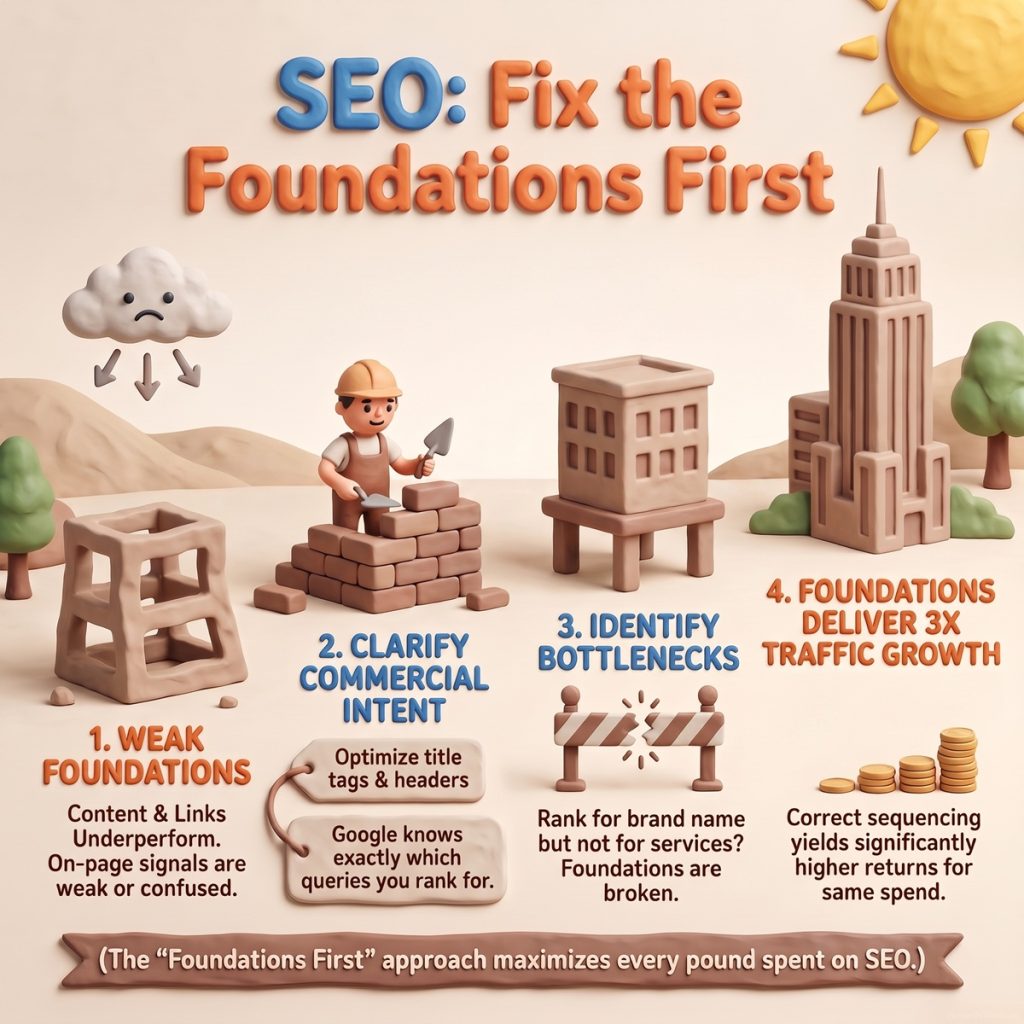
If you spend £2,000 per month on content and links without fixing on-page issues first, you’re likely capturing 40–60% of the ranking potential that budget should deliver. The rest is lost to relevance confusion, poor targeting, or internal competition between your own pages.
If you spend £3,000 upfront to get on-page foundations right, then spend the same £2,000 per month on content and links, you’re capturing 80–90% of the potential. The same budget delivers significantly better returns because it’s working with the algorithm, not against it.
The upfront cost feels larger. But the cumulative ROI over twelve months isn’t even close. The business that fixed foundations first will typically see 2–3 times the traffic growth for the same total spend.
When You Should Break This Rule
There are scenarios where investing in content or links before comprehensive on-page work makes sense.
If you’re in a low-competition niche and your existing on-page setup is reasonably competent, incremental content might be enough to move the needle without deeper work.
If you’ve just lost a critical backlink and need to recover authority quickly, targeted link acquisition might take priority.
If you’re launching a new product category and need visibility fast, a hybrid approach, decent on-page setup plus aggressive content, might compress the timeline.
But these are exceptions. For most UK SMEs competing in moderately competitive markets, getting on-page right first is the higher-return path.
What Fixing On-Page Foundations Actually Involves
This isn’t a five-hour job. Proper on-page search engine optimisation for a typical service business website involves:
Keyword mapping, deciding which pages target which queries, resolving overlaps and gaps.
Title and meta optimisation across all commercial pages, written for clarity and relevance rather than keyword stuffing.
Header restructuring to create logical content hierarchy and improve topical clarity.
Content gap analysis, identifying where pages are too thin to compete and need expanding, or where multiple weak pages should be consolidated into one strong page.
Internal linking architecture, ensuring the pages you want to rank receive adequate internal authority and contextual relevance signals.
For a fifty-page site, expect this to take four to six weeks if done properly. For larger sites, longer.
It’s not glamorous work. It doesn’t produce the satisfying dopamine hit of seeing a new piece of content go live or a new backlink appear in your dashboard. But it’s the work that determines whether everything else you invest in actually compounds.
Frequently Asked Questions
Q: Can’t we just fix on-page issues as we go whilst building content?
A: You can, but you’ll waste budget. Content written without a clear keyword map often targets the wrong queries or competes with your own pages. Fixing that later means rewriting or consolidating content you’ve already paid for. It’s almost always cheaper to map first, then create.
Q: How do I know if our on-page SEO is weak enough to prioritise fixing it?
A: If you’re ranking for branded queries but struggling with commercial non-branded terms, or if you’ve built links and content for six months without meaningful ranking improvement, on-page foundations are the likely bottleneck. A technical audit will confirm it, but those symptoms are reliable indicators.
Q: Does on-page SEO need ongoing work, or is it one-and-done?
A: The foundational work is largely one-and-done, with periodic reviews as your business evolves or you add new services. Ongoing SEO shifts toward content, links, and technical maintenance once the on-page layer is solid. That’s the point, you fix it once so the recurring investment actually works.
COMMERCIAL CLOSE:
If your SEO investment isn’t delivering the returns you expected, the issue is often sequencing rather than effort. Thickrope’s on-page SEO audits identify exactly where foundations are letting you down and what fixing them properly should cost, [book a consultation](https://thickrope.com/contact) and we’ll walk you through it.