
On-Page SEO Checkers: What UK Businesses Actually Get (And What Gets Missed)
Most on-page SEO checkers will tell you your title tag is two characters too long, your H1 is missing a keyword, and you’ve got 47 images without alt text. What they won’t tell you is which of those 47 fixes will actually improve your rankings, and which are irrelevant to how UK searchers find businesses like yours.
The truth: on-page SEO checkers are useful diagnostic tools. They spot technical problems quickly. But they can’t tell you why your competitor ranks first for “commercial solicitor Manchester” whilst you’re on page three, even though your on-page score is higher.
This article compares the three most common approaches UK businesses take to on-page SEO, DIY with free checkers, paid checker tools, and professional audits, and helps you decide which one matches where your business actually is.
What On-Page SEO Checkers Actually Do
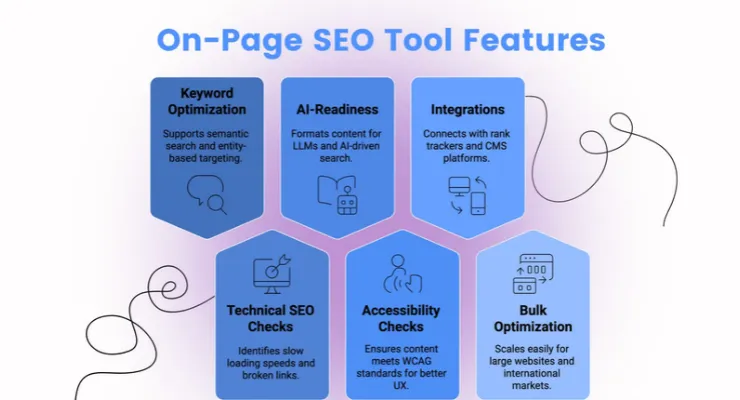
On-page checkers crawl your website and flag issues against a set of known SEO rules: missing meta descriptions, slow page speed, broken internal links, keyword density, header tag structure, mobile responsiveness.
The output is usually a score (often out of 100) and a list of issues ranked by severity.
What this approach solves:
- Speed. You get a technical health check in minutes, not days.
- Completeness. Checkers don’t forget to look at something. Every page gets the same treatment.
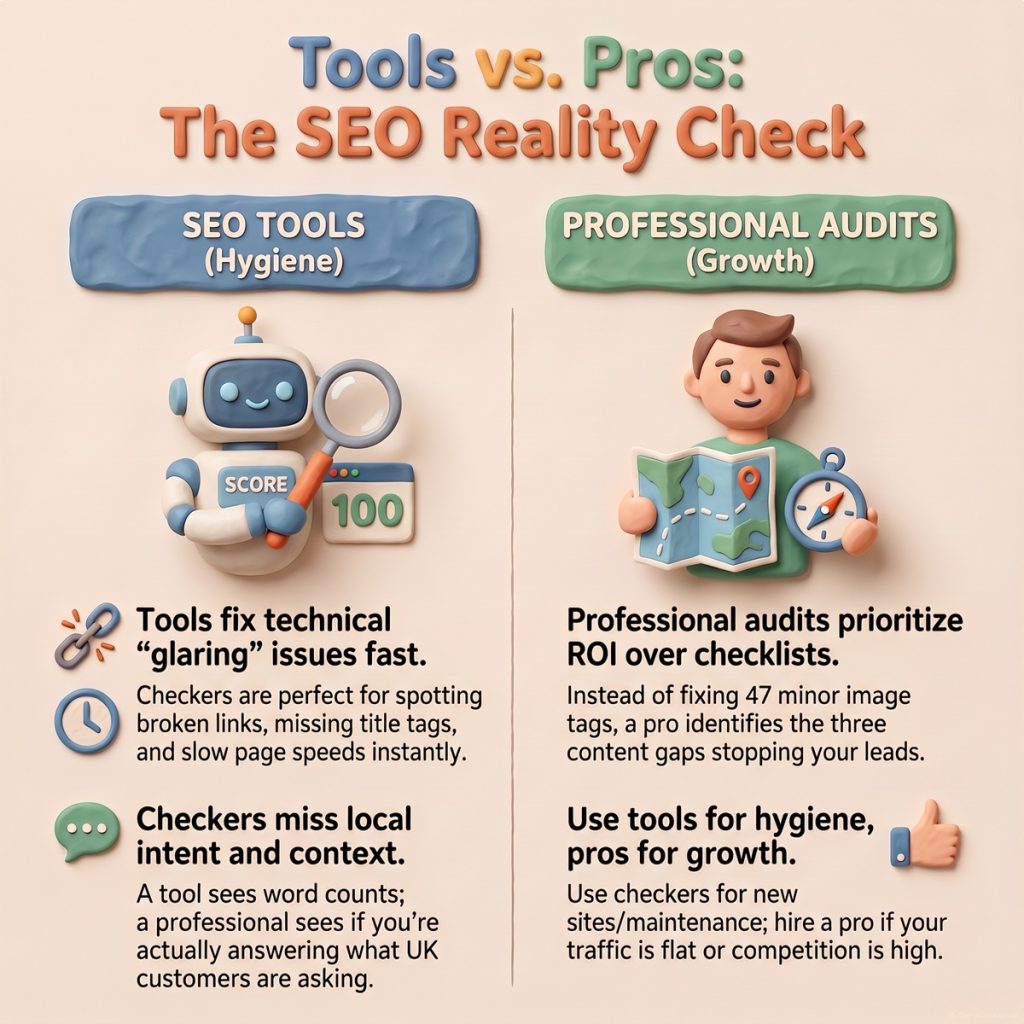
- Baseline fixes. If your site has glaring technical problems, broken links, missing title tags, uncompressed images, a checker will find them.
The limit:
Checkers grade your page against generic SEO rules. They don’t know your industry, your competition, or what UK searchers in your category actually respond to. A page can score 95/100 and still rank poorly because the content doesn’t match search intent, or because your topical authority is weak compared to competitors.
Three Approaches UK Businesses Use
Free On-Page Checkers
These tools, often browser extensions or freemium SaaS platforms, analyse individual pages or small batches and flag the most common issues.
Best for: New websites, businesses just starting with SEO, or quick spot-checks before publishing new content.
What you get: Basic technical feedback. Missing alt text, title tag length, meta description presence, keyword usage, readability scores.
What you don’t get: Competitor comparison, prioritisation based on actual ranking factors in your niche, or any insight into whether the issues flagged actually matter for UK search visibility.
Cost: Free, sometimes with limits on pages scanned per month.
Real outcome: You’ll fix surface-level problems. You won’t know if those fixes move the needle.
Paid On-Page Checker Tools
Subscription platforms that crawl entire sites, track changes over time, and offer more granular reporting: Core Web Vitals, schema markup validation, SERP preview simulation, content gap analysis.
Best for: Businesses with 50+ pages, e-commerce sites, or companies running ongoing content programmes where you need to monitor technical health across many URLs.
What you get: Detailed diagnostics, historical tracking, bulk issue exports, integrations with analytics platforms. Some tools include keyword research and backlink data.
What you don’t get: Strategic direction. The tool will tell you that 200 product pages have thin content. It won’t tell you which 20 products to prioritise based on commercial intent, UK search volume, or competitive gap.
Cost: £80–£400/month depending on site size and feature set.
Real outcome: You’ll maintain technical hygiene efficiently. You still need someone (in-house or external) to interpret the data and decide what to act on first.
Professional On-Page SEO Audits
A specialist reviews your site manually, combines tool data with competitive analysis, and delivers a prioritised action plan based on what actually affects rankings in your sector and geography.
Best for: Businesses that have tried DIY SEO without results, companies facing stiff UK competition in commercial sectors (legal, finance, trade services), or sites that have been penalised or lost traffic after an algorithm update.
What you get: Context. A professional audit answers why you’re not ranking, not just what is technically wrong. It includes content quality assessment, user intent mapping, competitor gap analysis, and prioritisation based on ROI.
For example: a tool might flag that your “services” page has low word count. A professional audit will tell you that the page ranks poorly because competitors are answering five specific questions UK searchers ask before they book, and your page answers none of them.
What you don’t get: Ongoing monitoring (unless you retain the agency). A professional audit is a point-in-time deliverable, though most include a roadmap for the next 6–12 months.
Cost: £800–£3,000+ depending on site size, sector complexity, and deliverables.
Real outcome: You get a roadmap that connects on-page fixes to business outcomes—more enquiries, better conversion from organic traffic, improved visibility for high-intent keywords.
What Every Checker Misses (And Why It Matters)
Even the best on-page tools consistently miss three things that directly affect whether UK businesses rank and convert:
1. Content quality and relevance to UK search intent
A tool can measure word count, keyword frequency, and readability. It can’t tell you if your content actually answers the question a searcher asked, or if it matches the intent behind a query.
Example: A UK accountancy firm ranks poorly for “contractor tax advice” despite a high on-page score. Manual review shows the page targets accountants, not contractors. The language, examples, and CTAs are wrong for the audience. No tool flags that.
2. Topical authority and competitive context
On-page checkers evaluate pages in isolation. They don’t assess whether your site has the breadth and depth of content needed to compete in your category, or how your pages compare to those already ranking.
If the top three results for “commercial property solicitor Leeds” all publish 15+ supporting articles on lease types, freehold vs leasehold, and stamp duty changes, your single service page, no matter how optimised, will struggle.
3. Real-world user behaviour signals
Tools estimate page speed and mobile-friendliness. They don’t see bounce rate, time on page, or conversion paths. If your on-page SEO is perfect but users leave after five seconds because the content is generic or the page layout is confusing, rankings will suffer.
Google’s algorithm increasingly prioritises user satisfaction. That’s hard to reverse-engineer from a checklist.
When a Tool Is Enough (And When It Isn’t)
Use a free or paid checker if:
- Your site is new and you need to fix obvious technical problems before launch
- You’re maintaining a site that’s already ranking well and want to catch issues before they become problems
- You have in-house SEO knowledge and just need data, not interpretation
- Your market isn’t particularly competitive (local trades, niche B2B services with low search volume)
Invest in a professional audit if:
- You’ve been “doing SEO” for 6+ months without ranking improvements
- Your sector is crowded (legal, financial services, healthcare, SaaS, e-commerce)
- You’re competing in major UK cities where page one is dominated by established brands
- You’ve lost rankings after a Google update and don’t know why
- Your traffic is flat or declining despite publishing new content regularly
The commercial difference: a tool might save you £100/month in subscription costs. A professional audit might identify the three content gaps stopping you from capturing 50 qualified leads per month. The ROI calculation isn’t close.
What Thickrope’s On-Page Audits Actually Include
We don’t run your site through a tool and email you the CSV. Our on-page SEO audits for UK businesses combine automated diagnostics with manual review:
- Technical crawl using enterprise-grade tools to identify indexation issues, site speed problems, mobile usability errors, and structured data gaps
- Content-intent mapping to assess whether your pages match what UK searchers in your category actually want
- Competitor gap analysis showing what the top 3–5 ranking sites do that you don’t (and which gaps matter most)
- Prioritised action plan with fixes ranked by effort vs. impact, so you know what to tackle first
- UK-specific optimisation, including local schema, regional keyword variations, and competitive context within your geography
Audits typically take 5–7 working days. You get a written report, a prioritised task list, and a 60-minute call to walk through findings and answer questions.
Frequently Asked Questions
Q: Can I just fix everything the tool flags and expect to rank better?
A: Not usually. On-page tools flag issues based on general SEO rules, but not all issues carry equal weight. Fixing 50 minor problems (missing image alt text, slightly slow page speed) often has less impact than fixing one strategic problem (content that doesn’t match search intent). Prioritisation matters more than completeness.
Q: How often should UK businesses run on-page SEO checks?
A: For most SMEs, a quarterly technical crawl is enough unless you’re publishing new content weekly or running a large e-commerce catalogue. After major site changes (redesigns, platform migrations, navigation updates), run a check immediately. If you’re actively competing for rankings, monthly monitoring helps catch issues before they cost you visibility.
Q: Do on-page checkers account for Google algorithm updates?
A: Not in real time. Most tools update their rulesets eventually, but they lag behind algorithm changes by weeks or months. After a major update (like the Helpful Content system or Core Web Vitals), a professional review is more useful than a tool report because it assesses why rankings shifted, not just what changed technically.
Q: Will fixing on-page SEO improve rankings if my site has no backlinks?
A: On-page optimisation helps Google understand what your pages are about and whether they’re relevant to a query. But for competitive commercial keywords in the UK, backlinks still matter, often more than on-page factors. If your on-page SEO is solid but you’re not ranking, the gap is usually authority (links, brand signals, topical depth), not technical issues.
Q: Can I use a tool to audit my competitors’ on-page SEO?
A: Some paid tools allow you to analyse competitor URLs and compare technical factors. This is useful for spotting content gaps or schema markup they use that you don’t. But you’re only seeing the surface. You won’t know their internal linking strategy, content update frequency, or conversion optimisation tactics without deeper analysis.
If you’ve been running your site through checkers for months without seeing movement in rankings or enquiries, the issue probably isn’t what the tool is measuring. [Book a professional on-page SEO audit](https://thickrope.com) and we’ll show you exactly what’s holding you back, and what to fix first.