
How Integrated Search Engine Marketing Delivers What SEO and PPC Can’t Achieve Separately
If you’re running SEO and PPC as separate budget lines, perhaps even with different agencies managing each, you’re not alone. Most Poole businesses do exactly this. What you might not realise is that this separation is quietly costing you money and opportunity every month.
The businesses outperforming their competitors in Poole, Bournemouth, and across the South Coast aren’t necessarily spending more on search. They’re running search engine marketing as a single, integrated system where paid and organic channels inform and strengthen each other.
Here’s what that integration actually looks like, and what it delivers that neither channel manages on its own.
The Data Feedback Loop Most Businesses Never Create
When SEO and PPC operate independently, each channel generates valuable intelligence, but that intelligence stays trapped within its own silo.
An integrated search engine marketing approach creates a feedback loop:
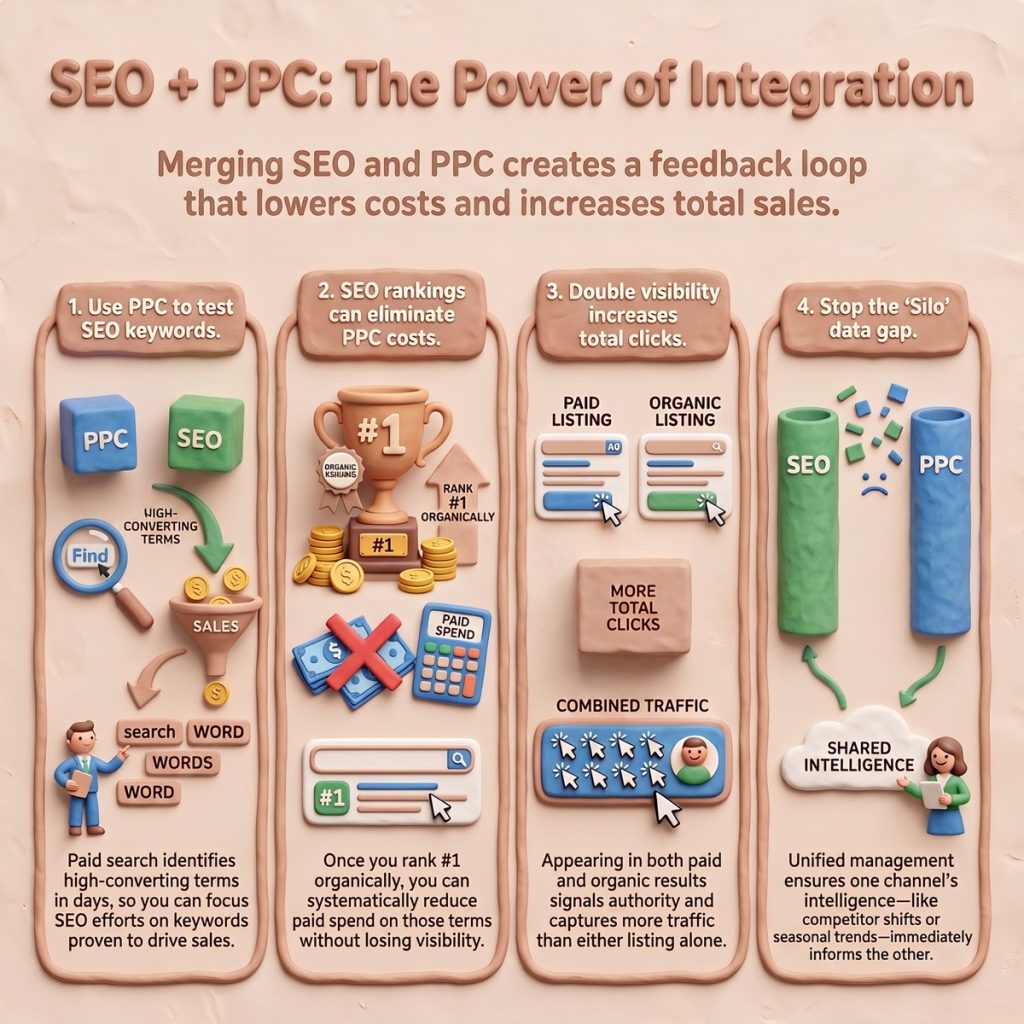
PPC tells you what converts before you commit SEO resources. Paid search gives you conversion data within days. You discover which keywords actually drive enquiries, which landing page messaging resonates, and what the customer journey looks like from search to sale. When SEO and PPC share strategy, you use paid data to prioritise organic efforts on terms that you’ve already proven convert, not on keywords that merely have high search volume.
SEO tells you where to reduce paid spend without losing visibility. As organic rankings improve for commercial terms, you can systematically reduce or pause PPC spend on those queries. The visibility remains; the cost-per-click disappears. But this only works when someone’s actively monitoring both channels and making coordinated decisions, something that doesn’t happen when SEO is with one provider and PPC with another (or managed in-house without strategic oversight).
Both channels reveal competitor movement you’d otherwise miss. When a competitor suddenly increases their paid presence for terms you rank organically for, that’s often a signal they’ve seen conversion success. When you notice organic ranking improvements from competitors on terms you’re paying for, it suggests those terms have commercial value worth defending. Integrated SEM monitoring catches these shifts; siloed channel management doesn’t.
The Visibility Gap That Costs You Revenue
Here’s something most Poole business owners don’t know: even when you rank number one organically, you’re not capturing all the available traffic for that search term.
Studies consistently show that when both paid and organic listings appear for the same query from the same business, total click-through increases, it doesn’t cannibalise. Users searching with commercial intent often scan both paid and organic results. Appearing in both positions signals authority and increases the probability of the click going to you rather than a competitor.
This matters particularly in competitive Poole markets, professional services, trades, hospitality, marine services, where multiple businesses are fighting for the same local terms. If you’re ranking well organically but a competitor occupies the paid position above you, they’re capturing clicks you assume are yours.
The inverse is equally important: if you’re running PPC but have weak organic presence, you’re paying for visibility that should increasingly become free. Every month you delay SEO is another month of unnecessary paid costs for terms you could own organically.
What Integrated SEM Looks Like in Practice

For a Poole business with a typical £2,000–£5,000 monthly search marketing budget, an integrated approach might work like this:
Month 1–3: PPC leads whilst SEO builds
Paid search carries the visibility burden whilst technical SEO issues are resolved, content is developed, and link building begins. PPC data identifies which service pages and which geographic terms (Poole, Sandbanks, Branksome, Parkstone) generate qualified leads. These insights directly shape the SEO content strategy.
Month 4–8: Coordination begins
Organic rankings improve for branded and some service terms. PPC budget shifts away from terms where page-one organic presence is established, redirecting spend toward competitive commercial terms or new service offerings where organic rankings haven’t yet developed. Total search visibility increases without budget increase.
Month 9–12: Strategic optimisation
For established terms with strong organic rankings, PPC runs only during peak commercial periods or when competitors increase their paid activity. Budget concentrates on defending high-intent terms and capturing searches where organic position isn’t sufficient alone. SEO focuses on expanding into adjacent terms and maintaining positions against competitor movement.
The result isn’t just combined visibility, it’s strategic efficiency. You’re not paying twice for the same result; you’re using each channel where it delivers the best return whilst systematically reducing waste.
The Poole Market Specifics
Local competition shapes how this integration works in practice.
Poole businesses face search competition from three directions: other Poole-based companies, larger Bournemouth competitors with bigger budgets, and national providers targeting “near me” searches. An integrated SEM strategy accounts for all three.
For example: a Poole accountancy firm might dominate organic results for “accountant Poole” but struggle to rank for “business accountant Dorset” against larger Bournemouth practices with established domain authority. PPC fills that gap whilst the SEO work continues. Simultaneously, strong organic presence for specific Poole neighbourhood terms (where PPC costs are lower due to less competition) allows budget reallocation to the more competitive broader terms.
This kind of strategic resource allocation only happens when one team, or one agency, manages the complete search engine marketing picture.
The Commercial Reality Nobody Mentions
Here’s the uncomfortable truth: most agencies prefer to sell you either SEO or PPC, not both.
SEO agencies often dismiss PPC as expensive and unsustainable. PPC agencies frequently characterise SEO as slow and unpredictable. Both positions protect their service offering; neither serves your commercial interest.
The businesses seeing the strongest search performance in Poole aren’t choosing between channels, they’re using both strategically, with coordination that maximises the return from each pound spent.
If your current arrangement has SEO with one provider and PPC with another, ask yourself: who’s responsible for the strategic decisions about where budget moves between channels? Who’s analysing whether paid spend on a term should continue now that organic rankings have improved? Who’s using PPC conversion data to prioritise SEO content development?
If the answer is “no one,” you’ve identified exactly where revenue is being left on the table.
What to Look for in Search Engine Marketing Services
Whether you’re currently running both channels separately or investing in only one, an integrated approach requires specific capabilities:
Unified reporting that shows total search performance, not separate SEO and PPC dashboards. You need to see combined visibility, combined cost-per-acquisition, and how channel interaction affects overall results.
Strategic budget flexibility between paid and organic based on performance data, not locked contracts that prevent reallocation when one channel outperforms.
Technical capability in both disciplines. Integrated SEM isn’t just project management, it requires deep expertise in both paid search optimisation and technical SEO, managed by professionals who understand how decisions in one channel affect the other.
Local market knowledge. Poole and South Coast search behaviour, competition intensity, and seasonal patterns (tourism peaks, maritime industry cycles, professional services rhythms) should inform strategy, not generic best practices imported from London or national case studies.
The Investment Question
The cost of integrated search engine marketing services in Poole typically reflects combined expertise: expect £1,500–£5,000 monthly depending on market competition and business size, plus your actual paid search spend.
That might seem substantial compared to basic SEO-only or PPC-only services. The question isn’t whether integrated SEM costs more than a single channel, it’s whether the return justifies the investment.
For most established Poole businesses with genuine growth ambition, the answer comes down to this: can you afford to keep paying for visibility that should be free, or to miss revenue opportunities whilst you wait months for organic rankings, when a coordinated approach delivers both efficiency and growth?
Frequently Asked Questions
Q: If I already rank well organically, why would I pay for PPC on the same terms?
A: Because even at position one organically, you’re not capturing all available traffic, particularly from users with strong commercial intent who scan paid results first. Combined presence increases total clicks and signals authority that improves conversion rates. However, this only makes commercial sense for high-value terms where the additional traffic justifies the cost.
Q: How quickly can I stop paying for PPC once SEO rankings improve?
A: There’s no fixed timeline, it depends on ranking position, competition intensity, and conversion rates from each channel. Generally, once you hold a top-three organic position consistently for 60+ days and can verify that organic traffic converts at comparable rates to paid, you can reduce or pause PPC for that term. This should be a data-driven decision, not a calendar-based one.
Q: Can I run integrated SEM with my current SEO agency and a separate PPC freelancer?
A: Technically yes, but you become the integration point, which means you’re responsible for strategic coordination, data sharing, and budget allocation decisions. Unless you have substantial digital marketing expertise, this arrangement usually delivers less than having one provider manage both channels with unified strategy and reporting.
Q: What’s the minimum budget needed for integrated search engine marketing in Poole?
A: For meaningful results, budget at least £1,200–£1,500 for agency services plus £800–£1,000 in PPC spend monthly. Below this threshold, you’re better off focusing exclusively on SEO until budget allows proper integration. Trying to run both channels with insufficient investment typically delivers poor results from both.
Q: How do I know if my current providers are actually integrating SEO and PPC or just running them in parallel?
A: Ask specific questions: How is PPC conversion data influencing SEO keyword targeting? Which terms have you reduced PPC spend on due to improved organic rankings, and what was the visibility impact? How are you using organic ranking improvements to inform paid search strategy? If you receive vague answers or separate reports with no strategic crossover narrative, you have parallel management, not integration.
If you’re running SEO and PPC as separate activities, or investing in only one whilst wondering whether the other might deliver better returns, we should talk. Thickrope’s integrated search engine marketing services for Poole businesses bring both channels under unified strategy with over 25 years of hands-on experience across paid and organic search. [Get in touch for a frank conversation](https://thickrope.com/contact/) about what coordinated SEM could deliver for your business.