

How to Choose an SEO Agency in Middlesbrough That Actually Understands Your Market
The Teesside business landscape doesn’t resemble London, Manchester, or anywhere else. You’ve got process engineering firms competing internationally, advanced manufacturing that most people have never heard of, a rapidly evolving digital sector, and retail and hospitality businesses serving both locals and tourists heading to the North York Moors.
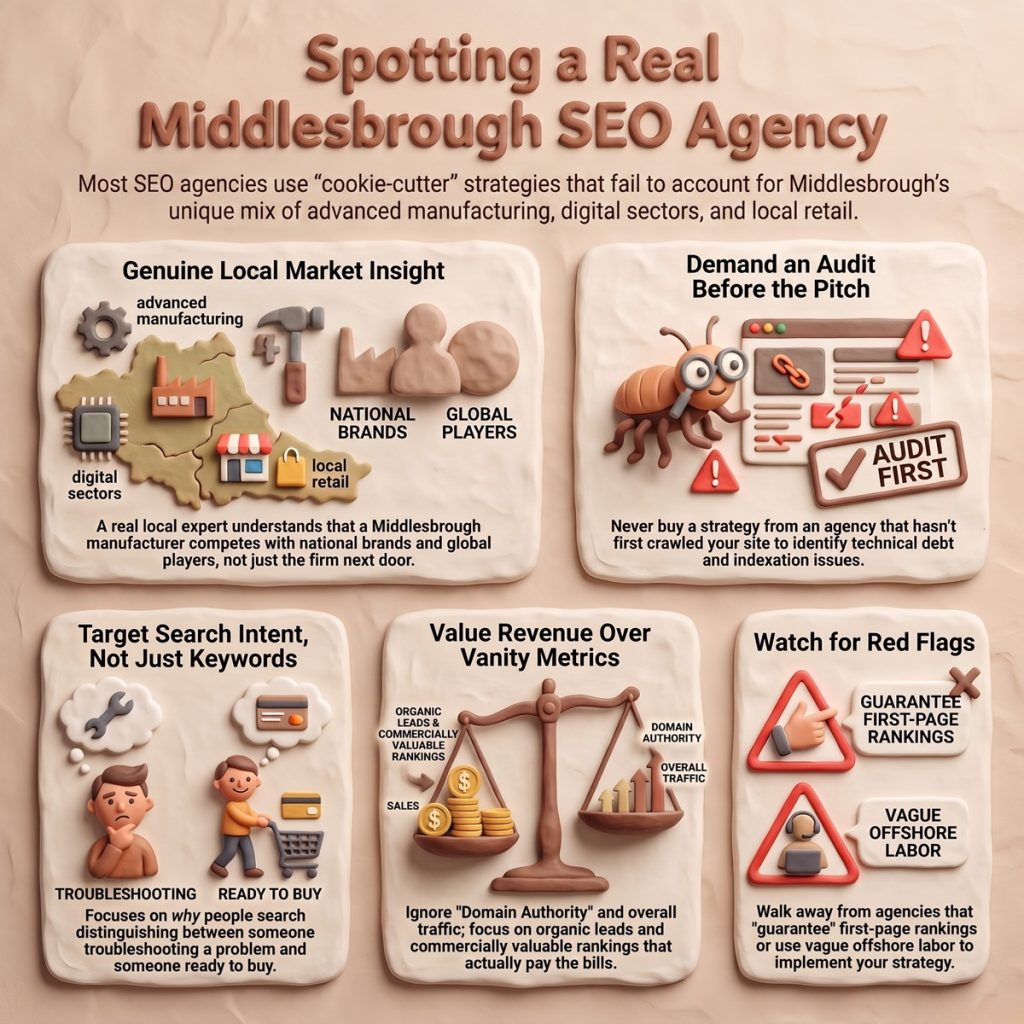
Yet when Middlesbrough businesses start looking for an SEO agency, they typically encounter one of two problems: national agencies that apply cookie-cutter strategies designed for service businesses in Surrey, or local providers who understand the area but lack the technical depth to compete in commercial search results.
Neither wastes your money efficiently.
Here’s how to identify an SEO agency in Middlesbrough, or one working in the area, that combines genuine local market knowledge with the technical competence to deliver measurable results.
What “Understanding Teesside” Actually Means in an SEO Context
When an agency claims to understand the local market, they’re rarely specific about what that means. Here’s what it should look like in practice:
They recognise your actual competitors. If you’re a Middlesbrough solicitor, your competition isn’t just the firm three doors down. You’re competing with national brands buying their way into “solicitor Middlesbrough” searches, comparison sites, and Newcastle firms whose geographic reach overlaps yours. An agency worth paying should identify all three layers without prompting.
They understand Teesside’s economic composition. Middlesbrough isn’t a service economy with some shops bolted on. It’s home to advanced manufacturing, petrochemicals, digital growth sectors, and a substantial public sector workforce. The search behaviour of a process engineer researching industrial suppliers differs fundamentally from someone looking for a plumber. Your agency should adjust keyword intent analysis accordingly.
They know where your customers actually are. Depending on your business, “local” might mean TS postcodes, the broader Tees Valley, or, if you’re in B2B manufacturing, nowhere near Teesside at all. A good agency asks about your actual customer geography before proposing a local SEO strategy. A mediocre one assumes you want to rank for “[service] Middlesbrough” because that’s what local SEO agencies do.
They’ve looked at your search volume reality. “Accountant Middlesbrough” gets roughly 170 searches per month. “Accountant Stockton” gets about 90. If your market is already limited by search volume, an effective agency will tell you that SEO alone won’t deliver your growth targets, and propose a broader digital strategy involving PPC, LinkedIn, or sector-specific directories. An agency chasing retainer fees will sell you six months of SEO anyway.
The Technical Competence Test
Local knowledge matters, but it’s useless without the technical ability to implement strategy. Here’s how to assess whether an agency can actually deliver:
They Audit Before They Pitch
Any agency proposing a strategy without first crawling your site, reviewing your backlink profile, and analysing your current rankings is guessing. A credible technical audit should identify:
- Indexation issues (pages Google can’t or won’t crawl)
- Site speed problems, particularly on mobile
- Duplicate content or cannibalisation (multiple pages competing for the same keywords)
- Technical debt from previous developers or platforms
- Backlinks that are actively harming your rankings
If the pitch deck is full of “content strategy” and “link building” without first diagnosing what’s broken, walk away.
They Talk About Search Intent, Not Just Keywords
Fifteen years ago, SEO was about ranking for keywords. Now it’s about matching search intent.
Someone searching “industrial valves manufacturer” wants supplier options. Someone searching “butterfly valve vs ball valve” is researching product specifications. Someone searching “valve failure causes” is troubleshooting a problem. All three searches might be valuable to a Middlesbrough engineering firm, but they require completely different content and conversion approaches.
An agency that simply proposes “ranking you for your target keywords” hasn’t kept pace with how Google works in 2026.
They Provide Transparent Reporting on What Matters
SEO agencies love reporting metrics that make them look good. Your agency should report on metrics that make you money:
- Revenue or leads from organic search (tracked properly through GA4 or your CRM)
- Rankings for commercially valuable terms, not vanity keywords with no search volume
- Organic traffic to pages that convert, not just overall traffic numbers inflated by blog posts no one reads
If their monthly report focuses on “domain authority” (a metric invented by a software company, not used by Google) or celebrates ranking #1 for a keyword nobody searches for, you’re paying for theatre.
What a Credible Middlesbrough SEO Proposal Contains
When evaluating proposals, look for these elements:
Specific Goals Tied to Your Business Outcomes
Not “improve your organic visibility” or “increase website traffic by 40%”. Instead:
- “Rank in the top three for [specific commercial keyword] within six months, estimated to generate 12-15 qualified enquiries per month based on current conversion rates”
- “Reduce cost per acquisition by 30% by shifting traffic from paid search to organic for [specific product category]”
If the agency can’t translate SEO activity into business outcomes, they either don’t understand your business or don’t want to be held accountable.
A Clear Timeline With Milestones
SEO takes time, but “it takes 6-12 months to see results” is a cop-out. A proper proposal breaks the work into phases:
- Month 1-2: Technical foundation (fix crawl errors, improve site speed, resolve indexation issues)
- Month 3-4: Content gaps filled (targeting medium-competition commercial keywords)
- Month 4-6: Authority building (earning links from relevant industry sources)
- Month 6+: Refinement and expansion based on what’s working
You shouldn’t see meaningful traffic improvements in week two, but you should see technical problems resolved and new content going live. If nothing visible is happening for three months, something’s wrong.
Honest Conversation About Link Building
Links from other websites remain one of Google’s primary ranking signals. But link building in 2026 is nothing like it was a decade ago.
Credible agencies build links through:
- Digital PR (getting your business featured in regional news or industry publications)
- Partnerships and supplier relationships (where they already exist)
- Creating genuinely useful resources other sites want to reference
- Speaking opportunities, industry directories, and trade associations
Agencies to avoid:
- Those offering “50 high DA backlinks per month” (they’re buying links from link farms)
- Those proposing guest posting on irrelevant sites (Google discounts these)
- Those who won’t show you exactly where links will come from
Ask directly: “Show me three examples of links you’ve built for similar clients, and explain how you got them.” The answer tells you everything.
The Middlesbrough-Specific Questions to Ask
Beyond general SEO competence, ask these questions to gauge whether an agency genuinely understands working with Teesside businesses:
“What’s the competitive landscape for my sector in this region?”
They should identify your actual competitors in search results, not just businesses similar to yours. If you’re a Middlesbrough recruitment firm, you’re competing with Indeed, Reed, and national agencies running massive PPC campaigns. Your SEO strategy must account for that reality.
“How do you approach seasonal variation?”
Many Teesside businesses have pronounced seasonality, tourism and hospitality obviously, but also manufacturing with shutdown periods, and professional services with tax-year patterns. Your SEO strategy should anticipate these cycles, not ignore them.
“What’s your experience with businesses at my turnover level?”
A £400k turnover Middlesbrough retailer has different resource constraints than a £12m manufacturing business. The strategies that work for one rarely suit the other. Ask for examples of similar-sized businesses they’ve worked with, ideally in the region.
“If SEO doesn’t deliver the leads I need, what else would you recommend?”
The honest answer might be “your search volume is too low, you need PPC to supplement organic” or “your market doesn’t search, they use trade directories and referrals.” An agency confident enough to recommend beyond their core service is more trustworthy than one insisting SEO solves everything.
Red Flags That Indicate You Should Walk Away
Some warning signs are universal. Others are specific to the Middlesbrough SEO market:
They guarantee first-page rankings. No agency can guarantee rankings. Google’s algorithm isn’t public, and hundreds of factors influence results. Guarantees indicate either dishonesty or incompetence.
They claim to have “special relationships” with Google. They don’t. Nobody does. Google doesn’t offer preferential treatment to agencies.
Their own website doesn’t rank. Check whether they rank for “SEO agency Middlesbrough” or related terms. If they can’t rank their own site in a relatively low-competition market, they’re unlikely to rank yours in a competitive one.
They dodge questions about past client results. Confidentiality is reasonable, client names can be withheld. But if they won’t show you any case studies, even anonymised ones, they probably don’t have results worth showing.
They’re vague about who’ll actually do the work. Some agencies employ skilled strategists who win the business, then offshore implementation to cheap contractors who don’t understand UK search behaviour or write readable English. Ask directly: “Who will be working on my account day-to-day, and can I meet them?”
What Success Actually Looks Like
Before you sign anything, agree on what success means. For most Middlesbrough businesses, it’s one of these:
- Lead generation: Organic search delivers X qualified enquiries per month at a cost per lead lower than PPC
- Revenue growth: Organic traffic converts at Y%, generating £Z additional revenue
- Market share: You rank competitively against specific named competitors for commercially valuable terms
- Cost efficiency: Reduced reliance on paid advertising as organic traffic increases
Notice none of these are “domain authority increased” or “1,000 new visitors per month.” Vanity metrics don’t pay the bills.
Set clear success criteria in your contract. If the agency resists, it’s because they don’t want to be held accountable to outcomes.
The Teesside Advantage When Done Right
When you find an SEO agency that combines technical competence with genuine understanding of the Teesside business environment, the advantage is tangible.
They don’t waste your budget targeting keywords your customers don’t use. They don’t pitch generic content strategies that ignore what actually converts in your market. They understand that a Middlesbrough manufacturer selling globally needs a completely different approach than a Stockton café serving locals.
Most importantly, they treat SEO as part of your broader commercial strategy, not a technical service delivered in isolation.
That’s what separates agencies that deliver measurable ROI from those that deliver monthly reports nobody reads.
Frequently Asked Questions
Q: How much should a Middlesbrough business expect to pay for professional SEO?
A: Credible agency SEO typically costs £800-£2,500+ per month depending on market competitiveness and business size. Anything significantly cheaper usually means offshore labour or corner-cutting. The question isn’t whether you can afford good SEO, it’s whether you can afford ineffective SEO that wastes six months and delivers nothing.
Q: How long before we see results from SEO?
A: Technical improvements and new content should be visible within weeks. Meaningful increases in rankings and traffic typically take 3-6 months, with continued improvement over 12 months. Any agency promising first-page rankings in 30 days is either targeting worthless keywords or using tactics that’ll get you penalised.
Q: Should we hire a Middlesbrough-based agency or is remote fine?
A: Location matters less than capability and market understanding. A London agency that’s worked with Teesside manufacturers will outperform a local agency with no relevant experience. That said, face-to-face meetings and genuine local knowledge do add value, it’s simply not the only factor worth considering.
Q: What’s the difference between SEO and PPC, and which should we prioritise?
A: PPC (paid search ads) delivers immediate traffic but stops when you stop paying. SEO takes months to build but delivers ongoing traffic without per-click costs. Most Middlesbrough businesses benefit from both: PPC for immediate lead generation whilst SEO builds, then gradually shifting budget to organic as rankings improve. The optimal split depends on your market’s search volume and competition.
We’ve spent over 25 years helping UK businesses, including those across Teesside, make SEO investments that actually deliver ROI, not reports that look impressive but change nothing. If you’d like a straightforward audit of where your Middlesbrough business currently stands in search and what it would realistically take to improve it, [get in touch for a free technical SEO audit.