

How to Choose an SEO Agency in Southampton Without Signing a Contract That Delivers Nothing
The worst SEO investment isn’t the one that costs too much. It’s the one that costs six months.
You pay £800 a month. Reports arrive like clockwork. “Rankings improved for 12 keywords” in month three. By month five, you’re asking where the actual enquiries are. By month six, you realise you’ve been sold the same package they sell to every dentist, solicitor, and kitchen fitter on the South Coast.
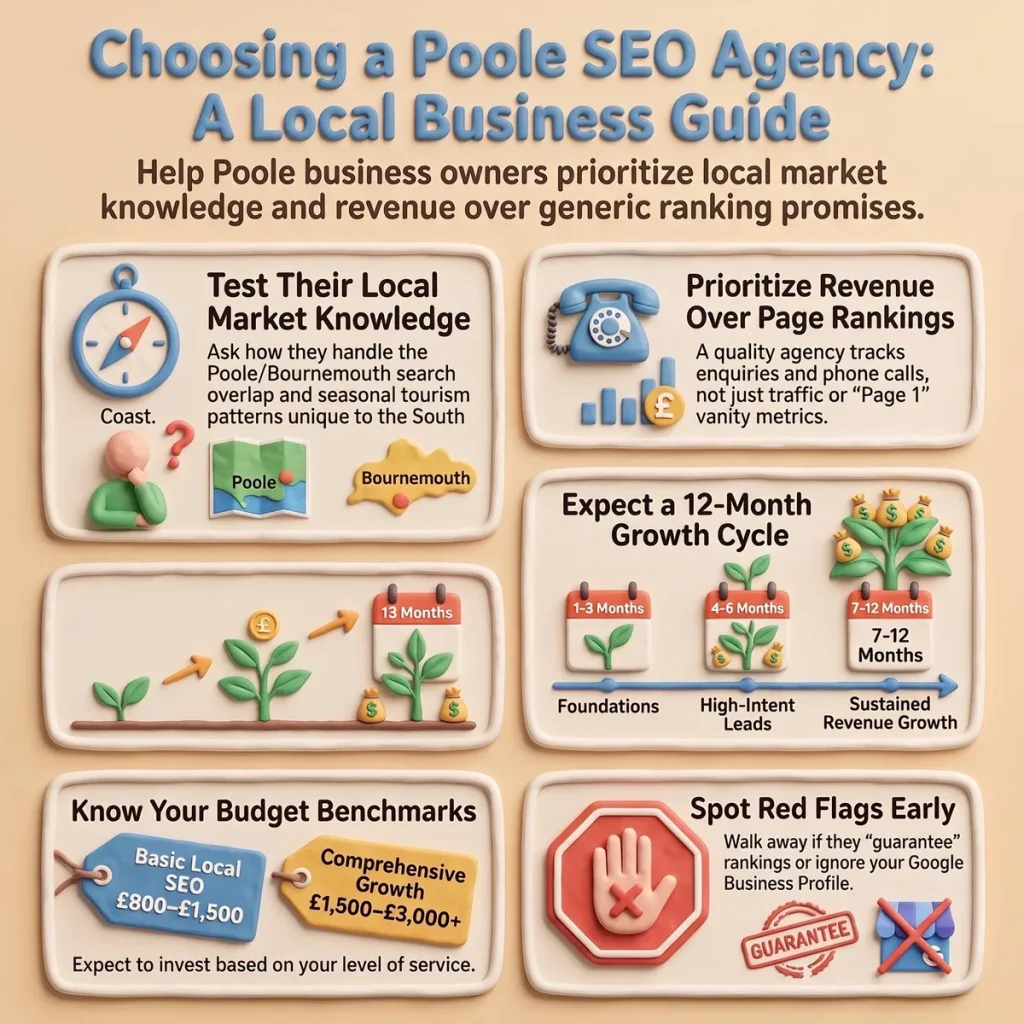
The Southampton SEO market splits cleanly into two groups: agencies doing proper strategic work, and operations running templated campaigns with your logo swapped into the header. The latter outnumber the former about four to one.
If you’ve never bought SEO before, telling them apart from a 30-minute sales call is genuinely difficult. This is your evaluation framework.
What a Proper SEO Audit Actually Reveals
Before any agency touches your site, they should audit it. The audit quality tells you everything about what follows.
A template audit runs your domain through automated tools, exports a PDF with 47 “issues,” and presents them all as equally urgent. Duplicate meta descriptions sit alongside broken pages that haven’t existed since 2019. You’re left thinking your site is catastrophically broken when actually it’s just old.
A proper audit separates signal from noise. It identifies the three or four issues actually costing you traffic, quantifies the opportunity size, and explains why those problems exist in the first place.
Here’s what that looks like in practice:
Template audit finding: “Your site has 23 pages with thin content.”
Strategic audit finding: “Your service area pages for Eastleigh, Fareham, and Totton have 120 words each and no unique value. Competitors ranking positions 1-3 have 800+ words with client case studies, local imagery, and area-specific service variations. These pages currently sit on page 4. Based on search volume (210 monthly searches combined) and your average customer value, ranking positions 2-4 would deliver approximately 15-18 additional enquiries monthly.”
The second version tells you the business impact, the strategic gap, and the realistic outcome. It also takes about five hours longer to produce, which is why most agencies don’t do it.
Ask to see a sample audit before you commit to anything. Not a template, an audit they’ve actually delivered to a client, with company details redacted. If they won’t show you one, that’s your answer.
The Questions That Separate Strategic Thinking from Package Delivery
You’re not an SEO expert. You’re trying to evaluate people who claim to be. That’s a fundamentally difficult position.
These questions reveal whether someone is thinking strategically about your specific business or mentally slotting you into Package B:
“What would you do differently for my business versus the last Southampton client you worked with?”
If they can’t articulate meaningful differences, they’re not tailoring anything. A strategic agency can immediately point to sector differences, competitive landscape variations, or business model nuances that change approach.
“Which keywords would you specifically avoid targeting and why?”
Anyone can list obvious target keywords. Strategic thinking means knowing what not to pursue. An agency that says “we’d go after everything relevant” hasn’t thought about resource allocation, commercial intent, or realistic ranking timelines.
“How would you prioritise the first three months if our budget were cut in half?”
This question forces them to separate essential work from nice-to-haves. A good agency can immediately identify the highest-leverage activities. A package vendor can’t, because the package is the package.
“What would you need from us monthly to make this work?”
SEO requires collaboration. If they say “nothing, we handle everything,” they’re either lying or planning to do surface-level work that doesn’t require business knowledge. Genuine SEO needs product information, customer insight, internal data, and access to people who understand what you actually sell.
What Monthly Accountability Actually Looks Like
Most SEO reporting is designed to look like progress without demonstrating results.
You’ll receive a 12-page PDF. Page one: executive summary with three metrics improving. Pages two through eight: ranking tables showing movement from position 47 to position 41 for keywords you’ve never heard of. Pages nine through eleven: technical work completed. Page twelve: “recommendations for next month.”
None of this tells you whether the investment is working.
Proper accountability answers three questions every month:
1. Are we getting more relevant traffic? Not just “traffic up 8%”, traffic from people actually searching for what we sell, in locations we serve.
2. Are enquiries increasing from organic search? Tracked via phone calls, form submissions, or whatever conversion matters to your business. If they’re not tracking this by month three, they’re not serious about results.
3. What specifically did we do this month and why? Not a list of tasks (“created 4 blog posts, built 12 links”), but strategic decisions with business rationale.
The reporting frequency matters less than the content. Monthly, quarterly, even bimonthly, whatever cadence works. But each report should let you answer: “Is this working, and do I understand why we’re doing what we’re doing?”
If you can’t answer those questions after three months, something’s wrong with the reporting or the work.
The Southampton Context: What Local Actually Means
Every SEO agency claims to understand local markets. Most mean they’ll add “Southampton” to your title tags.
Genuine local SEO for a Southampton business means understanding:
- Competition intensity varies dramatically by sector and area. Legal services SEO in Southampton is a different beast than tradesperson SEO in Eastleigh. Search volumes, competition levels, and user intent shift completely.
- The economic geography of the South Coast changes search behaviour. Someone searching in Hedge End has different intent than someone in Ocean Village. Commuter towns versus residential areas versus the city centre, each needs different content and targeting approaches.
- Local link opportunities require actual local relationships. A London agency subcontracting link building to someone in the Philippines cannot build genuine Southampton business connections. Local SEO at the level that moves rankings requires real presence.
Ask where the agency is based and who specifically will work on your account. “We have people all over” often means nobody is actually in Southampton, and nobody will attend a Chamber event or build a relationship with a local publication.
This matters more than it sounds. Local SEO isn’t just optimisation, it’s embeddedness.
Contract Terms That Protect You Versus Terms That Trap You
Most SEO contracts include a three or six-month minimum term. That’s reasonable, SEO takes time, and agencies need to prevent clients bailing after four weeks when rankings haven’t transformed yet.
But minimum terms should come with defined deliverables and exit clauses tied to performance, not just elapsed time.

Red flag contract terms:
- “Rankings are not guaranteed, and no refunds will be provided under any circumstances.” Correct that rankings can’t be guaranteed, but “no circumstances” means they could do literally nothing and you’d have no recourse.
- “All work product, including content created, remains the property of the agency.” You’re paying for blog posts and page content you can’t keep if you leave? No.
- Automatic renewal clauses without clear cancellation windows. Your six-month contract becomes 12 months because you missed a 60-day cancellation notice buried in paragraph nine.
Protective contract terms:
- Defined deliverables by month. Not “ongoing SEO services” but specific work: technical audit completion by week three, keyword research and strategy by week five, four cornerstone content pieces by month two. Deliverables create accountability.
- Performance review gates. A six-month minimum with a review at month four. If agreed KPIs aren’t trending correctly, either party can exit at month six without penalty.
- Work product ownership. Content created, technical improvements implemented, and documentation produced should transfer to you. You paid for it.
- Transparent reporting access. You should have direct access to Google Analytics and Search Console, not be dependent on the agency’s reporting portal. If they insist on being the gatekeeper to your own data, walk away.
Read the contract. Actually read it. Not the sales deck, the contract. If it’s vague about deliverables or heavy on limitation-of-liability clauses, that tells you what they expect to deliver.
What Genuine Expertise Sounds Like
Expertise has a texture you can feel even if you don’t speak the language.
An expert can explain complex ideas simply without being condescending. They acknowledge uncertainty where it exists, “rankings could move in 8-12 weeks, but it depends on how quickly we can execute the content plan and how Google responds.”
They ask questions about your business before proposing solutions. Not just “what are your goals” but specific operational questions: How do you currently get customers? What’s your average customer value? What capacity do you have to fulfil additional enquiries? Who are your actual competitors, not who you think they are, but who ranks above you?
They can cite specific examples from similar work without revealing client identities. “We worked with a Southampton-based professional services firm last year, similar size to you, competitive market. First six months focused exclusively on technical foundations and content depth. Enquiries increased 34% between month six and month twelve.” That level of specificity comes from doing the work, not selling packages.
And they say no to things. “That keyword is too competitive for your current domain authority, we’d be wasting budget trying to rank for that in the first twelve months. Here’s what we’d pursue instead.” Agencies that promise everything deliver nothing.
The Price Question: What Should Southampton SEO Actually Cost?
Pricing varies wildly, and expensive doesn’t guarantee quality. But implausibly cheap guarantees mediocrity.
Proper SEO requires skilled time: technical auditing, strategic analysis, content creation, outreach for links, monthly reporting and adjustment. That time costs money.
If an agency quotes £300-400 monthly for comprehensive SEO, the maths doesn’t work. At that price, they’re allocating perhaps 4-5 hours monthly to your account. That covers basic reporting and minor updates. Nothing strategic happens in five hours.
Realistic pricing for meaningful SEO work:
- £800-1,200 monthly for a small local business with limited competition. One person spending 8-12 hours monthly on strategy, content, and optimisation.
- £1,500-2,500 monthly for a competitive local market or a business targeting multiple service areas across the South Coast. Requires more content production, link building, and strategic complexity.
- £3,000+ monthly for highly competitive sectors (legal, medical, finance) or businesses with significant existing web presence needing comprehensive optimisation.
These are indicative, not absolute. But if someone quotes £500 monthly for competitive Southampton legal services SEO, they’re either incompetent or lying about what they’ll actually do.
Ask for a specific breakdown: how many hours monthly, who’s doing the work, what exactly those hours cover. Vague answers to that question tell you everything.
Before You Sign Anything
The right agency feels like a business partner, not a vendor. You should finish the sales conversation understanding your own situation better than when you started.
If you leave a sales meeting more confused, that’s by design. Confusion creates dependency.
If you leave with a clearer picture of what’s actually wrong, what’s realistic to achieve, and what it requires from both parties, even if it sounds difficult, that’s the beginning of something useful.
Most business owners don’t get this decision right the first time. The market is deliberately opaque, and expertise is hard to evaluate from outside. But the evaluation framework above will substantially improve your odds.
Frequently Asked Questions
Q: How long before we should see actual business results from SEO?
A: Meaningful traffic increases typically appear in months 3-5 for less competitive keywords, with enquiry increases following 4-8 weeks later as rankings stabilise. Highly competitive terms can take 8-12 months. Anyone promising page-one rankings in 30 days is selling something that doesn’t exist.
Q: Should a Southampton business only work with Southampton-based agencies?
A: Not necessarily, but local presence helps significantly for genuine local SEO work, building regional links, understanding the competitive landscape, and creating locally-relevant content. A London agency can do technical SEO remotely, but the local component suffers without actual presence.
Q: What happens to our rankings if we stop paying for SEO?
A: Rankings don’t disappear immediately, but they’ll gradually decline as competitors continue optimising and your content ages without updates. Technical improvements and content you’ve created remain, but the ongoing work that maintains and improves rankings stops. It’s not a subscription where everything vanishes, but momentum dies.
Q: Can we do SEO ourselves instead of hiring an agency?
A: Technically yes, practically difficult. Basic SEO, proper page titles, decent content, mobile functionality, is absolutely manageable in-house. Competitive SEO requiring technical auditing, strategic link building, and continuous content requires both expertise and time most business owners don’t have. Depends entirely on your market and capacity.
Q: How do we know if poor SEO results are the agency’s fault or just difficult keywords?
A: A good agency sets realistic expectations upfront about difficulty and timelines, then reports monthly against those expectations with explanations for variances. If they promised page one in three months and you’re on page four at month six with no clear explanation of what’s not working and why, that’s an agency problem.
If you’re evaluating Southampton SEO agencies and want an honest technical audit before you commit to anything, we’ll spend an hour with your site and give you a frank assessment of what’s actually wrong and what it would realistically take to fix it. No obligation, no sales deck, just straight information. [Get in touch](https://www.thickrope.com/contact) and we’ll arrange it.