

Why Bournemouth SEO Demands a Quarterly Strategy Reset (And Most Local Businesses Miss It)
If you’re running a business in Bournemouth and your SEO strategy looks the same in February as it does in July, you’re leaving revenue on the table every single quarter.
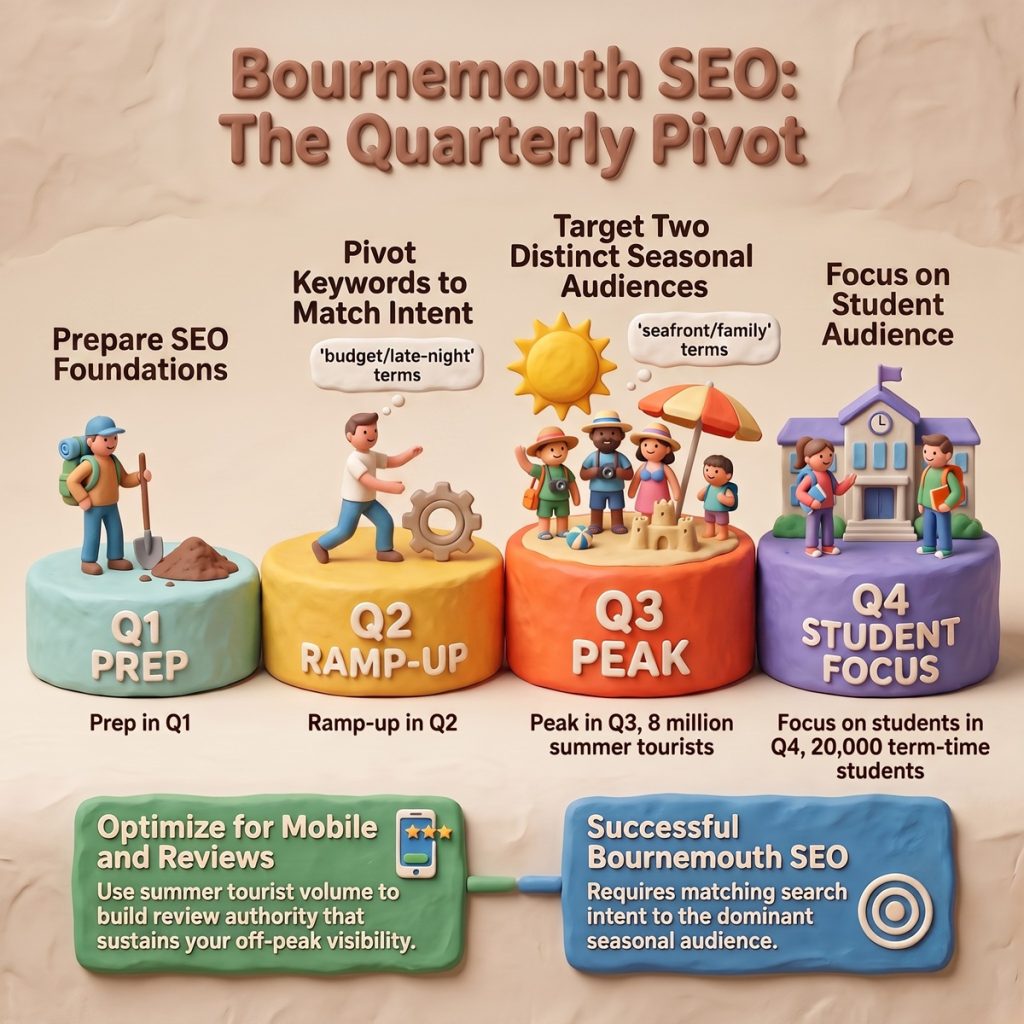
Bournemouth isn’t a typical market town with steady year-round search patterns. You’re operating in a coastal economy with two distinct, seasonally rotating audiences: roughly 20,000 students driving year-round local search in specific categories, and a tourism economy that swells to over 8 million visitor days annually between May and September. These two audiences search differently, buy differently, and transform the competitive landscape for local businesses depending on which quarter you’re in.
Most SEO agencies treat seasonality as a simple summer peak. In Bournemouth, it’s more nuanced than that. Your search visibility strategy needs to account for which dominant audience is actually in town, what they’re searching for, and how local competition shifts around them.
Here’s what that looks like in practice.
The Student Economy: September to June Search Patterns
When Bournemouth and Poole’s universities return in late September, you’re adding approximately 20,000 students to the local search landscape. That’s not just volume, it’s a complete shift in search intent across multiple business categories.
What changes:
Student accommodation searches spike from July through September, but the downstream effect lasts all academic year. From October onwards, search volume increases significantly for: student lettings and housing queries, budget restaurants and takeaways (particularly late-night options), part-time job opportunities, entertainment and nightlife, budget gyms and fitness classes, repair services (phones, laptops, bicycles), and printing and stationery services.
If you’re a restaurant in the Triangle or Westbourne, your October-to-May SEO strategy should be fundamentally different from your summer approach. Students search for “cheap eats Bournemouth,” “late night food Bournemouth,” and “student discount restaurants”, not “best seafood restaurant Bournemouth seafront” or “family-friendly dining Bournemouth.”
The commercial implications: businesses that optimise for student-related long-tail keywords during academic term see consistently lower cost-per-click in paid search (students are a less competitive audience than tourists) and higher conversion rates because you’re matching actual local demand rather than competing for tourist traffic you can’t convert in February.
The visibility gap most businesses miss:
Local services, particularly trades, repairs, and anything students need when they’re setting up a house share, see a predictable spike in “near me” and “open now” searches from late September through October. If your Google Business Profile isn’t optimised with student-friendly signals (budget options, late hours, student discounts), you’re invisible to this audience even if you rank well for general keywords.
The Tourism Surge: May to September Competitive Reset
Between May and September, Bournemouth’s search landscape transforms completely. You’re now competing for visibility in a market where tourism-related searches dominate, competition intensifies dramatically, and the businesses ranking in local pack results can change almost overnight.
What the data shows:
Searches for “things to do Bournemouth,” “Bournemouth beach,” “hotels Bournemouth,” and “restaurants near Bournemouth pier” increase by 300-400% during peak summer months. That volume attracts national chains, booking platforms, and aggregator sites with substantially larger SEO budgets than most independent Bournemouth businesses.
If you’re an independent café, boutique hotel, or activity provider, your February ranking position for “Bournemouth restaurants” is almost irrelevant come July. The SERPs are now dominated by TripAdvisor, Booking.com, and national restaurant chains with vastly more domain authority.
The strategic response:
Seasonal businesses that understand Bournemouth’s tourism economy don’t try to outrank national platforms for broad keywords during summer. Instead, they:
Go hyper-local with location-specific content. “Restaurants in Southbourne” or “things to do Boscombe” face less national competition than generic “Bournemouth” terms. Tourists searching these phrases are already in that specific area or have done enough research to know Bournemouth’s distinct neighbourhoods.
Optimise aggressively for “near me” and mobile search. Tourism search is overwhelmingly mobile and intent-driven. A visitor standing on Bournemouth pier searching “coffee near me” is a substantially easier conversion than someone researching “best cafes Bournemouth” three weeks before their holiday (who will likely click a listicle or TripAdvisor ranking).
Capture review volume during peak season to sustain off-peak visibility. Google’s local pack algorithm weighs review recency and volume heavily. Businesses that systematically request reviews from summer tourists build authority that carries them through the quieter student-focused months.
The Shoulder Seasons: April and September Strategy Windows
April and September represent transition periods where both audiences overlap, students are still in residence, but early/late tourists are beginning to search and visit. These months are strategically crucial because search competition hasn’t peaked, but volume is rising.
If you’re going to invest in new content, technical SEO improvements, or local link building, do it in March-April or September-October. You want those ranking improvements to settle before peak competition arrives.
Category-Specific Examples: Who Needs to Shift and When
Restaurants and cafés:
- October-May: Optimise for student budget keywords, late-night opening, delivery options
- May-September: Focus on family-friendly, seafront location, outdoor seating, tourist review generation
- Year-round: Maintain separate landing pages for both audiences
Retail (particularly clothing, gifts, beachwear):
- Tourism peak drives the majority of annual revenue but creates unsustainable competition for generic keywords
- Better ROI from hyper-local terms (“Boscombe vintage shops”) and shopping-adjacent content (“what to wear Bournemouth beach”)
- Student audience wants charity shops, budget fashion, textbook resale, completely different keyword universe
Activities and leisure businesses:
- Summer tourism competition is brutal for water sports, boat trips, adventure activities
- Winning strategy: own the pre-season research phase (February-April content and link building) so you’re ranking when tourists start planning
- Student market often overlooked: fitness classes, climbing walls, budget entertainment need year-round local visibility
Professional services (accountants, solicitors, marketing agencies):
- Your audience doesn’t shift seasonally, but your local competition does
- Summer months when hospitality businesses are fighting for tourist visibility represent opportunity to dominate B2B service keywords
- Student-facing services (landlord specialists, tenant legal advice) need September visibility
Trades and home services:
- Student lettings turnover (July-September) creates predictable demand spikes for cleaning, maintenance, furniture assembly
- Tourist season means holiday let turnovers and property maintenance, different commercial intent
- Year-round local visibility matters more than seasonal peaks, but timing content and paid campaigns to these demand cycles improves ROI substantially
What Bournemouth Businesses Should Actually Do Quarterly
This isn’t about rebuilding your website four times a year. It’s about strategic emphasis shifts that take a few hours per quarter but align your visibility with actual local demand.
Q1 (January-March): Pre-season preparation
- Audit and update tourism-facing content before competition heats up
- Build local links and citations while competitor attention is elsewhere
- Refresh Google Business Profile photos, posts, and summer service offerings
- Create or update location-specific landing pages for Bournemouth neighbourhoods
Q2 (April-June): Tourism ramp-up
- Shift paid search budget toward tourism keywords as competition increases
- Intensify review generation from early-season visitors
- Publish timely content (events, seasonal activities, “visiting Bournemouth” guides)
- Monitor local pack rankings weekly, make adjustments before peak season
Q3 (July-September): Peak tourism and student return
- Maximise review capture from tourist volume
- Launch student-focused content and offers from mid-August
- Adjust Google Business Profile attributes for student audience (budget-friendly, student discount)
- Prepare autumn-winter content pipeline
Q4 (October-December): Student-focused local search
- Shift keyword emphasis to student-related terms and local residential audience
- Reduce budget on tourism keywords where competition remains high but local intent drops
- Focus on review responses and reputation management
- Plan Q1 technical SEO improvements and content strategy
The ROI Reality: What This Actually Costs vs What You Gain
Shifting SEO strategy quarterly sounds resource-intensive. In practice, most of this is front-loaded work, creating the infrastructure (separate landing pages, content for both audiences, systematic review processes) takes time initially. Quarterly adjustments are primarily about emphasis, budget reallocation, and tactical content updates.
A typical Bournemouth business working with an agency on this approach might invest:
- Initial setup (audience research, site structure, content creation): 15-25 hours of agency time
- Quarterly strategy adjustments: 3-5 hours per quarter
- Ongoing content and optimisation: 4-8 hours monthly
Compare that to the cost of ranking well for generic “Bournemouth” keywords during summer (when you’re competing against national platforms with unlimited budgets) or running a static SEO strategy that ranks you for tourist keywords when students are your actual audience.
The businesses we’ve worked with that implement seasonally intelligent SEO in Bournemouth typically see 20-40% improvement in conversion rate from organic traffic (because you’re actually matching search intent to real local demand) and 15-25% reduction in overall SEO and paid search costs (because you’re not fighting unwinnable battles during peak competition periods).
The Mistake That Costs Bournemouth Businesses Most
The single most expensive error: optimising for the audience that’s easiest to rank for rather than the audience that’s actually present and searching in your category right now.
A Boscombe café owner once told me they’d spent £8,000 on SEO to rank for “best breakfast Bournemouth.” They got to position 5. During summer, that ranking generated traffic, mostly tourists who’d click through to TripAdvisor before deciding. Conversion rate was poor. During term time, students weren’t searching “best breakfast”, they were searching “cheap breakfast Bournemouth” and “student breakfast deals.” The café didn’t rank for those terms at all.
When they shifted strategy to match actual quarterly demand, student-focused keywords October through May, tourist-focused May through September, with separate landing pages for each audience, their organic traffic conversion rate doubled and their dependency on paid search dropped by 60%.
That’s the difference between generic local SEO and strategy that understands Bournemouth’s specific dual-audience dynamic.
Frequently Asked Questions
Q: Should Bournemouth businesses run separate websites for students versus tourists?
A: No, separate websites split your domain authority and create unnecessary management overhead. Instead, create distinct landing pages or sections targeting each audience, with appropriate internal linking. Your main site builds authority over time; fragmenting it across multiple domains weakens that considerably.
Q: Does this seasonal approach work for businesses that serve both locals and visitors year-round?
A: Absolutely. Most Bournemouth businesses have a year-round local customer base plus seasonal visitors. The strategy is about emphasis and budget allocation, not abandoning one audience completely. You maintain baseline visibility for core services whilst shifting content, paid search budget, and Google Business Profile messaging toward whichever seasonal audience dominates your category at that time.
Q: How quickly can I expect to see results from a seasonally adjusted SEO strategy?
A: Content and on-page optimisation changes can impact rankings within 4-8 weeks, which is why you start preparing each season 6-8 weeks in advance. Local pack visibility can shift faster, sometimes within days if you’re optimising Google Business Profile attributes and generating fresh reviews. The biggest gains come in your second year when you’ve built the infrastructure and are refining rather than building from scratch.
Q: What if my competitors aren’t doing this, do I really need quarterly strategy shifts?
A: If your competitors aren’t adjusting for Bournemouth’s seasonal audience shifts, that’s your opportunity. You’ll rank for high-intent student keywords when they’re optimised for absent tourists, and you’ll have built authority for tourist terms before summer competition peaks. Most Bournemouth businesses run static SEO strategies because their agencies don’t understand the local market dynamics, that creates a visibility gap you can own.
If your current SEO strategy doesn’t account for which audience is actually searching in Bournemouth right now, we should talk. We’ve spent over 25 years watching how coastal and university markets work, book a consultation and we’ll audit where your visibility gaps are quarter by quarter.