

Bournemouth’s Growing Digital Economy Is Creating Real SEO Opportunities, But Only for Businesses That Move Before the Market Catches Up
Bournemouth isn’t just deckchairs and tourism anymore. Over the past five years, the town has quietly built a legitimate digital and creative economy that sits alongside its traditional hospitality base, and if you’re running a business in tech, professional services, or the creative industries here, you’re competing in a search landscape that looks very different now than it will in 18 months.
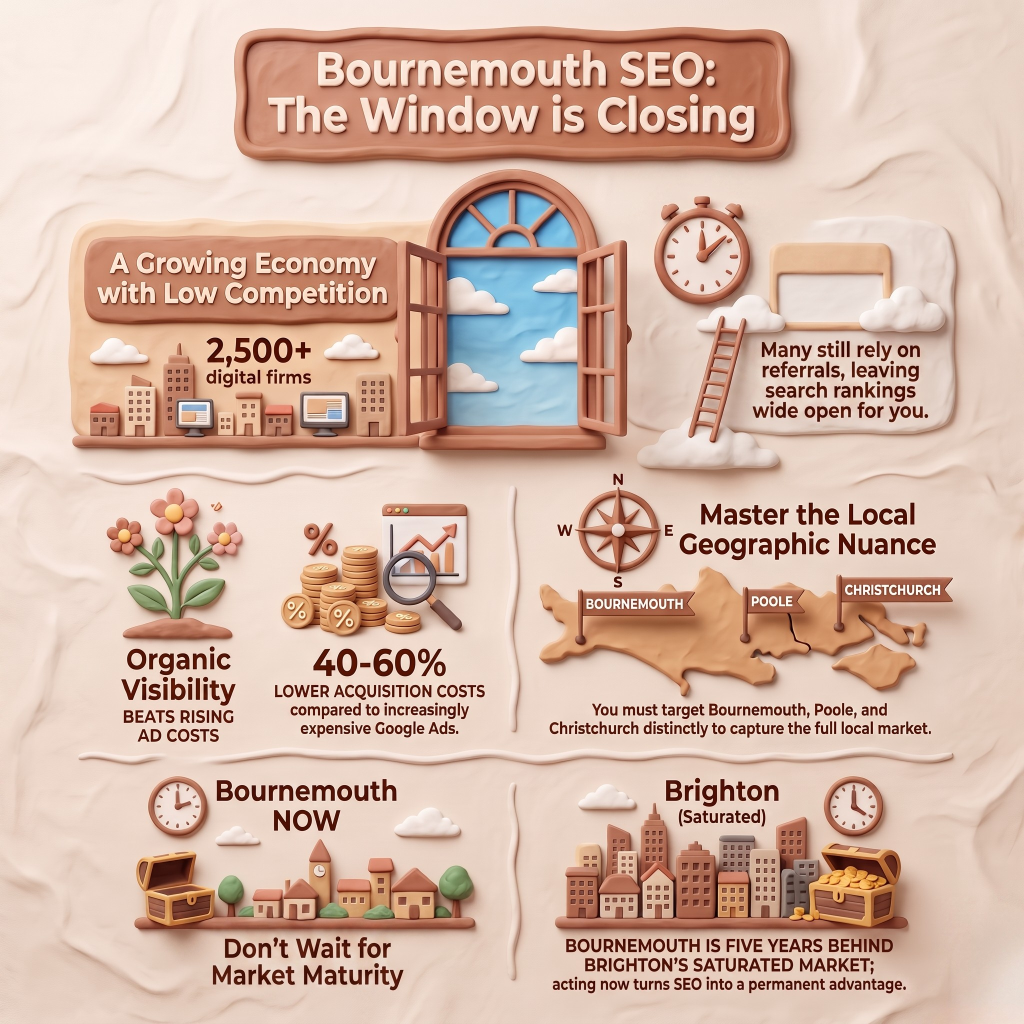
This isn’t about manufactured urgency. It’s about recognising where Bournemouth sits in its digital maturity curve, and what that means for businesses trying to establish search visibility before the competitive window narrows.
What’s Actually Happening in Bournemouth’s Digital Economy
The statistics tell part of the story. Bournemouth, Christchurch and Poole (BCP) now supports over 2,500 digital and creative businesses. The sector employs roughly 15,000 people locally. That’s not London scale, but it’s substantial enough to have changed the competitive dynamics for local search completely.
Walk through the town centre or the business districts around Lansdowne and you’ll see it: software houses, design agencies, IT consultancies, finance and legal firms that didn’t exist here a decade ago. Many are competing for the same search terms, the same client base, the same slice of local and regional visibility.
But here’s what matters from an SEO perspective: most of them still aren’t investing seriously in organic search. They’re relying on referrals, paid ads, or outdated websites built five years ago when competition was thinner. That creates a window, one that closes a bit more every quarter as digital literacy improves and budgets shift.
Why the Current Competitive Window Won’t Last
If you search for most commercial service terms in Bournemouth right now, “IT support Bournemouth,” “branding agency Bournemouth,” “chartered accountant Bournemouth”, you’ll find a mixed bag. A few businesses dominating page one, often for years. Then a scattering of directory listings, outdated sites, and businesses that clearly aren’t investing in content or technical SEO.
That’s the window. It exists because digital adoption in Bournemouth’s SME base has been uneven. Tourism and hospitality businesses moved online early out of necessity, TripAdvisor and booking platforms forced their hand. But professional services, B2B tech firms, and creative agencies often built a website once and left it.
The shift is happening now because:
Younger decision-makers expect to find you in search. The business owners and procurement managers in their 30s and 40s don’t use directories or wait for referrals the way previous generations did. They Google the service, scan page one, and shortlist from there.
Bournemouth’s business base is professionalising rapidly. As the digital economy matures, so does the competition. Businesses that could survive on word-of-mouth five years ago are now tendering for larger contracts, competing regionally, and realising that invisibility in search costs them opportunities.
Paid advertising costs are rising whilst organic visibility compounds. Google Ads works, but the cost per click for commercial terms in Bournemouth has steadily climbed. A well-optimised site that ranks organically doesn’t have that recurring cost, and the gap in cost-per-acquisition widens every year.
What “Expert SEO” Actually Means in a Market Like Bournemouth
Bournemouth isn’t London. You’re not competing against venture-backed startups with six-figure marketing budgets. But you are competing in a market where local knowledge, sector-specific optimisation, and consistent execution matter more than flashy tactics.
An SEO expert working in Bournemouth should understand:
The geography is weirdly complex. Bournemouth, Poole, and Christchurch merged administratively, but search behaviour hasn’t caught up. People still search “Poole,” “Christchurch,” and “Bournemouth” distinctly. Your content and local SEO structure needs to reflect that, or you’ll lose a third of your addressable market.
Local and regional blend awkwardly. Some Bournemouth businesses serve purely local clients. Others, particularly in tech and professional services co,mpete across Dorset, Hampshire, and into the Southwest. Your keyword strategy has to account for both without diluting focus.
Sector nuance trumps generic tactics. A hospitality business in Bournemouth has different search dynamics than a SaaS firm or a law practice. User intent, content depth, and conversion paths vary wildly. Cookie-cutter SEO doesn’t cut it.
Technical fundamentals are still neglected. A shocking number of Bournemouth business websites still have slow load times, poor mobile performance, or basic indexing issues. Fixing these isn’t glamorous, but it’s often the difference between page two and page one.
The Actual Opportunity Right Now
If you’re a business outside the saturated tourism and hospitality sectors, this is what the opportunity looks like in practical terms:
You can still rank for commercially valuable terms without spending a fortune. In more mature markets, Brighton, Bristol, Cambridge, the top-ranking businesses have been investing in SEO for years. Bournemouth’s emerging sectors haven’t reached that point yet. A focused six-month campaign can still move the needle significantly.
Content gaps are everywhere. Most Bournemouth businesses in professional services and tech have thin, generic website content. If you actually answer the questions your prospects are asking, with depth, local relevance, and evidence, you’ll outrank competitors who’ve been coasting on domain age alone.
Google Business Profile optimisation is shockingly underutilised. Even businesses that understand SEO often neglect their Google Business Profile. In Bournemouth’s competitive landscape, a well-optimised profile with regular posts, reviews, and accurate categories can be worth 30-40% of your local visibility.
Backlink profiles are weak across the board. Bournemouth has a growing network of business groups, local media, industry blogs, and partnership opportunities. Businesses that systematically build local and industry-relevant backlinks face far less competition than they would in London or Manchester.
What Happens If You Wait
The risk isn’t that you’ll never be able to rank. It’s that the cost, in time, budget, and competitive intensity, rises sharply once the market matures.
Look at what happened in Brighton’s digital sector between 2015 and 2020. As the creative and tech economy there grew, SEO investment became table stakes. Businesses that established visibility early compounded their advantage. Those that waited found themselves competing against entrenched competitors with years of content, backlinks, and authority.
Bournemouth is roughly five years behind that curve. The window exists because the market hasn’t fully caught up to its own growth. But digital adoption accelerates, it doesn’t plateau.
Every quarter you delay, you’re competing against:
- More businesses that have started investing in SEO
- Competitors whose content and authority have had more time to compound
- Rising costs as agencies and consultants respond to increased demand
- A narrowing gap in search visibility that gets harder to close
What Moving Now Actually Looks Like
This isn’t about panic. It’s about pragmatism.
If you’re a Bournemouth business in the digital, professional services, or creative sectors, moving now means:
Starting with a proper technical and competitive audit. Understand where your site actually stands, not where you think it stands. What’s broken, what’s missing, and what quick wins exist.
Building a local and sector-specific content strategy. Not blog posts for the sake of it, but content that directly addresses what your prospects are searching for and positions you as the obvious local choice.
Systematically fixing the technical foundations. Site speed, mobile performance, proper schema markup, clean site architecture. These aren’t optional extras, they’re the price of entry.
Treating SEO as a 12-month minimum commitment. You won’t rank for competitive terms in six weeks. But 12 months of consistent, expert execution in Bournemouth’s current market can establish visibility that competitors will struggle to displace.
Why Local Expertise Matters More Than You’d Think

You could hire an SEO agency in London or an offshore firm offering cut-rate packages. Some businesses do. But Bournemouth’s specific market dynamics, the geographic quirks, the sectoral mix, the blend of local and regional competition, get missed by agencies treating it as just another postcode.
An SEO expert who understands Bournemouth knows which local citations actually matter, which media outlets and business networks provide valuable backlinks, and how to position your business in a market that’s transitioning from tourism-dominated to digitally diverse.
They also understand the seasonal rhythms. Bournemouth’s economy still has strong seasonal swings tied to tourism, which affects everything from search volume to competitor activity. Your SEO strategy needs to account for that, pushing hard in Q4 and Q1 when commercial search intent peaks, adjusting in summer when the town’s focus shifts.
The Honest Assessment
If you’re a hospitality or tourism business in Bournemouth, you’re competing in a mature, saturated search market. The window closed years ago. You can still win, but it requires serious investment and a long-term view.
If you’re in the emerging digital, tech, professional services, or creative sectors, you’re competing in a market that’s growing fast but hasn’t fully matured. The businesses that establish strong organic visibility now, whilst competition is still manageable and costs are still reasonable, will compound that advantage for years.
The window won’t stay open. Not because of some artificial deadline, but because digital adoption accelerates and competitors eventually catch up. The question is whether you establish visibility whilst it’s still a competitive advantage, or wait until it becomes a cost of survival.
Frequently Asked Questions
Q: How long does it realistically take to rank for commercial terms in Bournemouth?
A: For moderately competitive commercial terms, “accountant Bournemouth,” “web design Bournemouth”, you’re looking at 6-12 months with consistent, expert execution. Less competitive long-tail variations can rank faster, often within 3-4 months. Claims of instant results are fiction.
Q: Is it worth investing in SEO if I’m already running Google Ads successfully?
A: Yes, because the economics are fundamentally different. Ads stop the moment you stop paying; organic rankings compound over time. A business ranking organically for its core terms typically sees cost-per-acquisition drop by 40-60% compared to relying solely on paid traffic. They’re not either/or, they’re strongest together.
Q: Can I do SEO myself or do I genuinely need an expert in Bournemouth?
A: You can handle some elements yourself, basic content updates, Google Business Profile management, fixing obvious technical issues. But competitive commercial SEO requires expertise in technical optimisation, strategic content, backlink development, and ongoing algorithm adaptation. Most business owners’ time is better spent running their business whilst an expert handles search visibility.
Q: What should I actually expect to invest for serious SEO in Bournemouth?
A: For a credible campaign that moves the needle on commercial terms, you’re looking at £800-£1,500 per month minimum, typically on a 12-month commitment. One-off projects exist but rarely deliver lasting results. Anything substantially cheaper usually means offshore labor, automated tools, or junior staff learning on your budget.
Q: How do I know if an SEO expert actually understands Bournemouth’s market?
A: Ask specific questions about local search dynamics, how they’d handle the Bournemouth/Poole/Christchurch geographic complexity, which local citation sources they prioritise, how they’d approach seasonal variations in search volume. Generic answers mean generic execution. Also ask for case studies from similar markets, not just big-city clients.
If you’re a Bournemouth business in the digital, professional services, or creative sectors and you’re ready to establish search visibility before the competitive window narrows further, we offer a no-obligation technical and competitive audit that shows exactly where you stand and what the opportunity actually looks like. Book a conversation with our team at [Thickrope Marketing](https://thickrope.com), we’ve been doing this for over 25 years, and we’ll tell you straight whether SEO makes commercial sense for your business right now.