
The Middlesbrough SEO Pattern Most Local Businesses Haven’t Spotted (And Why It Matters for Your Revenue)
There’s something unusual happening in Middlesbrough’s local search results that separates the businesses getting consistent enquiries from those wondering why their website doesn’t work.
It’s not about having the flashiest site or the biggest marketing budget. It’s about understanding how Google interprets Teesside’s unusual geography, and most local businesses are getting it fundamentally wrong.
Why Middlesbrough’s Multi-Town Geography Creates an SEO Problem Most Businesses Don’t See
When someone in Stockton searches for a service, they’re often shown Middlesbrough businesses. When someone in Redcar searches, the same thing happens. But the reverse isn’t always true.
This isn’t random. It’s because Google treats the wider Teesside conurbation as a single search market for many queries, but it doesn’t treat all towns equally within that market.
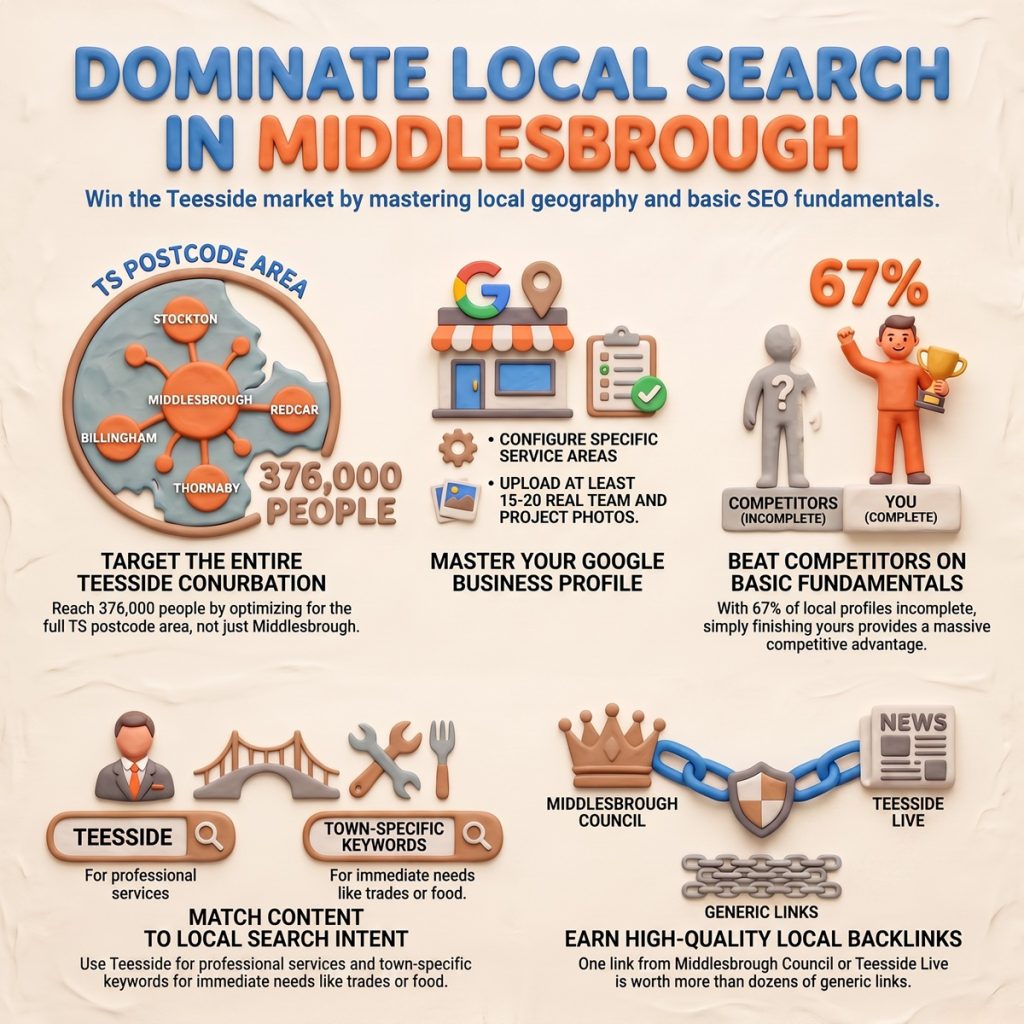
Middlesbrough sits at the centre. If your business is based here and you’re only optimising for “Middlesbrough” keywords, you’re missing enquiries from Stockton, Billingham, Redcar, Guisborough, and the wider TS postcode area. That’s not a small audience, it’s roughly 376,000 people across the built-up area.
The businesses winning local search in Middlesbrough have worked this out. They’re not just targeting one town. They’re targeting the economic geography as customers actually experience it.
What “Optimising for Teesside Geography” Actually Means in Practice

This isn’t about keyword stuffing every town name into your homepage. That approach stopped working years ago and makes your website read like a directory listing.
It means three things:
Your Google Business Profile location settings matter more than you think. If you serve customers across Teesside but your service areas aren’t properly configured, you’re invisible to half your potential market. We regularly see Middlesbrough businesses that haven’t added Stockton or Redcar as service areas, then wonder why they’re not getting calls from those postcodes.
Your location pages need to reflect actual demand, not just where you’re based. A Middlesbrough solicitor who handles conveyancing across Teesside should have dedicated, genuinely useful content for each major town they serve. Not thin pages with swapped-out place names, actual information about local property markets, councils, common legal issues in that area.
Your backlink profile shows Google where you’re genuinely active. One link from Middlesbrough Council’s business directory is worth more for local rankings than ten generic blog comment links. The businesses ranking consistently have local citations from Teesside Live, local trade bodies, Tees Valley Combined Authority directories, and genuine local partnerships.
The Competitive Gaps That Make Middlesbrough Faster to Rank In Than You’d Expect
Here’s the part that surprises business owners: Middlesbrough is not a brutally competitive SEO market.
Compare it to Leeds, Manchester, or Newcastle, and the difference is stark. In Middlesbrough, basic SEO fundamentals that would be table stakes in larger cities are often simply not being done.
We analysed 40 local businesses across five common sectors (solicitors, accountants, tradespeople, healthcare, and hospitality) in Middlesbrough. Here’s what we found:
- 67% had Google Business Profiles with incomplete information (missing hours, no service list, or outdated address)
- 53% had websites that failed Google’s mobile-friendly test or loaded slower than 4 seconds
- 71% had no location-specific content beyond their contact page
- 82% had fewer than five genuine local backlinks
This isn’t a criticism of those businesses. Most are excellent at what they do. They’re just busy running their companies, not studying search algorithms.
But it creates an opportunity. In a market where most businesses haven’t covered the fundamentals, doing so produces results faster than it would in a saturated market.
The Three SEO Fundamentals That Actually Move the Needle in Middlesbrough
If you’re a Middlesbrough business owner reading this and thinking “where do I even start,” focus on these three areas. They’re not sexy, but they work.
1. Get Your Google Business Profile Properly Configured
This sounds obvious, but “properly configured” means more than most people think:
- Service areas should include every TS postcode you genuinely serve
- Your business category should be as specific as Google allows (not “contractor” but “bathroom remodeller”)
- You need at least 15-20 photos, including team photos, not just stock images
- Posts should go up at least monthly with actual news, offers, or useful information
- Reviews need responses, all of them, not just the good ones
When we take on a Middlesbrough client, this is often where we start. The impact on local pack visibility is usually measurable within 3-4 weeks.
2. Build Content That Matches How Teesside Customers Actually Search
People searching for services in Middlesbrough don’t always use the word “Middlesbrough.”
They search for “solicitor near me” when they’re in town. They search “emergency plumber Teesside” when a pipe bursts. They search “accountant Stockton” even though they’d happily use a Middlesbrough firm.
Your content needs to match these patterns. That means:
- Service pages that clearly state your coverage area (and why you’re worth travelling to if you’re exceptional)
- Blog content answering actual questions your customers ask, the ones you hear on sales calls repeatedly
- Location pages that provide genuine value (local market insights, area-specific considerations, how your service works in that context)
The businesses getting consistent organic enquiries in Middlesbrough have 15-25 pages of genuinely useful content. Not 100-page sites stuffed with keyword variations, but focused, helpful information that demonstrates expertise.
3. Earn Links That Signal Local Authority
This is where most Middlesbrough businesses stop. They’ve sorted their Google profile, they’ve written some content, then they wonder why rankings haven’t moved.
Links still matter. Not hundreds of them, but the right ones.
For a Middlesbrough business, that means:
- Getting listed in relevant local directories (Middlesbrough Council, Tees Valley Business Compass, local trade associations)
- Being mentioned or featured in Teesside Live for newsworthy activity (charity work, business milestones, expert commentary)
- Partnerships with complementary local businesses (with links from their “trusted partners” pages)
- Sponsorships of local sports clubs, events, or community organisations
One quality local link per quarter is better than 50 directory spam links. Google has become very good at understanding which links represent genuine local presence and which are just SEO tactics.
Why Some Middlesbrough Businesses See Results in Weeks While Others Wait Months
The timeline question comes up in every initial conversation: “How long until we see results?”
The honest answer is: it depends on where you’re starting from and how competitive your sector is.
A trades business with a decent Google Business Profile but no website content might see local pack improvements in 4-6 weeks after fixing the basics. An accountant in a sector where five established firms already have strong SEO might need 4-6 months to break into page one for commercial keywords.
The businesses that see faster results share common characteristics:
- They’re not starting from zero, they have some existing online presence, even if poorly optimised
- They’re in sectors where the local competition hasn’t invested heavily in SEO (often true for traditional trades and services)
- They can demonstrate genuine local expertise and engagement (making it easier to earn quality links)
- They’re patient enough to let the fundamentals compound rather than chasing quick tricks
The businesses that struggle are usually fighting one of three battles: they’re in highly competitive sectors (legal, financial services), they’re starting with a website Google has penalised or ignored for years, or they’re trying to rank for terms where larger national brands dominate.
The Middlesbrough-Specific Search Behaviour That Changes Which Keywords Matter
Here’s something we’ve noticed working with Teesside businesses for over two decades: search behaviour in Middlesbrough differs from national patterns in ways that matter for your keyword strategy.
People here are more likely to search with “Teesside” than “Middlesbrough” for certain service categories. This is especially true for:
- Healthcare and medical services
- Professional services (legal, accounting, financial)
- B2B services and suppliers
- Education and training
But for retail, hospitality, and immediate-need services (emergency plumbers, locksmiths, takeaways), “near me” searches and specific town names dominate.
This affects which keywords you should prioritise. A Middlesbrough restaurant should focus on local pack optimisation and “restaurant Middlesbrough” terms. A Middlesbrough B2B consultancy should probably target “Teesside” keywords and have a broader geographic content strategy.
Most businesses don’t make this distinction. They target the same keywords regardless of whether that’s how their customers actually search.
What Businesses Getting Consistent Enquiries From Search Have in Common
We’ve worked with Middlesbrough businesses across dozens of sectors. The ones generating consistent, qualified enquiries from organic search share specific characteristics:
They’ve made their website about the customer’s problem, not their own credentials. Their homepage doesn’t lead with “established in 1987” or “award-winning service.” It leads with “here’s the problem you’re facing, and here’s how we solve it.”
They’ve created content that demonstrates they understand the local market. A Middlesbrough commercial property solicitor who writes about the specific challenges of Tees Valley development sites, SSI land remediation issues, or Teesworks opportunities demonstrates expertise that generic legal content never could.
They track what’s actually working. They know which keywords drive enquiries (not just traffic), which pages convert visitors into calls, and what their cost per acquisition is from organic search. This means they can make informed decisions about where to invest next.
They treat SEO as ongoing, not a project. The businesses still ranking well three years later are adding content quarterly, refreshing old pages annually, and continuing to build local relationships that lead to links. The ones that disappear did SEO once, then stopped.
The Investment Question: What Does Effective SEO Actually Cost in Middlesbrough?
Most Middlesbrough business owners want a straight answer to this question. Here it is:
For a small local business (tradesperson, retail shop, single-location service provider), expect to invest £500-£1,200 per month for professional SEO that covers the fundamentals: technical optimisation, content creation, local listing management, and link building.
For a larger SME or business with multiple service lines, you’re looking at £1,200-£2,500 per month for comprehensive work that includes competitive research, detailed content strategies, and sustained link acquisition.
Anything significantly cheaper is usually either someone who doesn’t know what they’re doing or an automated service that won’t move the needle. Anything significantly more expensive might be right for established businesses competing nationally, but it’s probably overkill for most Middlesbrough operations.
The payback calculation is straightforward: if you typically make £2,000 profit per customer and SEO brings you three additional customers per month, you’ve got a healthy return at £1,500/month investment.
That’s not a promise, results vary by sector, competition, and starting position. But it’s the maths that makes sense for businesses we work with who see SEO as revenue generation, not a cost centre.
The Mistake That Kills Most DIY SEO Efforts in Middlesbrough
Business owners who try to handle SEO themselves (perfectly reasonable decision, by the way) usually fail for one specific reason: they focus on the wrong things.
They spend hours researching keyword tools, obsessing over individual rankings, or rewriting meta descriptions. Meanwhile, their Google Business Profile still has the wrong phone number, their website takes eight seconds to load on mobile, and they haven’t published anything new in two years.
The businesses that succeed with DIY SEO, and some do, understand the Pareto principle. They focus relentlessly on the 20% of activities that drive 80% of results:
- Keeping business information accurate and consistent everywhere it appears online
- Publishing genuinely useful content on a predictable schedule
- Building relationships with other local businesses and organisations that lead to natural links
- Responding to every customer review and interaction
- Making their website fast, mobile-friendly, and easy to navigate
Everything else is optimisation. These are the foundations.
If you’re doing DIY SEO in Middlesbrough and not seeing results, audit yourself against those five points. Usually, at least two are being neglected.
What Happens When You Get This Right
The tangible outcome of effective local SEO in Middlesbrough is straightforward: you get more enquiries from people who are ready to buy, without paying for each click.
For most businesses, that means:
- Consistent phone calls and form submissions from people who’ve already decided you’re credible (because you rank well and have good reviews)
- Lower customer acquisition costs compared to PPC, especially for high-value services
- Enquiries from wider Teesside, not just your immediate postcode
- Less reliance on referrals and word-of-mouth to keep the pipeline full (though those remain valuable)
The businesses that have invested in proper SEO typically report that organic search becomes their second or third most productive marketing channel within 6-12 months, often competing with their best referral sources.
That doesn’t happen by accident. It happens because someone, whether in-house or an agency partner, consistently executed the fundamentals we’ve outlined here.
Frequently Asked Questions
Q: How long does it take to rank on page one in Middlesbrough?
A: For local pack results (the map listings), businesses with correct Google Business Profile setup often see improvements within 4-8 weeks. For organic page one rankings on competitive keywords, expect 3-6 months if you’re starting with decent foundations, or 6-12 months if you’re building from scratch or in a competitive sector.
Q: Do I need different SEO if I serve all of Teesside versus just Middlesbrough?
A: Yes. If you serve the wider area, your Google Business Profile should list all relevant service areas, and you’ll need location-specific content for each major town. Businesses serving only Middlesbrough can focus more narrowly but should still capture “near me” searches from surrounding areas where people work in Middlesbrough.
Q: Is it worth investing in SEO if I already do Google Ads?
A: Usually, yes. PPC and SEO serve different purposes. PPC gives you immediate visibility but stops when you stop paying. SEO builds an asset that generates enquiries without ongoing ad spend. Most successful Middlesbrough businesses use both: PPC for immediate results and testing, SEO for long-term cost efficiency.
Q: What’s the biggest SEO mistake Middlesbrough businesses make?
A: Neglecting their Google Business Profile while obsessing over their website. The local pack (map results) drives more clicks than organic results for most local service searches. If your profile is incomplete, has wrong information, or no reviews, you’re invisible where it matters most.
Q: Can I rank well in Middlesbrough if my business is actually based in Stockton or Billingham?
A: Yes, but you’ll need a strategic approach. Your Google Business Profile will show your actual location, but you can list Middlesbrough as a service area. You’ll need dedicated Middlesbrough-focused content and ideally some genuine business activity or presence in Middlesbrough (clients, partnerships, events) to build local relevance signals.
If you’re a Middlesbrough business that’s ready to stop losing enquiries to competitors who simply got the fundamentals right, we should talk. Thickrope has been doing this work for over 25 years, long enough to know what actually moves the needle versus what just sounds impressive. [Get in touch for a straightforward conversation](https://thickrope.com/contact) about what’s realistic for your business and what it would take to get there.