

Why Southampton Businesses Are Losing Local Search Traffic to Competitors They’ve Never Heard Of, And What’s Causing It
You’re a Southampton business owner. You’ve been trading in the city for years. You know your market, you know your competitors, or at least you thought you did.
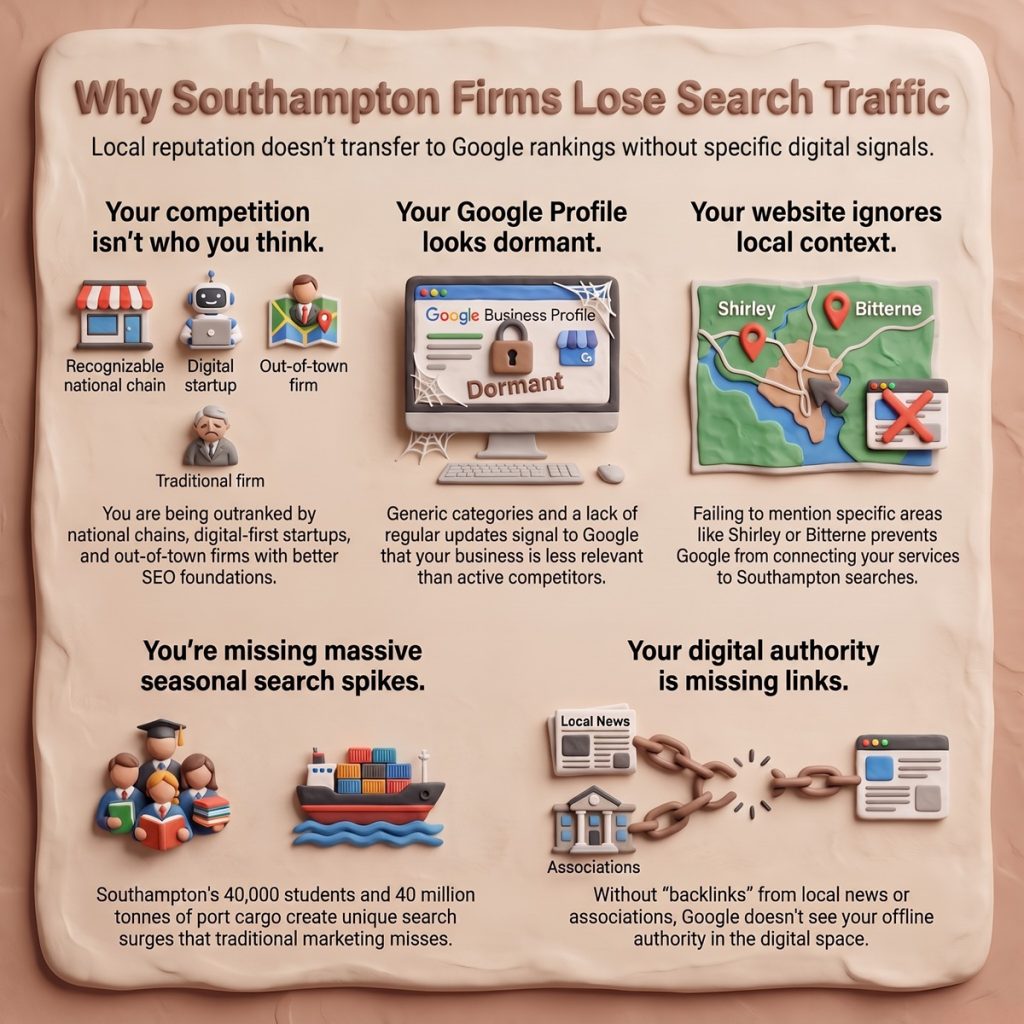
Then someone mentions they found a competitor online. You’ve never heard of them. You search for the service you offer, the one you’ve been providing in Southampton for a decade, and there they are: page one, positions 2 through 4. You’re on page three, or worse.
Who are these businesses? And why are they ranking above you when you’ve got more experience, better reviews, and actual premises in Southampton?
The answer isn’t what most agencies will tell you. It’s not about “dominating local search” or “crushing the competition.” It’s about understanding how Southampton’s specific search landscape works, and where the gaps in your own visibility sit.
Southampton’s Dual Identity Creates a Split Search Market
Southampton isn’t just a port city, and it’s not just a university city. It’s both, simultaneously, and that creates search behaviour most local businesses don’t account for.
During term time, roughly 40,000 students add to Southampton’s 250,000 permanent population. That’s a 16% population swing, three times a year. These searchers behave differently: they’re looking for short-term solutions, they’ve got no existing supplier relationships, and they trust Google results more than local reputation.
The port brings a different dynamic. Southampton handles roughly 40 million tonnes of cargo annually, with thousands of transient workers, cruise passengers, and supply chain professionals rotating through. They search for services whilst they’re here, often from outside the city, with zero local knowledge.
Your established business, with its reputation built on word-of-mouth and long-term customer relationships, isn’t set up to capture either audience. The businesses outranking you are.
The Businesses Beating You Aren’t Who You Think They Are
When Southampton business owners finally check their search rankings, they’re often surprised by who’s above them. It’s not the competitor down the road. It’s:
National chains with barely any Southampton presence, They’ve got domain authority built over years, optimised landing pages for every UK city, and enough scale to justify dedicated SEO resource. They might have one small office in Southampton, or just a “serving Southampton” page. But they’ve built the technical foundations that independent businesses haven’t.
New businesses started by people who understand digital-first, Someone launches a Southampton business in 2023 or 2024, builds the website properly from day one, understands that Google Business Profile setup isn’t optional, and treats content as a core business function rather than an afterthought. Within 18 months, they’re outranking businesses that have been trading since the 1990s.
Businesses from Portsmouth, Winchester, and Eastleigh that have better SEO, They’re not even in Southampton. But they’ve targeted “Southampton” as a service area, they’ve built location pages that answer the searches Southampton residents are making, and Google sees them as relevant. You’re in Southampton, but you’re invisible.
This isn’t about these businesses being better at what they do. It’s about them being better at showing Google, and searchers, that they’re a relevant answer to what’s being searched for.
The Three Gaps That Kill Southampton Business Visibility
After working with Southampton businesses for over two decades, the pattern is consistent. Three gaps appear repeatedly:
Gap One: Your Google Business Profile Doesn’t Match How People Search
You’ve claimed your Google Business Profile. You’ve added photos. You think you’re done.
But your business category is generic, your service list doesn’t include the specific phrases Southampton residents actually search for, and your description is three sentences about “quality service since 1998.”
Meanwhile, the business ranking above you has selected every relevant category, listed 15 specific services (each one a potential search term), added posts twice a week, and responds to every review within 24 hours.
Google interprets this as signals of relevance and activity. Your profile looks dormant by comparison.
Gap Two: Your Website Doesn’t Acknowledge Southampton Exists
Your homepage mentions your location once, in the footer. Maybe there’s a “Contact Us” page with an address.
That’s not enough.
Google needs to understand what you do where. If you’re an accountant, a solicitor, a plumber, or a marketing agency, and Southampton isn’t referenced in your core content, in your service page headlines, and in context that makes sense for searchers, you’re not being served for Southampton-specific searches.
The businesses outranking you have woven Southampton throughout their content, not through keyword stuffing, but through genuine local context. They mention Portswood, Shirley, Bitterne. They reference the universities, the port, specific local business challenges. Google sees this and understands: this business serves Southampton searchers.
Gap Three: No One Links to You
Backlinks remain one of the strongest ranking signals. The Southampton businesses ranking above you typically have dozens or hundreds of links from other websites: local news mentions, supplier directories, industry associations, Portsmouth and Hampshire-wide business listings.
You’ve been trading for years, but your website has seven backlinks, four of which are from directory spam sites you didn’t even know listed you.
This isn’t about buying links or manipulating rankings. It’s about being present in the local digital ecosystem. The Chamber of Commerce, local news sites covering business stories, industry bodies, partnerships with complementary businesses, all of these create natural link profiles that signal authority to Google.
What “Fixing the Foundations” Actually Means
This isn’t about a six-month SEO strategy with content calendars and link building campaigns. Before any of that, Southampton businesses need foundations that most simply don’t have:
A properly configured Google Business Profile, Complete categories, exhaustive service lists, regular posts, review response protocols, and Q&A sections that answer the questions your prospects are actually asking.
On-page signals that Google can interpret, Title tags and meta descriptions that reference Southampton and specific services. H1 headlines that match search intent. Service pages that are actually about services, not vague “solutions.” Internal linking that helps Google understand what you do.
Content that serves searchers, not your ego, Your “About Us” story is lovely, but it doesn’t rank. Content that answers “how much does [service] cost in Southampton” or “what [your industry] service do I need for [specific Southampton context]” does. This isn’t blog fluff. It’s commercial content that closes information gaps between searchers and the decision to contact you.
A backlink profile that reflects your actual presence, If you’ve been in Southampton for 15 years, sponsor local events, work with other businesses, and have expertise worth quoting, that should be reflected in who links to you. Getting there means outreach, relationship building, and creating content that local organisations want to reference.
None of this is complicated. But it takes time, consistency, and understanding what actually moves the dial in Southampton’s search landscape.
The Student and Port Economy Creates Search Spikes You’re Missing
Here’s something most Southampton businesses don’t track: search volume for their services isn’t constant.
September and January see spikes as students arrive and search for everything from letting agents to pizza delivery to printer repairs. June and July see different spikes as cruise season peaks and port activity increases.
If your content and Google Business Profile posts aren’t timed to these patterns, you’re missing high-intent search traffic when it matters most.
The businesses ranking above you often understand this. They’re not necessarily Southampton natives, they’ve just done the work to understand when their services are being searched for, and they’ve built content and optimisation around those windows.
What This Means for Your Business
If you’re a Southampton business owner reading this and recognising the gaps, you’re not alone. Most established businesses built their reputation offline, and the shift to search-driven customer acquisition wasn’t something they saw coming.
The uncomfortable truth is this: your reputation in Southampton doesn’t transfer to Google unless you do the work to make it visible. The businesses outranking you haven’t earned better reputations, they’ve just built better signals that Google can interpret.
This isn’t irreversible. But it does require acknowledging that SEO isn’t a “nice to have” or something you’ll get round to eventually. It’s how the majority of your potential customers find their next supplier, and if you’re not visible in that process, someone else is winning that business.
Frequently Asked Questions
Q: How long does it take to start ranking for Southampton search terms?
A: For Google Business Profile improvements, you can see movement within 2-4 weeks. For website rankings, expect 3-6 months for competitive terms if the foundations are solid. The timeline depends entirely on your current state and the competitiveness of your specific industry in Southampton.
Q: Do I need to target Portsmouth and Winchester as well, or just Southampton?
A: It depends on your service area and capacity. If you genuinely serve those areas and can deliver the same quality, targeting them makes sense, but you’ll need dedicated content and optimisation for each. Claiming areas you don’t really serve damages trust and wastes budget.
Q: Can I do Southampton SEO myself, or do I need an agency?
A: You can absolutely handle Google Business Profile optimisation, basic on-page improvements, and content creation yourself if you’ve got the time and inclination to learn. Most business owners don’t have either, and that’s where an agency becomes the more cost-effective option. It’s about whether your time is better spent on this or running your business.
Q: Why am I not ranking when I’ve been in Southampton longer than my competitors?
A: Because Google doesn’t rank based on how long you’ve been trading, it ranks based on relevance signals, technical foundations, and authority indicators like backlinks and engagement. Longevity gives you advantages (reputation to leverage, relationships to build links from), but you still need to do the technical work.
Q: Is it worth investing in SEO if I already get enough work through word-of-mouth?
A: If you’re genuinely at capacity and turning work away consistently, SEO might not be your priority. But most businesses saying this are vulnerable: word-of-mouth shrinks if economic conditions change, key clients leave, or newer competitors capture the next generation of customers searching online. SEO is insurance as much as growth.
If you’re a Southampton business that’s tired of watching competitors you’ve never heard of take search traffic that should be yours, we should talk. Thickrope has been working with UK businesses on practical, results-focused SEO for over 25 years, we’ll show you exactly where the gaps are and what fixing them actually involves.