

What a Slough Business Discovered After Two Years With an SEO Agency That Promised the Thames Valley and Delivered Nothing
The onboarding felt impressive. Case studies from Reading, Maidenhead, Windsor, all Thames Valley businesses that had apparently tripled organic traffic. Monthly reports arrived on time, packed with charts showing keyword rankings climbing and traffic graphs trending upward. For eighteen months, the owner of a mid-sized logistics firm in Slough Trading Estate watched those numbers rise whilst enquiries from the website stayed exactly where they’d always been: sporadic, low-quality, mostly tyre-kickers.
By month twenty-four, the monthly retainer, £1,200 for two years, had cost nearly £29,000. The business had three new customers it could trace to organic search. Total contract value: roughly £14,000. The maths didn’t work, and the excuses had stopped landing.
When the contract finally ended, a proper audit revealed what two years of “SEO activity” had actually delivered, and, more importantly, what it hadn’t.
The Traffic That Looked Good on Paper but Did Nothing for the Business
The agency hadn’t lied about the traffic. Google Analytics confirmed it: organic sessions had increased 140% over the baseline. The problem was where that traffic came from.
Roughly 60% of the new sessions were landing on blog posts optimised for keywords like “what is supply chain management” and “how does freight forwarding work.” Educational content, written competently enough, but aimed at students, job seekers, and people researching the industry rather than businesses looking to move goods.
The remaining 40% came from local searches, but for terms the business didn’t actually service: “same-day courier Slough,” “man and van hire near me,” “cheap parcel delivery Thames Valley.” The firm handled pallet freight and container logistics for manufacturers and wholesalers. The traffic was local, but it was the wrong local audience entirely.
The audit showed that not a single page had been optimised for the terms actual customers used when they were ready to buy: “pallet freight Slough to Europe,” “container haulage Thames Valley,” “manufacturer logistics partner Berkshire.”
Traffic had gone up. Enquiries hadn’t. The agency had optimised for the easier keywords, not the commercial ones.
What the Monthly Reports Didn’t Mention
The reports were detailed. Twelve pages on average, with ranking tables, competitor analysis sections, backlink summaries, and technical health scores. They looked thorough. But three critical gaps only became obvious under scrutiny:
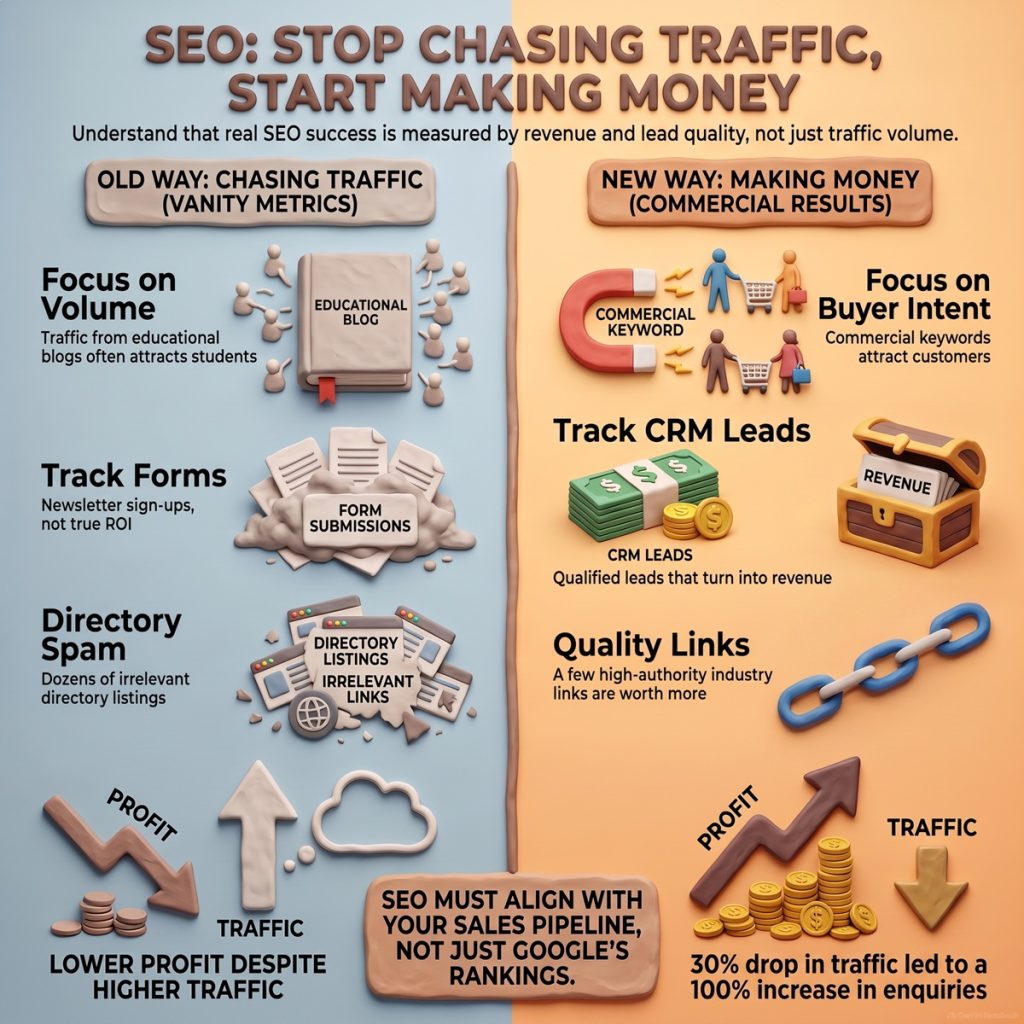
No conversion tracking beyond form submissions. The agency reported “enquiries” as any form fill, including newsletter signups, brochure downloads, and contact requests that never turned into conversations. Actual qualified leads, the ones the sales team followed up and logged in the CRM, weren’t tracked. The disconnect meant the agency had no feedback loop between their work and revenue.
No commercial intent filtering. The keyword strategy prioritised volume and ranking difficulty, not buyer intent. High search volume pushed them toward informational queries. Low difficulty meant avoiding the competitive terms where customers actually were. The result was visibility in the wrong part of the funnel.
Backlinks from irrelevant sources. The link building report showed sixty-seven new backlinks over two years. Impressive on paper. The audit revealed most came from business directories no one used, low-traffic niche blogs, and a handful of press release syndication sites. Not one link came from an industry publication, a customer’s website, or a local business association that mattered. Quantity over relevance, every time.
The agency had done work. It just wasn’t the work that connected to revenue.
The Turning Point: When the Retainer Became a Business Decision, Not a Marketing One
The breaking point wasn’t a single incident. It was a board meeting where the finance director asked a simple question: “If we’re spending fourteen hundred a month on SEO and can’t point to customers it’s brought in, what are we actually buying?”
The marketing manager didn’t have an answer that satisfied the room. The agency’s response, that “SEO is a long-term investment” and “brand visibility has value beyond direct attribution”, sounded reasonable in isolation but felt hollow after two years.
The business made the decision most Slough SMEs eventually reach: prove it works, or stop paying for it.
What the New Agency Did Differently in the First Thirty Days
The replacement wasn’t chosen for their pitch or their portfolio. They were chosen because the first thing they asked for was CRM access, sales pipeline data, and a list of the last twenty customers the business had won. They wanted to understand what a valuable lead looked like before they touched a single keyword.
Within a month, the differences were structural:
Conversion tracking rebuilt from scratch. GA4 events for qualified enquiry forms, phone calls from organic traffic, and brochure downloads segmented by service type. The agency could now see which pages and keywords were driving leads that the sales team actually wanted to speak to.
Keyword strategy rewritten around commercial intent. They binned the blog content targeting informational queries and focused entirely on service pages optimised for buying-stage searches: specific routes, specific freight types, specific industry needs. Traffic dropped 30% in the first two months. Enquiries doubled.
Link building tied to industry credibility. No more directory spam. They targeted trade associations, industry news sites, and local business forums where logistics buyers actually spent time. Four high-relevance links in three months, each from a source the sales team recognised and respected.
The new agency’s monthly retainer was higher, £1,600 versus £1,200, but the first quarter delivered nine qualified leads that turned into five new contracts worth £67,000 combined. The ROI maths finally worked.
What Slough Businesses Should Ask Before Signing an SEO Contract
This isn’t a story about one bad agency. It’s a pattern that plays out across the Thames Valley every month: businesses paying for activity that doesn’t connect to outcomes.
If you’re evaluating an SEO agency in Slough, or already working with one, these questions cut through the presentation layer:
How will you track whether our investment is generating revenue, not just traffic? If the answer doesn’t include CRM integration, conversion tracking, or regular sales pipeline reviews, the agency is optimising for metrics that don’t pay your bills.
Which keywords are you targeting, and why those specifically? If the list is dominated by high-volume, low-intent queries or topics your customers don’t care about, you’re buying visibility in the wrong place.
What does success look like in six months, and how will we measure it? If the answer is “rankings” or “traffic” without reference to enquiries, pipeline value, or customer acquisition cost, alignment is already broken.
Can you show me three businesses similar to ours where this approach generated measurable commercial outcomes? Case studies matter, but only if they’re relevant to your sector, location, and business model. A retail case study tells a B2B logistics firm nothing useful.
The agencies that answer these questions clearly and specifically tend to be the ones that treat SEO as a revenue channel, not a visibility exercise.
What Changed When Accountability Became the Default
Twelve months into the new relationship, the logistics firm’s organic channel was contributing 22% of new business revenue, up from less than 5% during the previous agency’s tenure. Traffic had stabilised at a lower level than the peak under the old provider, but every meaningful metric had improved: time on site, pages per session, enquiry-to-customer conversion rate, average contract value from organic leads.
The difference wasn’t better content or smarter technical fixes. It was alignment. The agency’s success metrics were the same as the business’s success metrics. When that alignment exists, every decision, which keywords to target, which pages to optimise, which links to pursue, points toward revenue instead of vanity.
The owner’s reflection, eighteen months after switching: “The first agency made us look busy. The second one made us money. I should’ve asked harder questions two years earlier.”
Frequently Asked Questions
Q: How long should it take to see results from an SEO agency in Slough?
A: For local commercial searches, you should see movement in rankings and early-stage enquiries within three to four months if the strategy is sound. If you’re six months in with no qualified leads traceable to organic search, the strategy needs scrutiny, not more time.
Q: What’s a reasonable monthly retainer for a Slough-based SME working with an SEO agency?
A: For a local business targeting Thames Valley customers, expect £1,200–£2,500 per month depending on competitiveness and scope. Anything below £800 typically means you’re getting template work; anything above £3,000 should come with dedicated account management and measurable pipeline contribution.
Q: Should my SEO agency have access to our CRM and sales data?
A: Yes, if they’re serious about commercial outcomes. An agency optimising without understanding what a valuable customer looks like, how long your sales cycle runs, or which services drive margin is guessing. The best relationships treat CRM data as essential, not optional.
Q: How do I know if my current SEO agency is targeting the right keywords?
A: Ask your sales team which search terms your best customers used before they enquired. Cross-reference that list with what your agency is actively targeting. If there’s minimal overlap, you’re paying for visibility that won’t convert.
Q: Can I measure SEO ROI the same way I measure PPC?
A: Not as directly, because attribution is messier and the timeline is longer, but yes, you can and should track cost per acquisition, customer lifetime value, and revenue contribution from organic leads. If your agency isn’t reporting these, ask why not.
If the gap between your SEO activity and actual business results feels familiar, a diagnostic audit will show you exactly where the disconnect is, and what it’ll take to close it. Thickrope’s Slough SEO service starts with your CRM and your sales data, not a keyword tool, because visibility without revenue isn’t marketing, it’s just noise.