

Why Edinburgh SEO Marketing Fails When You Don’t Know Which City You’re Competing In
Most Edinburgh businesses approach SEO as if they’re targeting one market. They’re not. Edinburgh operates as three distinct cities simultaneously, each with completely different search behaviour, seasonal patterns, and commercial intent. Your competitor isn’t necessarily the business next door, it depends which Edinburgh you’re selling into.
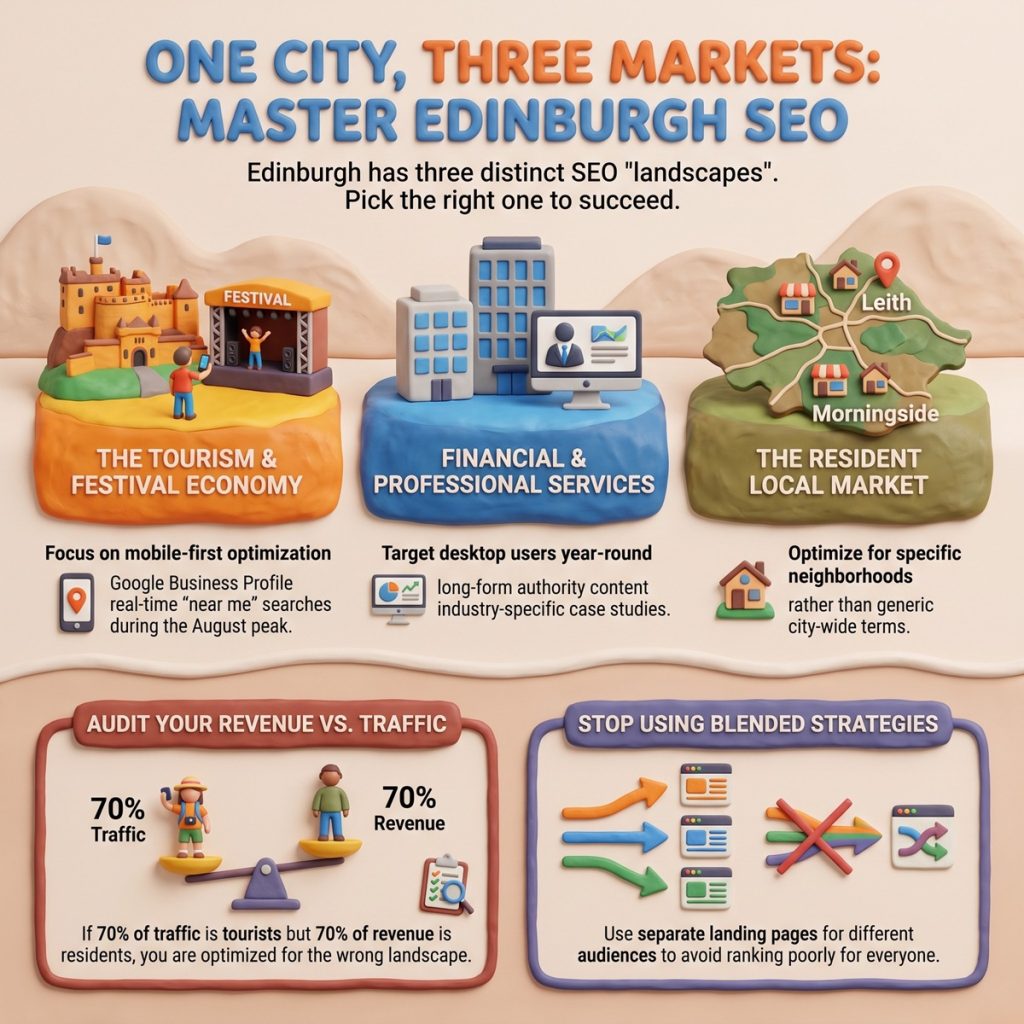
Get this wrong and you’ll optimise for tourists when you need local professionals, or chase local volume during Festival season when your actual customers are international visitors searching from abroad.
This isn’t about Edinburgh being “diverse” or “unique.” It’s about recognising that effective SEO marketing in Edinburgh requires you to identify which of three search landscapes your business actually operates in, then build strategy accordingly.
The Three Edinburgh Search Landscapes
1. The Tourism and Festival Economy (Peak: July–September)
Between the Fringe, International Festival, Tattoo, and year-round castle visitors, Edinburgh attracts over 4.5 million tourists annually. These searchers have entirely different patterns:
Search behaviour: High mobile usage, last-minute intent (“restaurants near me open now”), image-heavy results, review dependency, and searches conducted whilst actually in the city. They’re not researching in February for an August visit, they’re searching in real time.
Seasonal concentration: August search volume for hospitality, tours, and entertainment can be 300-400% higher than January. If you’re a city centre restaurant, hotel, or tour operator, you’re not competing in a steady market. You’re in a three-month sprint.
Geographic origin: Searches come from London, Manchester, international visitors, and cruise ship passengers with 4-6 hours in port. Your local Edinburgh rankings matter far less than your visibility to someone searching from a hotel in Leith or a train arriving at Waverley.
SEO implications: You need mobile-first optimization, aggressive Google Business Profile management, review velocity during peak months, and content that answers “best [thing] near Edinburgh Castle” rather than building long-term domain authority. Your competitors aren’t other Edinburgh businesses, they’re TripAdvisor, VisitScotland, and aggregator sites.
If you’re in this landscape and you’ve spent six months building backlinks from Edinburgh business directories, you’ve optimised for the wrong signals entirely.
2. Financial and Professional Services (Year-Round, Weekday-Heavy)
Edinburgh is the UK’s second-largest financial centre. The professional services sector, financial services, legal, insurance, pensions, investment management, creates B2B search demand that has nothing to do with tourism.
Search behaviour: Desktop-dominant during working hours, longer research cycles, and decision-makers often searching from Glasgow, London, or other UK cities for Edinburgh-based expertise. “Edinburgh” appears in the search not because they’re visiting, but because they’re specifically looking for Scottish legal jurisdiction, financial regulation expertise, or regional sector knowledge.
Seasonal patterns: Volume drops during Edinburgh holidays but holds steady otherwise. December and August may see dips, but nothing like the tourism economy’s volatility.
Geographic intent: Searchers want Edinburgh expertise but may never visit your office. They’re qualifying firms based on sector specialisation, case studies, and authority signals. Local pack rankings matter less than appearing for “[specialisation] solicitor Scotland” or “[sector] financial adviser Edinburgh”.
SEO implications: You’re building for expertise and authority, not proximity. Long-form content addressing specific regulatory scenarios, sector case studies, and professional qualifications matter more than Google Business Profile reviews. Your competition is national firms with Edinburgh offices who outspend you, and specialist boutiques who out-expert you.
If you’re a financial adviser and you’ve optimised your homepage for “financial adviser near me,” you’ve misunderstood which Edinburgh you’re competing in.
3. The Resident Local Market (Year-Round, Evening and Weekend Peaks)
Edinburgh’s permanent population of around 525,000 creates consistent local search demand for services, tradespeople, health practitioners, schools, and retail. These are people who live here, not visit.
Search behaviour: Research-heavy for high-value decisions (choosing a plumber, dentist, solicitor for conveyancing), review-sensitive, and locally bounded. They’re searching “Morningside,” “Leith,” “Corstorphine”, not “Edinburgh city centre.”
Seasonal patterns: Steady year-round with predictable spikes: tradespeople in spring, solicitors during moving season, accountants before tax deadlines.
Geographic specificity: Edinburgh’s neighbourhood identity is strong. Someone in Portobello wants a tradesperson in Portobello, not Newington. Citywide rankings matter less than hyper-local visibility.
SEO implications: Google Business Profile with accurate service areas, neighbourhood-specific content, consistent NAP citations across local directories, and reviews from actual residents (not tourists who’ll never return). You’re competing with long-established local businesses who’ve been in the same location for 20 years.
If you’re a Stockbridge plumber targeting “Edinburgh plumber” citywide, you’re wasting budget on searches from areas you don’t serve and missing the neighbourhood specificity that actually converts.
How to Identify Which Landscape You’re Actually In
Most Edinburgh businesses know instinctively which market they serve, but their SEO doesn’t reflect it. Here’s how to audit your current approach:
Revenue timing: When do you actually make money? If 60% of revenue lands July–September, you’re in the tourism economy whether you think of yourself that way or not. If revenue is steady year-round with weekday concentration, you’re B2B professional services.
Customer geography: Where do your customers come from? Pull last year’s data. If they’re 70%+ from outside Edinburgh, your SEO shouldn’t prioritise local pack rankings.
Search query reality: Check Google Search Console. What queries actually drive traffic? If you’re seeing “near me” and mobile traffic spikes, you’re in real-time local search. If you’re seeing long-tail professional queries from desktop users, you’re in the expertise economy.
Competitor set: Who actually takes your customers? If it’s national chains and aggregator sites, you’re not in a local SEO fight. If it’s the business three streets away with a 15-year domain, you are.
This isn’t theoretical. Your SEO budget is finite. Spending it on the wrong landscape means losing to competitors who’ve correctly identified theirs.
What Effective SEO Marketing Looks Like in Each Landscape
For Tourism and Festival Economy Businesses
Prioritise: Google Business Profile optimization (photos, posts, Q&A), mobile site speed, review acquisition strategies during peak season, and content that matches real-time intent (“open now,” “near [landmark]”).
Deprioritise: Long-form blog content, slow-burn link building, and desktop user experience. Tourists don’t read your 2,000-word guide to Edinburgh history before booking.
Seasonal approach: Ramp up budget and activity April–June to capture early planners and peak visibility during July–September. Scale back October–March unless you have genuine winter appeal.
Measurement: Track mobile traffic, Google Business Profile actions (calls, direction requests), and conversion rate during peak vs. off-peak. If your August conversion rate is 8% and your February rate is 2%, you know exactly which months to invest in.
For Professional Services Businesses
Prioritise: Authority content (sector insights, regulatory updates, case studies), professional backlinks (industry bodies, sector publications), and LinkedIn integration. Your SEO and your professional reputation need to reinforce each other.
Deprioritise: Google Business Profile optimization beyond basic accuracy, proximity-based local search, and review quantity over quality. A testimonial from a known industry figure beats 50 tourist reviews.
Content strategy: Publish consistently on topics where you have genuine expertise. “How the [recent regulation change] affects [sector]” positions you as current and expert. Generic “what is financial planning” content doesn’t.
Measurement: Track rankings for professional long-tail queries, time on site (professionals read), and enquiry quality. One £50k client from organic search justifies a year’s SEO investment.
For Resident Local Market Businesses
Prioritise: Neighbourhood-specific content, Google Business Profile with accurate service areas, and local citations (Edinburgh directories, community sites). If you serve Leith, say “Leith” everywhere, not just “Edinburgh.”
Deprioritise: Citywide ranking obsession and competing for tourist searches you’ll never convert.
Review strategy: Focus on resident reviews that mention specific services and problems solved. “Fixed our boiler on a Sunday in Marchmont, reasonable price” beats “Great service!”
Measurement: Track local pack visibility in your actual service area, phone calls (residents call, tourists click), and returning customer rate. Local SEO is about building reputation in a defined geographic area, not traffic volume.
The Mistake: Blended Strategy for a Segmented Market
The most common Edinburgh SEO failure is trying to serve all three audiences with one generic approach. Homepage content that says “serving Edinburgh residents, visitors, and businesses” serves none of them well.
Your website can’t be simultaneously optimised for:
- A tourist searching “best whisky bar Edinburgh” on their phone at 6pm on a Saturday
- A Glasgow solicitor researching “Edinburgh employment law firm” at their desk on a Tuesday morning
- A Corstorphine resident searching “local electrician Corstorphine” after a fuse blows
Each requires different content, different technical optimization, and different conversion paths.
If you’re a city centre restaurant trying to rank for both “romantic dinner Edinburgh” (tourists) and “business lunch venue Edinburgh” (professional services), you need separate landing pages with distinct optimization, or you’ll rank poorly for both.
Multi-Landscape Businesses: When You Serve Two Audiences
Some Edinburgh businesses genuinely operate in two landscapes. A law firm might do commercial work (professional services landscape) and residential conveyancing (local resident landscape). A restaurant might serve tourists and local regulars.
The solution isn’t blended content. It’s segmented SEO strategy with clear separation:
Separate landing pages: /commercial-law/ optimised for B2B professional searches vs. /conveyancing-edinburgh/ optimised for local resident searches with neighbourhood mentions.
Different content types: Long-form authority pieces for professional audience, practical local guides for resident audience.
Distinct tracking: Measure each audience separately. Your tourist traffic might be high volume/low value whilst your local traffic is low volume/high lifetime value.
Budget allocation: Spend according to revenue contribution. If 70% of your revenue comes from residents but 70% of your traffic comes from tourists, your SEO is attracting the wrong audience.
Timing: When Edinburgh’s Search Landscapes Collide
August is when all three landscapes peak simultaneously, and competition for visibility is highest:
- Tourists searching for immediate needs
- Professional services competing for attention amongst Festival distraction
- Residents trying to find local services whilst the city is gridlocked
If you’re a resident-focused business, August may be when you reduce spend on competitive citywide terms and focus exclusively on neighbourhood-specific searches where tourists aren’t competing. If you’re tourism-dependent, August is when every pound of SEO investment from the previous six months pays off.
Understanding this timing prevents the mistake of judging your SEO performance in February based on August traffic, or wondering why your August spike disappeared in September.
Frequently Asked Questions
Q: Can I target all three Edinburgh audiences with one SEO strategy?
A: Only if you have significant budget and create genuinely separate content and landing pages for each audience. For most SMEs, choosing your primary audience and optimising ruthlessly for that landscape delivers better ROI than a diluted approach that ranks poorly for everything.
Q: I’m a local business but most of my website traffic comes from tourists, is that a problem?
A: If tourists aren’t your customers, yes. High traffic from the wrong audience lowers conversion rate and obscures performance data. Check where your actual revenue comes from, then optimise for that audience even if it means lower traffic volume.
Q: Do Edinburgh businesses need different SEO than Glasgow or other UK cities?
A: Edinburgh’s three-landscape structure is unusual. Most UK cities don’t have this degree of simultaneous tourism, financial services, and residential search demand. Glasgow’s SEO challenges are different; so are Manchester’s. Edinburgh requires audience segmentation most cities don’t.
Q: Should I mention “Edinburgh Festival” in my content if I’m open during August but don’t directly serve tourists?
A: Only if Festival-goers are genuinely a revenue source. Mentioning the Festival to capture traffic might bring visitors who aren’t your customer. A Bruntsfield accountant doesn’t benefit from ranking for Festival-related searches.
Q: How do I know if my current SEO is targeting the right Edinburgh audience?
A: Pull six months of Google Search Console data and categorise queries by audience type (tourism/professional/resident). Then compare traffic share to revenue share from each audience. If 60% of traffic is tourist searches but tourists generate 10% of revenue, you’re optimised for the wrong landscape.
If you’re not certain which Edinburgh search landscape your business actually competes in, or you’ve been running SEO that treats Edinburgh as one homogeneous market, we can audit your current performance and show you where your opportunities actually sit. [Get in touch with Thickrope Marketing](/contact/) for an Edinburgh SEO review that starts with understanding which audiences drive your revenue, not just your traffic.