

Why SEO in Slough Requires a Strategy You Won’t Use Anywhere Else in the Thames Valley
Slough doesn’t behave like Reading, Maidenhead, or Windsor when it comes to search. The reason is structural: nowhere else in the South East has the same concentration of B2B trading estate businesses sitting alongside a high-density, multicultural residential population with exceptionally specific consumer search behaviour. That split creates two entirely separate search landscapes operating in the same postcode area, and most SEO strategies miss one or the other entirely.
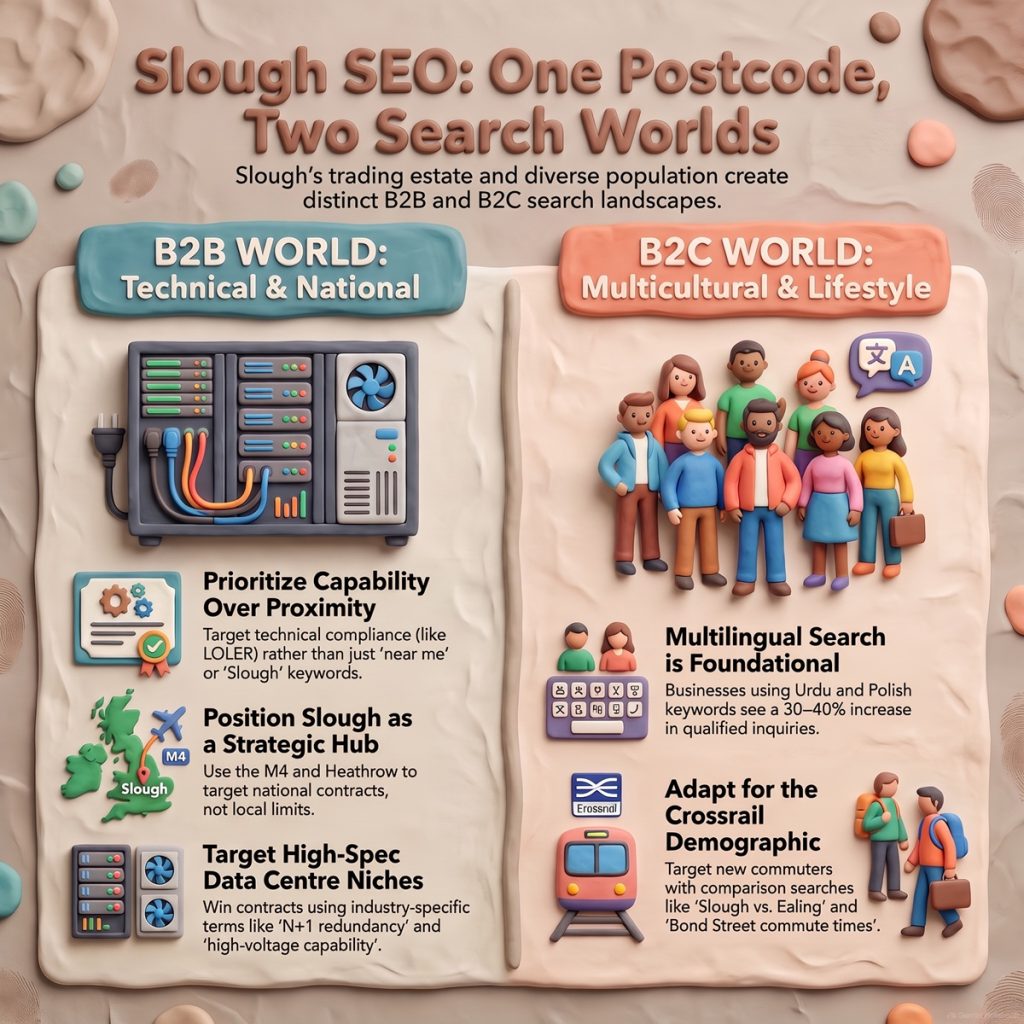
If you’re running a business in Slough and your search visibility isn’t delivering, the problem is often that your agency has treated you like you’re in Guildford or Cambridge. You’re not. Here’s what makes Slough different, and what that means for how you should approach SEO.
The Slough Trading Estate Is One of Europe’s Largest, and It Distorts Local Search Behaviour
The Slough Trading Estate covers over 486 acres and houses more than 17,000 employees across sectors as varied as pharmaceutical manufacturing, data centres, logistics, and tech. Companies like Mars Wrigley, Akzo Nobel, and historically O2 and BlackBerry’s UK operations have anchored a B2B economy that dominates commercial search intent in the area.
What this means practically: if you’re a B2B service provider in Slough, anything from industrial cleaning to IT support to commercial vehicle maintenance, your customers are not searching “near me.” They’re searching by capability, compliance standard, or contract size. A forklift repair company doesn’t win work by ranking for “forklift repair Slough.” It wins work by ranking for “LOLER-compliant forklift servicing Berkshire” or “same-day forklift breakdown cover M4 corridor.”
The trading estate economy skews heavily toward procurement-driven search: longer queries, technical language, and searchers who already know what they need. If your SEO strategy is built around local map pack rankings and generic service terms, you’re solving for the wrong search behaviour.
Slough’s Residential Search Behaviour Reflects One of the Most Multicultural Populations Outside London
Slough’s residential population is approximately 45% white British, one of the lowest proportions in the South East. The largest minority groups include Pakistani, Indian, and Polish communities, with significant Somali, Nepalese, and Caribbean populations as well.
This isn’t a cultural observation, it’s a search behaviour fact. Consumer businesses in Slough that rely on local foot traffic or residential customers need to account for:
- Language-specific search queries: searches conducted in Urdu, Polish, Punjabi, or Hindi happen at materially higher volumes in Slough than in neighbouring towns.
- Different service terminology: what one community calls “money transfer” another searches as “remittance services” or “international bank transfer.”
- Search platform variation: WhatsApp and Facebook search behaviour plays a larger role in certain demographics than Google alone.
If you’re a retailer, salon, restaurant, or tradesperson working the residential side of Slough and your SEO strategy doesn’t include multilingual keyword research or culturally specific search intent mapping, you’re leaving revenue on the table. A plumber ranking #1 for “emergency plumber Slough” may still get fewer inquiries than a competitor ranking #6 but visible in Polish and Urdu search results.
The M4 and Heathrow Proximity Makes Slough a Logistics and Fulfilment Hub, Which Changes What “Local” Means
Slough’s position between Junction 5 and 6 of the M4, within 15 minutes of Heathrow, has made it a strategic location for logistics, fulfilment centres, and distribution. Amazon, DHL, and XPO Logistics all have significant operations in or around Slough.
For businesses operating in this space, “local SEO” is almost a misnomer. Your customers aren’t local, they’re national or international businesses evaluating you on network reach, SLA capability, and operational footprint. A Slough-based fulfilment company isn’t competing with other Slough fulfilment companies. It’s competing with facilities in Tilbury, Northampton, and the East Midlands Gateway.
The SEO implication: backlink strategy and content marketing matter more than citation consistency. Ranking for “third-party logistics Slough” delivers far less qualified traffic than ranking for “UK-wide ecommerce fulfilment with Heathrow export capability” or “same-day dispatch fulfilment South East.”
The businesses that win contracts in this space are the ones whose SEO strategies treat Slough as a logistics advantage, not a geographic limitation.
Slough’s Regeneration and Crossrail Have Changed Search Volume and Intent — But Not Evenly
Slough’s town centre regeneration and the arrival of the Elizabeth Line (Crossrail) have increased search interest in Slough as a residential and commercial location. Property searches, commuter-focused services, and hospitality have all seen upticks in query volume.
But this hasn’t lifted all businesses equally. If you’re a business targeting the new professional demographic moving into Slough for the Crossrail commute, your SEO strategy needs to reflect that these searchers are comparing Slough to Ealing, Romford, and Stratford, not Maidenhead or Bracknell. They’re searching “Slough to Bond Street commute time” and “best coffee shops near Slough station,” not “Slough family solicitors” or “Slough accountants.”
If you’re an established Slough business and your search traffic has plateaued despite the town’s profile rising, the issue may be that new demand is arriving through search queries you’re not targeting. A café near the station should be optimising for “work-friendly café Slough” and “laptop-friendly coffee Slough,” not just “café Slough.”
Conversely, if you’re a long-established business serving Slough’s existing residential or trading estate base, don’t assume regeneration automatically benefits you. The new search volume may not be your volume.
The Data Centre Concentration in Slough Creates Uncommon B2B Search Opportunities
Slough is home to one of the UK’s highest concentrations of data centres, including major facilities operated by companies like Equinix, Digital Realty, and Global Switch. This creates an entire ecosystem of B2B service demand that barely exists in other Thames Valley towns: cooling and HVAC specialists, electrical contractors with high-voltage capability, security providers with data centre clearance, and facilities management firms with uptime SLAs.
If you’re a B2B service provider in Slough and your offering maps onto this sector, your SEO strategy should be targeting data centre-specific terminology and pain points. Ranking for “commercial electrician Slough” is fine. Ranking for “N+1 redundant power installation data centres UK” or “emergency HVAC repair data centre Slough” wins contracts.
The mistake most businesses make is assuming their core service term is enough. In a town where your potential customer base includes some of the most mission-critical infrastructure in the UK, generic SEO loses to specific capability signalling.
What Slough-Specific SEO Actually Looks Like in Practice
Here’s what a properly designed SEO strategy for a Slough business should account for:
For B2B businesses serving the trading estate or data centre economy:
- Keyword targeting should prioritise capability and compliance over geography
- Content should answer procurement-stage questions: certifications, SLAs, case studies, operational footprint
- Backlinks from industry bodies, trade publications, and sector directories matter more than local business directories
- Schema markup should emphasise ServiceArea, not just LocalBusiness
For consumer businesses serving Slough’s residential population:
- Multilingual keyword research isn’t optional, it’s foundational
- Google Business Profile optimisation must reflect the cultural and linguistic mix of your actual customer base (e.g., services listed in multiple languages where appropriate)
- Reviews and citations should be cultivated across platforms beyond Google, Facebook, ethnic community sites, and WhatsApp Business presence all contribute to discoverability
- Content should map to culturally specific search intent, not just generic service terms
For logistics, fulfilment, and distribution businesses:
- SEO should position Slough as a strategic advantage (M4, Heathrow, Crossrail) rather than a location constraint
- Content marketing should target decision-makers evaluating network coverage, not local searchers
- Link building should focus on industry-specific directories, trade bodies, and logistics/supply chain publications
- Location pages should emphasise connectivity and reach, not “serving Slough and surrounding areas”
For businesses targeting the new Crossrail demographic:
- Keyword research should include comparison searches (Slough vs. other Elizabeth Line towns) and commuter-specific queries
- Content should reflect the concerns of people new to the area, not long-term residents
- Local landing pages should answer “is Slough right for me?” questions, not just list services
Frequently Asked Questions
Q: Does multilingual SEO actually make a measurable difference for Slough businesses?
A: Yes, particularly for consumer-facing businesses. We’ve seen retailers and service providers increase qualified inquiries by 30–40% after implementing multilingual keyword targeting and Google Business Profile optimisation in Urdu and Polish. The volume exists, most businesses just aren’t capturing it.
Q: Should a Slough B2B business focus on local rankings or broader regional/national visibility?
A: It depends entirely on your customer base. If you’re serving trading estate businesses or data centres, local rankings are often a distraction. Your customers are searching by capability, not proximity. Focus on ranking for what you do and how you solve procurement problems, not where you’re based. If you’re a consumer-facing business, local rankings still matter, but even then, Slough-specific nuances (multilingual search, cultural intent) change how you approach them.
Q: How much does Slough’s regeneration and Crossrail actually affect SEO opportunity?
A: Meaningfully, but unevenly. If your target customer is the new professional demographic moving into Slough for the commute, search volume and intent have both shifted in your favour. If you’re serving established Slough businesses or long-term residents, regeneration hasn’t necessarily increased your addressable search market. The key is knowing which search behaviour you’re solving for and not assuming all rising tides lift all boats.
If your Slough business isn’t showing up where it should, or you’re getting traffic but not the right traffic, the issue is often strategy, not effort. We’ve been doing SEO for UK businesses for over 25 years, and we’ve worked with enough Slough clients to know what works in this specific market. If you’d like us to audit where your visibility gaps actually are and what a Slough-specific strategy would look like for your business, [get in touch](https://www.thickrope.com/contact) and we’ll walk you through it.