
Why Windsor Business Websites Fail When They Try to Serve Everyone (And What Works Instead)
Most agencies will tell you a good website needs clear messaging, fast loading times, and mobile responsiveness. All true. All completely inadequate if you’re running a business in Windsor.
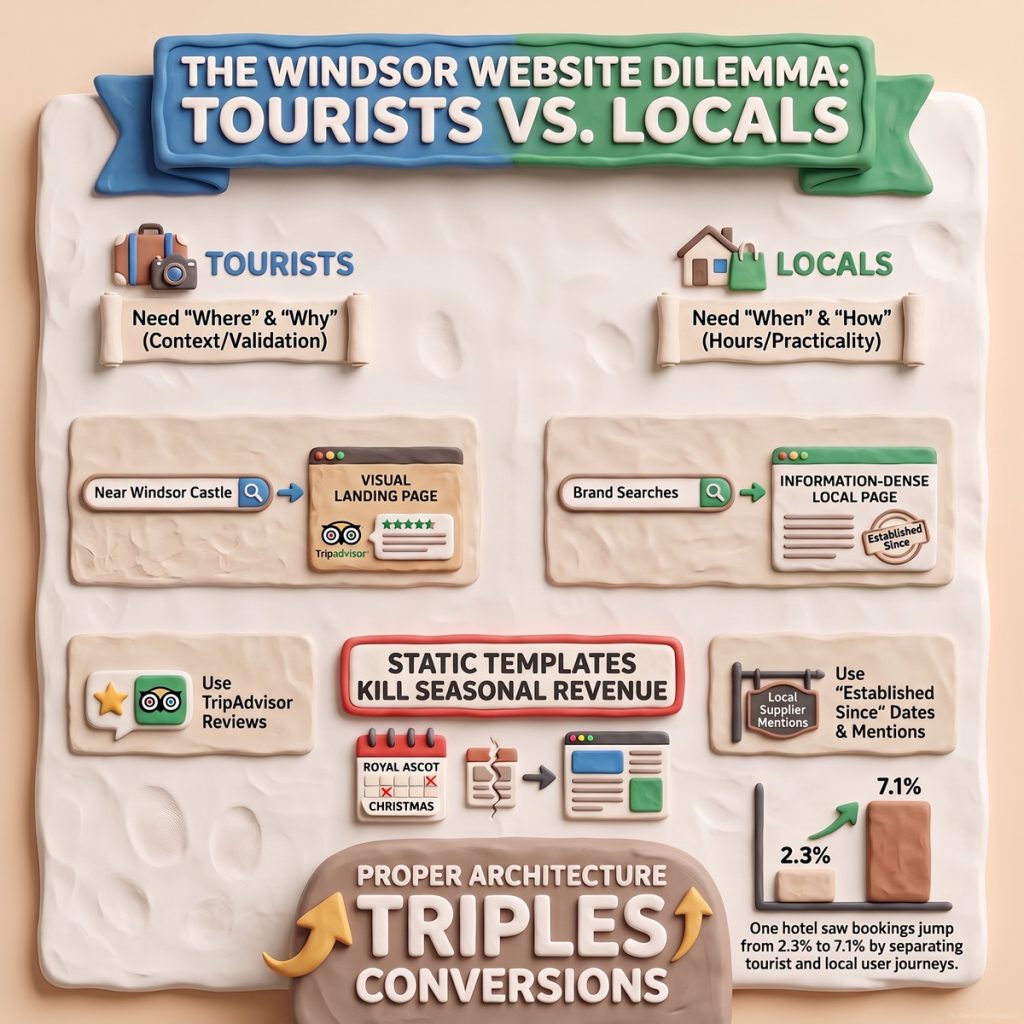
Because here’s what they won’t tell you: a Windsor business website has to do something that breaks every conventional “best practice” in web design, it needs to speak fluently to two audiences who arrive with completely different expectations, knowledge levels, and intent.
On one side: international tourists searching “things to do near Windsor Castle” who’ve never heard of your business, don’t know Eton from Slough, and need convincing in approximately eight seconds that you’re legitimate and worth the detour.
On the other side: Berkshire residents and professionals who spot generic stock photography from fifty paces, expect you to understand local context without explaining it, and will quietly click away if your site feels like it was built for anyone, anywhere.
A £400 template can’t solve this. Neither can an agency that doesn’t understand why it’s a problem in the first place.
The Tourist-Local Split Isn’t Just Different Messaging, It’s Conflicting Website Architecture
Walk through what actually happens when these two audiences land on the same homepage.
The tourist arrives from Google with zero context. They’re searching “afternoon tea Windsor” or “restaurants near Windsor Castle” on their phone whilst standing on Peascod Street. They need:
- Immediate location confirmation (yes, we’re the one you’re looking for, we’re 200 metres from where you’re standing)
- Visual proof you’re not a scam (real interior photos, not stock images of generic “British” tea rooms)
- Friction-free booking (they’re deciding between you and three other tabs open right now)
- Simple transport information (because they don’t know where Windsor & Eton Central is relative to Windsor & Eton Riverside)
The local resident arrives via recommendation or repeat visit. They already know you exist. They’re checking your opening hours, looking at your updated menu, or finding your phone number. They need:
- Fast access to practical information (hours, contact, current offers)
- Evidence you understand the local market (seasonal references, local supplier mentions, community involvement)
- No insulting explanations of where Windsor is or why the Castle matters
- Professional credibility markers that signal “we’re one of you”
Here’s where templates fail spectacularly: they force you to choose one priority architecture. Either your homepage is built for discovery (tourist-focused, lots of explanation, big hero images) or it’s built for conversion of warm traffic (local-focused, information-dense, minimal fluff).
Try to serve both equally and you end up with a cluttered mess that converts neither.
What Actually Works: Intelligent Traffic Routing, Not Compromise Design
The solution isn’t finding a middle ground. It’s building a website that routes different traffic intelligently from the first click.
Start with search intent differentiation. When someone searches “Windsor spa hotel,” they’re a tourist. When they search “spa Windsor Berkshire” or include your business name, they’re likely local or returning. Your SEO strategy and landing page architecture should reflect this.
Tourists should land on pages that:
- Lead with location validation (“5-minute walk from Windsor Castle”)
- Include transport and parking details prominently
- Feature booking CTAs above the fold
- Use photography that shows your actual premises in recognisable Windsor locations
- Provide context without assuming knowledge
Locals should land on pages that:
- Prioritise practical information architecture (opening hours, contact, menu/services)
- Reference seasonal or local context naturally (Windsor Royal Show, Ascot week, local supplier partnerships)
- Demonstrate longevity and local integration (established date, local testimonials, community involvement)
- Avoid explaining things they obviously know
This isn’t two separate websites. It’s one website with intelligent homepage variants, landing page targeting for different search terms, and navigation that lets each audience self-select their path quickly.
The Trust Signal Problem: What Works for Tourists Undermines Local Credibility
Here’s what most Windsor businesses get wrong: they optimise entirely for tourist conversion because that’s where the volume is, then wonder why local residents think they’re a tourist trap.
Tourist trust signals:
- TripAdvisor ratings and review volume
- “As featured in” media mentions
- Prominent booking widgets and instant confirmation
- Currency converters and multilingual options
- Lots of photography showing you what to expect
Local trust signals:
- Longevity markers (established dates, “family-run since”)
- Local supplier names and partnerships
- Community involvement (sponsorships, local charity work)
- Professional accreditations relevant to UK standards
- Sophisticated design that doesn’t over-explain
The problem: heavy tourist optimisation makes locals think you’re overpriced, impersonal, and not really “for them.” But if you don’t optimise for tourists, you lose the volume that keeps you viable during off-peak months.
The answer is layering these signals strategically. Your homepage and main service pages can carry both, but the prominence and positioning matters enormously. Tourists need trust signals in the first screen. Locals will scroll or navigate deeper, looking for the credibility markers that matter to them.
One Windsor restaurant client saw a 34% increase in midweek local bookings after we restructured their site to separate “Visit Us” (tourist-focused, heavy on location and booking) from “Our Story” (local-focused, emphasising 15 years in Windsor and relationships with local suppliers). Same information. Different architecture. Completely different conversion pattern.
The Local SEO Layer That Generic Templates Ignore Completely
Windsor businesses face a local SEO challenge that a template built in California or a offshore developer will never understand: you’re competing in multiple geographic markets simultaneously.
You need to rank for:
- “Windsor” searches (high volume, high tourist intent, competitive)
- “Near Windsor Castle” searches (ultra-high tourist intent, transactional)
- Berkshire-wide searches (local intent, lower volume, higher value)
- Specific neighbourhood searches if you’re in Eton, Clewer, or Old Windsor
A generic template gives you one location field and assumes that’s sufficient. It isn’t.
Proper Windsor local SEO requires:
Schema markup that specifies your exact relationship to Windsor landmarks (serves area, distance from notable location), not just a postcode
Content architecture that naturally references both tourist and local geographic markers without keyword stuffing (“Situated in Old Windsor, five minutes from Windsor Great Park and fifteen minutes from Heathrow”)
Google Business Profile integration that handles multiple search categories (because you might legitimately need to appear for both “Windsor restaurant” and “Berkshire private dining”)
Seasonal content capability to capitalise on Royal Windsor events, Ascot week, and Christmas at Windsor Castle, the traffic spikes that can make or break your year
Review schema and testimonial architecture that separates tourist reviews (volume, recency) from local testimonials (depth, relationship, repeat custom)
None of this happens automatically. Templates give you a contact page with a Google Map embed and call it local SEO.
The Seasonal Tourism Problem That Breaks Fixed Template Structures
Windsor businesses don’t have consistent demand. You have Royal Ascot week when you’re fully booked and turning people away. You have January and February when you’re relying entirely on local trade. You have Chinese New Year when your audience demographics shift dramatically for a fortnight.
Your website needs to adapt without requiring a developer every time.
What this actually means:
Homepage hero content that you can swap seasonally (highlighting Christmas packages in December, emphasising local regulars and neighbourhood feel in February)
Service page prioritisation that changes based on demand (wedding packages prominent April-September, corporate and local services prominent October-March)
Promotional banners for event-driven traffic spikes that you can deploy in 24 hours when Windsor hosts a major royal event
Analytics integration that shows you tourist vs. local traffic patterns so you can make evidence-based decisions about messaging
Templates give you fixed hero images and static service listings. They’re built for businesses with consistent positioning year-round. That’s not Windsor.
What “Mobile-First” Actually Means for Mixed Tourist and Local Traffic
Everyone bangs on about mobile responsiveness. Fine. Irrelevant if you don’t understand how your two audiences use mobile differently.
Tourists use mobile for immediate, location-based decisions. They’re standing in Windsor, comparing options, and need:
- Click-to-call prominent and working reliably
- Directions integration that opens their preferred maps app
- Booking forms that work flawlessly on small screens with autofill
- Loading times under two seconds on variable hotel WiFi or international data
Locals use mobile for quick reference checks. They’re looking up your opening hours whilst driving, checking what time you close, or finding your phone number. They need:
- Opening hours visible without scrolling or clicking through
- Phone number immediately accessible
- Menu/pricing easily scannable
- Fast loading because they’re multitasking
Different mobile optimisation priorities. Different testing requirements. A template gives you responsive breakpoints. It doesn’t give you user journey optimisation for two distinct mobile behaviours.
Why Windsor Businesses Can’t Afford Generic Hosting and Security
One final element templates ignore: Windsor businesses handle international payment data and European customer information under UK GDPR.
You’re processing credit card details from tourists who’ve never heard of you. You’re storing email addresses and phone numbers from residents who expect professional data handling. You’re potentially dealing with bookings that include children’s information.
Cheap shared hosting with a free SSL certificate isn’t adequate. Neither is a template contact form that emails submissions in plain text.
Minimum requirements:
- UK-based hosting with actual support during UK business hours
- PCI DSS compliant payment processing if you’re taking deposits or prepayment
- GDPR-compliant forms with proper consent management and data retention policies
- Backup and recovery capability (because losing your booking data the week before Ascot is a business-ending event)
- Security monitoring that alerts you to intrusion attempts
Templates are designed to get you online cheaply. They’re not designed to protect your business and your customers’ data. For a Windsor business handling tourist and local bookings, that’s not optional extra, it’s fundamental infrastructure.
What This Actually Costs (And What Happens If You Cheap Out)
Here’s the uncomfortable truth: a properly built Windsor business website costs between £3,500 and £8,000 depending on booking system integration, content volume, and custom functionality.
A template costs £400 to £1,200.
So why wouldn’t you just use a template?
Because the template will cost you more in lost bookings and local credibility than you’ll save on development. We’ve rebuilt seventeen Windsor business websites in the last four years, every single one came to us because their template site was converting poorly and they couldn’t figure out why.
The common issues:
- Tourist traffic converting at 1-2% because trust signals were buried or absent
- Local traffic bouncing immediately because the site felt generic and tourist-focused
- Seasonal revenue spikes missed because they couldn’t update messaging quickly enough
- Google Business Profile traffic lost because local SEO was treated as an afterthought
- Mobile bookings abandoned because forms didn’t work reliably on phones
One Windsor hotel came to us after spending £800 on a template site that looked fine. Their direct booking conversion rate was 2.3%. After rebuilding with proper audience differentiation and intelligent routing, it climbed to 7.1% within three months. At their average booking value of £240, that rebuild paid for itself in forty-seven days.
Templates cost less to build. They cost more to run.
Frequently Asked Questions
Q: Can’t I just build separate pages for tourists and locals on a template site?
A: You can build separate pages, but templates don’t give you the SEO architecture, schema markup, or traffic routing to actually direct each audience to the right page effectively. You’ll end up with most traffic landing on your homepage, which still has to choose one audience to prioritise. The problem isn’t having pages, it’s getting the right people to the right pages based on search intent and behaviour.
Q: How long does a properly built Windsor business website take to develop?
A: Four to eight weeks typically, depending on content readiness and booking system integration requirements. That includes strategy, design, development, content population, SEO setup, and testing. Rush jobs are possible for seasonal deadlines (we’ve done full builds in three weeks for Ascot-dependent businesses) but they cost more and require intensive client availability.
Q: Do I need to understand technical SEO to manage this kind of website afterwards?
A: No. The technical architecture should be built once properly, then you manage content through a normal CMS. What you do need is the ability to update seasonal messaging, add new content, and adjust service page priority, basic content management, not technical SEO work. If your agency builds something you can’t operate without calling them for every small change, they’ve built it wrong.
Q: Will this work for service businesses or just hospitality and retail?
A: The dual-audience challenge applies to any Windsor business serving both tourists and locals, that includes professional services (accountants, solicitors, estate agents serving London relocations vs. local market), medical and dental practices (insurance patients vs. private), and trades (emergency call-outs vs. planned local work). The specific trust signals and content strategy differ, but the fundamental architecture challenge is identical.
If your Windsor business website is converting tourists but alienating locals, or worse, doing neither particularly well, the problem likely isn’t your marketing budget or your photography. It’s that you’re trying to solve a genuinely complex dual-audience challenge with tools built for simple, single-audience businesses. We’ve built websites for Windsor businesses for over a decade, and we’d be happy to show you what proper audience differentiation looks like for your specific situation. [Get in touch for a no-obligation website review](https://www.thickrope.com/contact/) and we’ll walk through exactly what’s working, what isn’t, and what it would take to fix it.