

What a Windsor Business Owner Discovered When They Stopped Accepting Generic Thames Valley SEO
I run a mid-sized home interiors business in Windsor. We’ve got a showroom on Peascod Street and we’ve been here eleven years. For the last four of those years, we’ve been paying for SEO services.
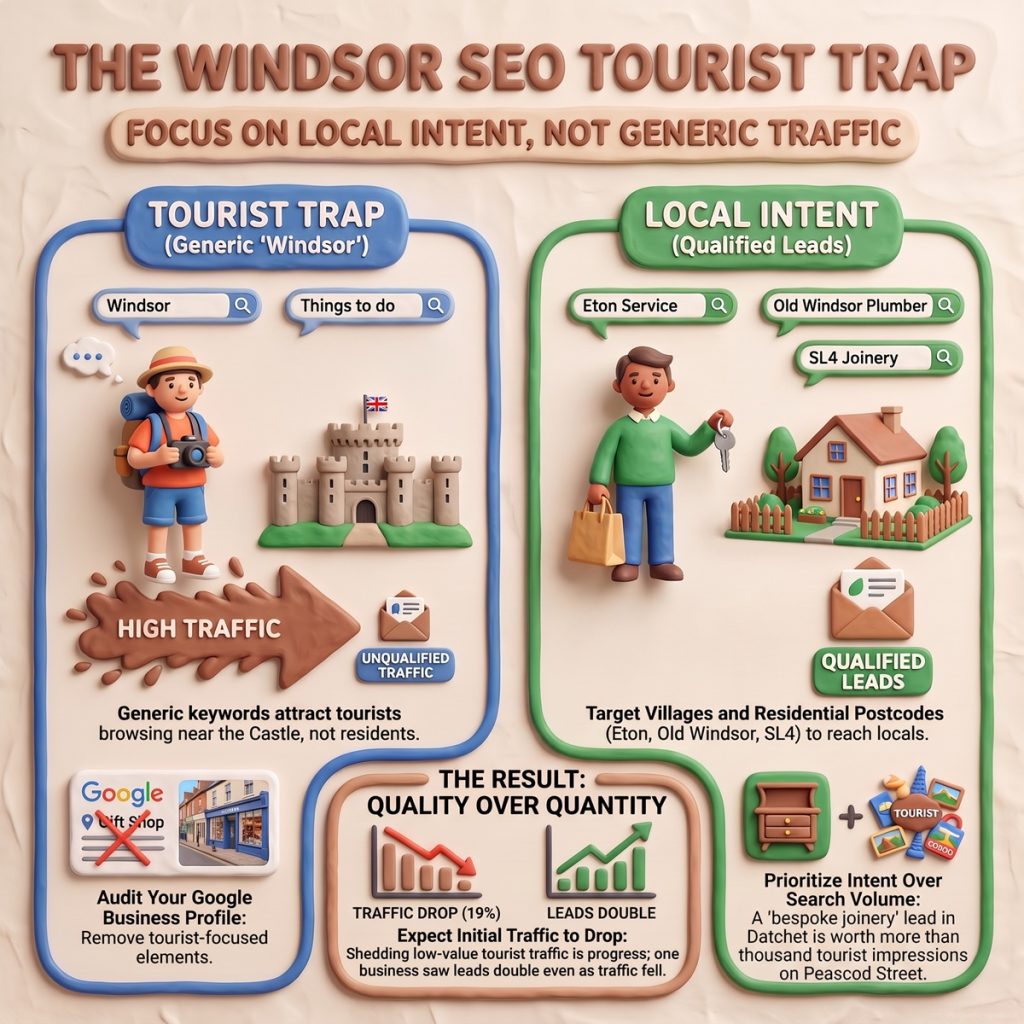
Until eighteen months ago, I would have told you SEO was mostly nonsense. We were spending £850 a month with a Thames Valley agency that treated us exactly like they treated their clients in Maidenhead, Reading, and Slough. They’d send monthly reports showing we ranked for “interior design Berkshire” and “home furnishings Thames Valley.” The traffic numbers looked reasonable. But the phone hardly rang, and when it did, it was often tourists asking if we stocked Union Jack cushions or whether we had a café.
Then something shifted, and I want to tell you what actually changed, because if your business serves Windsor’s residential market whilst sitting in a town where 8 million tourists turn up every year, you’re probably making the same expensive mistake I was.
The Problem No One Had Actually Diagnosed
Here’s what I didn’t realise: Windsor isn’t just another Thames Valley market town. It has a completely different search behaviour pattern to anywhere else in Berkshire.
When someone in Maidenhead searches for “kitchen designer near me,” they’re almost certainly a local homeowner. When someone in Windsor searches for the same thing, there’s a decent chance they’re a tourist staying at the Castle Hotel who’s browsing idly, or they’re looking for something castle-themed for a gift.
My previous agency had never even mentioned this. They optimised our Google Business Profile with photos of our showroom exterior, which happens to have Windsor Castle visible in the background. Lovely for brand, terrible for attracting serious residential customers who were trying to work out if we were a proper trade showroom or a tourist gift shop.
Our website ranked page one for “furniture shop Windsor.” But so did four tourist-focused homeware shops selling royal memorabilia and three antique dealers aimed squarely at American visitors with healthy budgets. We were getting the traffic. We were getting the impressions. We just weren’t getting the residential customers who actually spend £8,000 on a bespoke media unit.
What the Audit Actually Found
When I finally moved to a provider who’d worked in Windsor before, the audit was uncomfortable reading.
The keyword targeting was fundamentally wrong. We were ranking for broad terms that pulled in both audiences. “Interior designer Windsor” sounds like a win until you realise that half the people searching that phrase are browsing whilst they’re in town for the Changing of the Guard.
The content was making it worse. Our service pages mentioned Windsor twelve times per page, great for location signals, but we’d never once mentioned Eton, Datchet, Old Windsor, or Wraysbury. We were invisible to the homeowners in the SL4 postcode who were specifically trying to avoid the tourist-facing businesses.
Our Google Business Profile was optimised for foot traffic, not intent. We had opening hours that covered Sundays, photos emphasising our high street location, and categories that included “gift shop” because we do stock some smaller items. All of this told Google we were tourist-friendly. Which we are, but that’s about 11% of our revenue.
The biggest revelation: we weren’t ranking at all for the terms that residential customers in Windsor’s catchment actually use. Phrases like “bespoke joinery near Eton,” “kitchen designer Old Windsor,” “media unit maker SL4”, we had zero visibility. Our competitors in Ascot and Virginia Water were outranking us for our own neighbouring villages.
What a Windsor-Specific Strategy Actually Looked Like
The new approach wasn’t revolutionary. It was just specific.
Keyword separation by intent. We built separate landing pages for residential services and optimised them for the villages and postcodes around Windsor, not Windsor town centre itself. We still ranked for Windsor terms, but the on-page content and meta descriptions made it immediately clear we were a trade showroom, not a tourist stop.
Content that acknowledged the tourist economy without serving it. We added a single page for visitors that ranked for “home interiors Windsor gift” and similar, then made sure that page was a dead-end. No internal links to our main services. It soaked up the tourist traffic and kept it away from our consultation request forms.
Google Business Profile restructure. We removed “gift shop” from our categories. We changed our primary photos to show our design consultation space and workshop, not our street frontage. We added posts specifically targeting residential projects in Eton and Datchet. We shortened our Sunday hours.
Review strategy that filtered by customer type. We started specifically asking our residential customers to mention their village or project type in reviews. “Helped us redesign our Clewer kitchen” is worth infinitely more than “Lovely shop in Windsor.”
Local link building that meant something. Instead of generic Berkshire directories, we focused on Eton College suppliers, Old Windsor parish mentions, and Windsor & Eton Society affiliations. Links that carried residential intent, not tourist weight.
What Actually Changed Over Twelve Months
I’m going to give you the real numbers, because vague “we increased traffic” claims are useless.
Month 1-3: Traffic dropped 19%. This was expected and planned for. We were deliberately shedding the tourist search volume that was never going to convert.
Month 4-6: Enquiry form submissions doubled, from an average of 11 per month to 23. Crucially, the qualification rate went from roughly 40% (meaning 40% were serious residential customers) to 78%.
Month 7-9: We started ranking position 1-3 for six different “near Eton” and “Old Windsor” service terms. Our Clewer and Datchet visibility went from essentially zero to page one for our main service categories.
Month 12: Overall traffic had recovered to 91% of where it started, but the composition was completely different. Consultation bookings were up 140% year-on-year. Our cost per qualified lead dropped from approximately £89 to £34.
The bit that surprised me: our tourist traffic didn’t disappear. It just got properly contained. That single visitor-focused page still ranks, still gets traffic, and occasionally someone does buy a gift. It’s just not muddying the water anymore.
What This Means If You’re a Windsor Business Serving Residents
If you’re in Windsor and your actual customers are local homeowners, professionals, or businesses, not tourists, your SEO strategy needs to actively work against Windsor’s default search profile.
That means:
Don’t optimise for “Windsor” if you can avoid it. Optimise for the residential postcodes and villages around Windsor. Let your address do the work of telling Google you’re in Windsor; your content should be telling them who you’re for.
Your Google Business Profile is probably attracting the wrong people. If you’re open seven days, prominently feature your town centre location, and your photos show your high street frontage, you’re telling Google you want tourist foot traffic.
Generic Thames Valley SEO will hurt you. A strategy that works in Bracknell or Wokingham will actively damage you in Windsor. The tourist overlay changes everything.
You need to separate traffic by intent, not just volume. More visitors means nothing. More qualified enquiries from residential customers within your actual service area, that’s the only number that matters.
What I’d Tell My Eighteen-Months-Ago Self
Pay the extra money for someone who’s actually worked in Windsor’s specific economy. Don’t accept being lumped in with the rest of Berkshire.
Ask to see the keyword strategy before you sign anything. If they’re targeting broad “Windsor” terms without a plan to filter intent, walk away.
Expect traffic to drop before it improves. If you’ve been getting tourist volume, you need to shed it. That’s not a failure, it’s progress.
And don’t assume that ranking page one for your town name is success. In Windsor, it’s often the opposite.
Frequently Asked Questions
Q: Will focusing on surrounding villages instead of Windsor itself hurt my local visibility?
A: Not if you’re still physically located in Windsor. Your Google Business Profile and NAP citations will maintain your Windsor presence, but your content strategy can and should focus on where your actual customers live. We found this improved overall visibility because we stopped competing in the overcrowded tourist-intent Windsor terms.
Q: How long does it realistically take to shift from tourist traffic to residential traffic in Windsor?
A: In our case, about four months before we saw the enquiry quality improve, and seven months before the volume recovered. The timeline depends on how entrenched your tourist visibility is and how competitive your residential keywords are. Expect a temporary dip, it’s the cost of correction.
Q: Is it worth having separate pages for tourist visitors, or should I just ignore that traffic entirely?
A: We found a single contained page useful, it ranks for gift/visitor terms and keeps that traffic from cluttering our analytics and conversion tracking. But it’s isolated from the main site structure. Don’t spend meaningful time or budget on it; just let it exist as a filter.
Q: Can I do this myself or do I need Windsor-specific SEO expertise?
A: The strategy isn’t technically complex, but the keyword research and intent filtering require local knowledge. If you don’t know which villages and postcodes carry residential intent versus tourist overspill, you’ll struggle. Most general SEO contractors won’t pick up on Windsor’s dual-audience problem without prompting, we’d been working with a competent agency for four years and they’d never raised it.
If your Windsor business has been investing in SEO without seeing the right kind of enquiries come through, it’s worth having someone audit whether you’re accidentally optimised for the wrong audience. We’ve worked with businesses across Windsor’s residential economy, [get in touch](https://thickrope.com/contact/) for a straight conversation about what’s actually showing up in your search visibility and whether it matches who you’re trying to reach.