
Why Windsor’s Three Economic Identities Require an SEO Company That Actually Understands the Town
If you’re running a business in Windsor and your SEO company treats the town as just another Thames Valley location, you’re likely paying for a strategy that only works for one slice of your potential market.
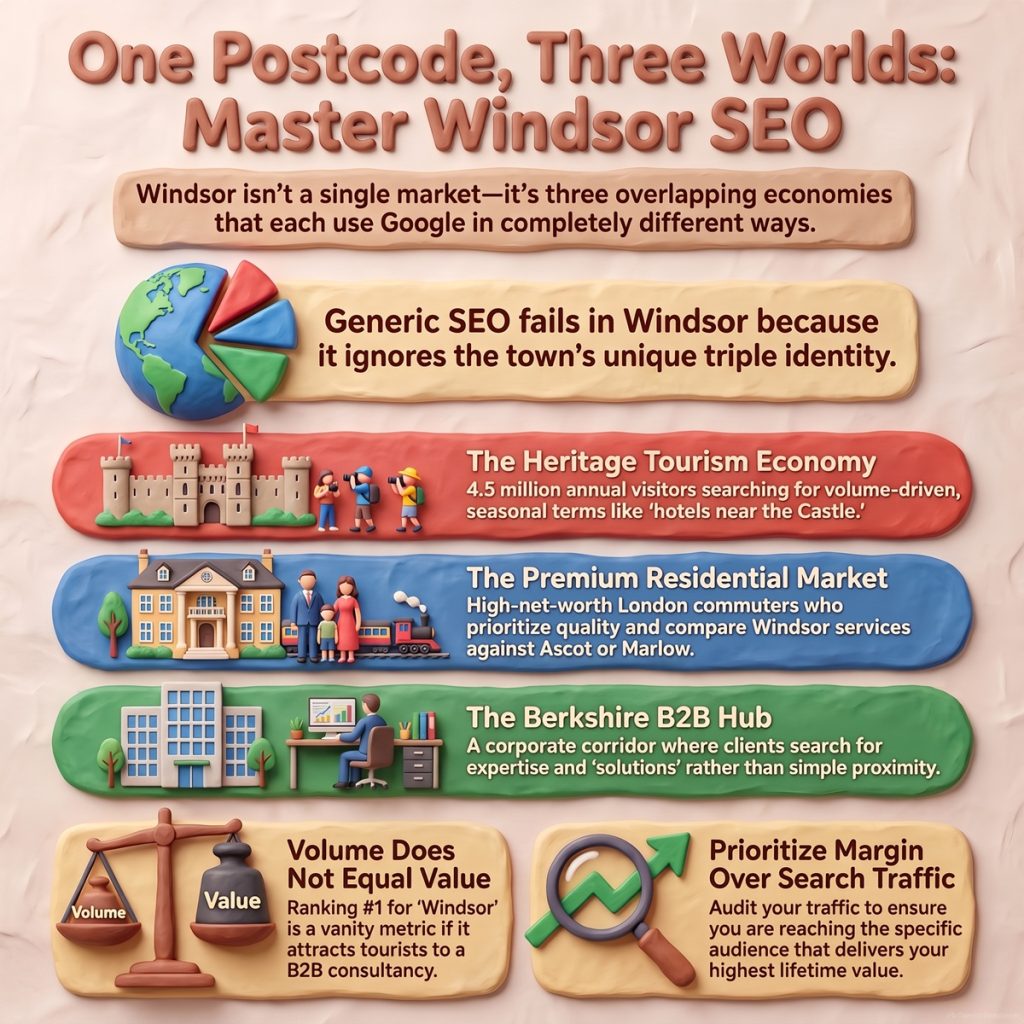
Windsor operates as three distinct economies occupying the same postcode. There’s the heritage tourism economy, 4.5 million visitors annually coming for the Castle and the pageantry. There’s the premium residential market, London professionals who live here and commute, bringing City-level expectations to local services. And there’s the Berkshire business hub, professional services, corporate headquarters, and B2B commerce that has nothing to do with the Royal connection.
Most SEO companies pick one of these audiences and optimise accordingly. That’s not incompetence, it’s just easier. But it means a Windsor hotel captures tourism traffic whilst missing the corporate hospitality market. A restaurant ranks for “afternoon tea Windsor” but never appears when a Maidenhead finance director searches for “business lunch venues near Windsor”. A solicitor’s practice dominates “family law Berkshire” but remains invisible to the High Net Worth individuals actually living in SL4.
The complexity isn’t just academic. It determines whether your SEO investment returns £3 for every £1 spent or burns budget on the wrong audience entirely.
How Windsor’s Economic Split Actually Emerged
Windsor’s triple identity isn’t new, but the commercial pressure it creates for local businesses has intensified dramatically over the past fifteen years.
The tourism economy has always been there, William the Conqueror built the Castle in the 11th century, and it’s been a visitor attraction ever since. By 2010, Windsor was already receiving roughly 3 million annual visitors. That grew to 4.5 million by 2019, making it one of the most visited towns outside London. The Royal Wedding in 2018 generated a global media audience of 1.9 billion and cemented Windsor as a brand recognised worldwide.
The residential transformation happened faster. The Elizabeth Line extension plans, announced in the mid-2000s and operational by 2022, turned Windsor into a genuine 45-minute commute to central London. Property prices responded accordingly, average house prices in Windsor rose from £430,000 in 2010 to over £650,000 by 2023, outpacing both Berkshire and UK averages. That demographic shift brought different spending patterns, service expectations, and search behaviours.
The B2B economy is the part most outsiders miss entirely. Windsor Business Park houses over 100 companies. The town sits within the Thames Valley business corridor, surrounded by Slough Trading Estate, Maidenhead’s office market, and Bracknell’s tech sector. Companies locate here precisely because Windsor offers corporate credibility without London costs.
Each economy uses Google differently. Tourism searches are volume-driven, seasonal, heavily mobile, and dominated by out-of-area users searching “things to do in Windsor” or “hotels near Windsor Castle”. Residential searches are quality-focused, repeat in nature, and often compare Windsor providers against options in Maidenhead, Ascot, or even Marlow. B2B searches are solutions-oriented, often start outside Windsor entirely (“accountant Berkshire”), and convert based on expertise rather than proximity.
An SEO company that doesn’t recognise these differences will optimise your site for whichever pattern they encounter first, and you’ll rank beautifully for an audience you don’t actually want.
What Genuine Windsor SEO Expertise Actually Looks Like
Understanding Windsor’s economic split isn’t enough. The SEO company you work with needs to translate that understanding into how they structure your content, target keywords, and build authority.

Audience segmentation at keyword level. This isn’t about creating three versions of your website. It’s about recognising that “wedding venue Windsor” and “corporate event space Windsor Castle” describe the same physical offering but attract entirely different searchers with different conversion values. A competent Windsor SEO strategy identifies which audience segments matter most to your business model, then prioritises accordingly. A hotel might target tourism for volume and corporate for margin. A restaurant might focus on residential repeat business rather than one-time tourist traffic. The wrong priority costs you revenue even when rankings improve.
Geographic context that extends beyond the postcode. Windsor businesses don’t just compete with other Windsor businesses. A Michelin-level restaurant competes with Bray, three miles away. A corporate training venue competes with Heathrow hotels. A family solicitor competes with practices across Berkshire. Effective SEO means understanding where your actual customers are searching from and what alternatives they’re evaluating. Local SEO for a Windsor business often means ranking in Ascot, Eton, Slough, and Maidenhead, not just SL4.
Content strategies that acknowledge Windsor’s reputation premium. Windsor carries associations, heritage, quality, Royal endorsement, that other Thames Valley towns simply don’t. Some businesses benefit from amplifying that connection. Others need to distance themselves from it to avoid being pigeonholed as tourist-focused or overpriced. An SEO company that defaults to “leverage the Royal brand” for every Windsor client fundamentally misunderstands the market. A B2B software consultancy gains nothing from ranking for “Windsor Castle area businesses” and potentially loses credibility with corporate buyers who want expertise, not location-based branding.
Seasonal traffic management. Tourism in Windsor peaks during school holidays, Royal events, and summer months. If your business relies on residential or B2B customers, you need SEO strategies that maintain visibility when tourism-related searches dominate local results. That often means shifting budget toward more specific long-tail keywords or increasing investment in off-season months when cost-per-click drops and competition eases. Few SEO companies think in these terms, they optimise for average traffic patterns, which means your visibility suffers precisely when you most need it.
Reputation signals that match your actual market position. Google increasingly factors third-party reputation signals into local rankings, reviews, citations, mentions in local media. But “local” means different things depending on which Windsor economy you’re serving. A tourism-focused business benefits from TripAdvisor, VisitBritshire, and travel blogs. A residential service provider needs Google reviews, local Facebook groups, and mentions in Berkshire community publications. A B2B company needs industry-specific directories, case studies, and trade press coverage. An SEO company working across all three audiences needs to know which signals Google weights most heavily for each sector, and where to focus your limited time accordingly.
The Commercial Reality: Most Windsor Businesses Straddle Two Economies
Very few Windsor businesses operate in just one of these three markets. That’s where strategy gets genuinely difficult.
A Windsor accountancy practice might serve local SMEs (Berkshire commerce), handle tax planning for High Net Worth residents (premium residential), and provide services to hospitality businesses dependent on tourism. Each audience searches differently, evaluates differently, and converts differently. The residential client wants a personal recommendation and checks your Google reviews. The SME client searches “accountant near me” and wants same-day response. The hospitality client needs sector-specific expertise and searches “accountant for hotels UK” without geographic limitation.
The wrong approach is trying to be everything in your SEO. The right approach is understanding which audience delivers the highest lifetime value and lowest acquisition cost, then building your core SEO strategy around that segment whilst ensuring you don’t accidentally repel the others.
This requires actual data, not assumptions. Many Windsor businesses think they know which customer segment is most valuable, but haven’t measured it. A restaurant might assume tourists are their bread and butter because they generate volume, whilst the residential repeat customers who visit monthly actually deliver 60% of annual profit. If your SEO strategy prioritises volume over value, you’re optimising for revenue that doesn’t reach your bottom line.
An SEO company worth working with will ask which customers you want more of, not just which keywords you want to rank for. They’ll look at your actual conversion data, customer lifetime value, and capacity constraints before recommending a strategy. If they don’t ask these questions in the first conversation, they’re not doing Windsor SEO, they’re doing generic local SEO that happens to be located in Windsor.
What Windsor Businesses Should Demand From an SEO Company
You shouldn’t need to become an SEO expert to know whether your agency understands Windsor. Here’s what competence looks like in practice.
They audit your existing traffic by audience type. Before recommending anything, they should analyse which of Windsor’s three economies currently drives your organic traffic, what those visitors actually do on your site, and whether that aligns with your business model. If 70% of your traffic comes from tourism-related searches but you’re a B2B service provider, that’s not an SEO success, it’s a targeting failure.
They can articulate your competitive set accurately. Ask them who you’re actually competing against in search results. If they only list other Windsor businesses, they don’t understand your market. Your real competitors might be in Maidenhead, Slough, or not geographically bound at all.
They recommend keyword priorities based on commercial value, not search volume. “Windsor” as a keyword modifier generates substantial search volume, but much of it is worthless to businesses outside tourism. An SEO company that prioritises “Windsor [your service]” over more specific, lower-volume terms that attract your actual buyers is optimising for vanity metrics.
They understand the difference between brand association and brand dependency. Some Windsor businesses benefit from the Royal/heritage connection. Others are harmed by it because it suggests they’re tourist-traps or overpriced. A good SEO company knows which category you’re in and adjusts content strategy accordingly.
They track beyond rankings. Rankings are necessary but not sufficient. Traffic from the wrong audience is waste. An SEO company should report on assisted conversions, traffic quality segmented by keyword theme, and ultimately revenue attributed to organic search, not just “you’re now ranking #3 for this keyword”.
Why Location-Agnostic SEO Agencies Struggle With Windsor
Many excellent SEO companies operate nationally or internationally and deliver strong results for most clients. But Windsor is genuinely unusual, and remote agencies working from templated local SEO playbooks often miss the nuances that matter.
The standard local SEO approach optimises for “[service] near me” and “[service] [town name]” keywords, builds citations in local directories, encourages Google reviews, and creates content around local landmarks. For a plumber in Swindon or a solicitor in Exeter, this works perfectly well.
For a Windsor business, it’s incomplete at best and counterproductive at worst. Optimising for “near me” when your actual customers are searching from Ascot or Sunningdale means you’re invisible in the moments that matter. Building content around Windsor Castle when you’re a B2B consultancy creates brand associations that repel your target market. Treating Windsor as a single local market when it’s demonstrably three means you optimise for one and ignore the others.
This isn’t a criticism of national agencies, it’s a reality of scalability. To service hundreds of clients economically, you need standardised processes. Local nuance doesn’t scale. But Windsor requires nuance to work properly, which means you need an SEO company that either has genuine Windsor-specific experience or invests the time to develop it for your account specifically. Most won’t. The economics don’t support it.
The Diagnostic Question Every Windsor Business Should Ask
If you’re evaluating an SEO company, ask them this: “Which of Windsor’s three economic audiences should we prioritise, and why?”
If they don’t understand the question, they won’t deliver effective Windsor SEO. If they answer immediately without asking about your business model, margins, and capacity, they’re guessing. If they suggest targeting all three equally, they don’t understand prioritisation or budget constraints.
The right answer starts with questions back to you: What’s your customer acquisition cost by channel currently? What’s the lifetime value difference between customer types? What’s your capacity to serve different audiences? Where are your highest-margin opportunities? Only after understanding your commercial reality can anyone recommend an SEO strategy that actually serves your business rather than just generating traffic.
Windsor’s economic complexity makes it a difficult market for SEO, but that same complexity creates opportunity. Businesses that get their targeting right face less competition because most of their peers are inadvertently targeting different audiences. The premium residential market in particular is underserved by local SEO because so many Windsor businesses default to tourism-focused strategies.
But capturing that opportunity requires working with an SEO company that genuinely understands what makes Windsor unusual, not just as a matter of local colour, but as a commercial reality that determines where your budget goes and who sees your business when they search.
If you’re running a Windsor business and suspect your current SEO strategy is targeting the wrong audience entirely, we should talk. Thickrope has worked with Thames Valley businesses for over 25 years, we’ll audit your existing traffic against Windsor’s three markets and show you exactly where the opportunity is.