

How to Choose a PPC Agency in Sheffield That Actually Understands Your Market
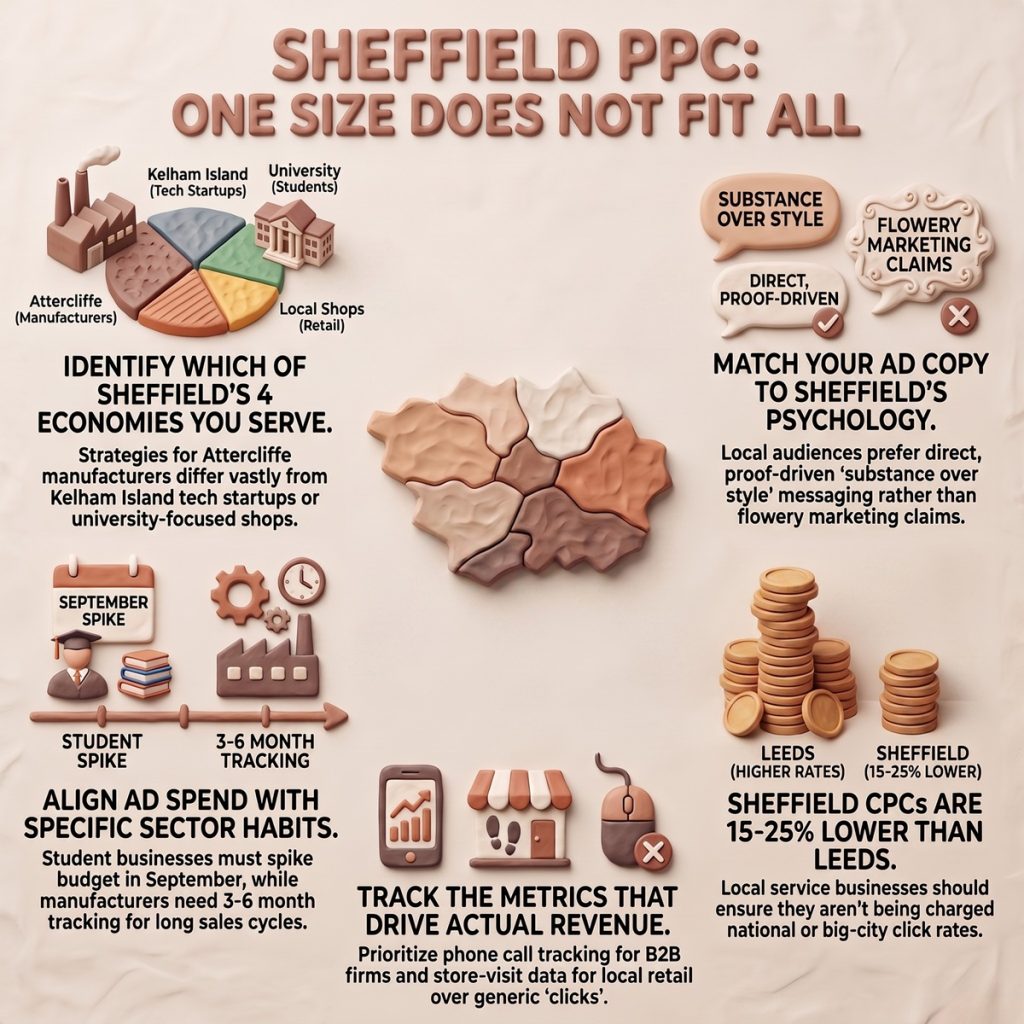
Sheffield isn’t one business community, it’s at least four, and the PPC strategy that works for a precision engineering firm in Attercliffe won’t work for a coffee shop near the universities or a SaaS startup in the Cultural Industries Quarter.
Yet most PPC agencies pitch the same approach to every Sheffield business: Google Ads, Shopping campaigns if you sell products, some remarketing, monthly reports. That’s not wrong, it’s just incomplete if your agency doesn’t understand which Sheffield audiences actually convert for your business and which ones waste your budget.
After 25 years running campaigns for businesses across the UK, we’ve learned that local market knowledge isn’t about mentioning the Crucible Theatre in your ad copy. It’s about knowing that a manufacturer selling to procurement teams nationwide needs a completely different keyword strategy than a gym targeting postcode sectors S1 through S11.
This guide walks you through what genuine Sheffield market understanding looks like when you’re evaluating PPC agencies, specifically, how they account for the city’s unusual economic mix in their proposals.
What Sheffield Market Knowledge Actually Means in a PPC Proposal
When an agency claims to “understand Sheffield,” here’s what that should look like in practice:
They Ask Which Sheffield Economy You’re Part Of
Sheffield has four distinct business ecosystems, and your PPC strategy changes significantly depending on which one you operate in:
Manufacturing and engineering businesses (often B2B, often exporting): Your buyers aren’t in Sheffield. They’re searching from procurement departments in Milton Keynes, Munich, or Michigan. Geographic targeting to Sheffield makes no sense. Your campaigns need industry-specific keywords, LinkedIn integration, and conversion tracking that accounts for 3-6 month sales cycles. An agency that suggests postcode targeting for a precision components manufacturer doesn’t understand your market.
Digital, creative, and tech sector (concentrated around the Cultural Industries Quarter and Kelham Island): You’re competing nationally or internationally, but you might also hire locally. Your PPC needs differ by whether you’re selling services, recruiting talent, or both. Student populations matter if you recruit graduates. An agency should ask about your hiring calendar and whether you need separate campaigns for client acquisition versus recruitment.
Student economy businesses (hospitality, retail, entertainment, accommodation): You have two completely different customer bases with opposite cash flow patterns, term-time students and everyone else. Your PPC should shift budget between these audiences seasonally. September and January are your peak acquisition months. An agency that doesn’t ask about term dates doesn’t understand Sheffield’s demographic pattern.
Local retail, hospitality, and services: Your competition is both city-centre chains and neighbourhood independents. Geographic targeting matters, but so does understanding that Sheffield sprawls, someone in S35 (Chapeltown) isn’t driving to S7 (Abbeydale Road) for a haircut. Radius targeting needs to be tight, and you need location extensions configured properly.
A good agency asks which category you’re in during the first conversation. A mediocre one assumes you’re local retail and builds accordingly.
They Recognise Sheffield’s Business Psychology
Sheffield’s business community has a specific character that affects how PPC campaigns should be built:
The city has a deep manufacturing heritage, which means even businesses that aren’t manufacturers often think like them, they value substance over style, they’re sceptical of marketing claims, and they want to see the numbers. Your PPC campaigns shouldn’t be flowery. Ads that work in Brighton or Bristol often feel too “marketing-y” for Sheffield audiences. An agency that understands this writes different ad copy, more direct, more proof-driven, fewer superlatives.
Sheffield businesses often compete on precision and quality rather than price alone. If you’re a high-end joiner or a specialist engineering firm, your PPC shouldn’t be fighting for bargain-hunters. Negative keywords matter more than most agencies admit. An agency with Sheffield experience should ask about which customers you don’t want and build negative keyword lists accordingly. Otherwise, you’ll get clicks from people who’ll never pay your rates.
The city’s digital sector is newer but growing fast. If you’re in tech or creative services, you’re often competing against Leeds, Manchester, and national players. Your PPC needs to articulate why Sheffield, lower costs, talent from two universities, quality of life. An agency that just copies Manchester tech sector campaigns won’t differentiate you properly.
They Know Where Sheffield Searches Happen
Search behaviour varies by sector:
B2B manufacturing and engineering: Much of your search volume happens during business hours, often from company networks. Mobile traffic is lower than consumer sectors. If an agency is pushing mobile-first campaigns without asking about your customer research behaviour, they’re guessing.
Student-adjacent businesses: Mobile is dominant. Instagram and Facebook matter as much as Google for discovery. Evening and weekend search spikes. Term-time versus vacation search volume can differ by 40-60%. If an agency doesn’t ask about your Analytics data to check this, they’re not doing due diligence.
Local services: “Near me” searches matter, but Sheffield’s geography means someone searching “near me” in Hillsborough has different intent than someone in Ecclesall. Hyperlocal targeting requires understanding Sheffield’s neighbourhood structure. An agency should ask which areas you want to serve and which you don’t.
What to Look For in a Sheffield PPC Proposal
Beyond the market understanding, here’s what separates a good PPC proposal from a generic one:
Budget Allocation That Matches Your Business Model
Most agencies suggest splitting budget evenly across campaigns or weighting toward Search. But the right allocation depends entirely on your sector:
- Long sales cycle B2B: More budget to Display and YouTube for brand building, less to Search (which captures existing demand but doesn’t create it). Remarketing is critical because purchase decisions take months.
- Student economy businesses: Heavy weighting toward paid social, particularly September and January. Search budget should spike before term starts, not during.
- Local services: Search-heavy is correct, but Shopping campaigns matter even for services if you sell any products. Local Services Ads (the Google Guaranteed listings) should be mentioned if you’re in an eligible category, many agencies ignore them because they’re not traditional PPC.
If an agency proposes the same budget split for a manufacturer and a restaurant, they’re not thinking strategically.
Keyword Strategy That Reflects Sheffield’s Competition
Sheffield sits between Leeds and Manchester, which means:
Cost-per-click in Sheffield is generally lower than those cities, typically 15-25% less for many local service categories. If you’re a local business, you shouldn’t be paying Leeds prices. An agency should know approximate CPC ranges for your sector before the proposal.
But if you’re targeting nationally, Sheffield’s location is irrelevant to your CPC. You’re paying national rates. An agency that promises “better value because we’re local” for a B2B national campaign doesn’t understand how Google Ads pricing works.
Competitor bidding needs local context. If you’re competing against specific Sheffield businesses, should you bid on their brand terms? That’s a strategic question that depends on your market position and budget. An experienced agency should have a point of view on this and explain the trade-offs.
Conversion Tracking That Matches Your Sales Process
This is where most agencies reveal whether they understand your business:
Manufacturers and B2B firms: Phone calls are often your primary conversion. Form fills matter, but most serious buyers ring. If an agency’s proposal doesn’t mention call tracking and call recording integration, they’re not set up to track your actual leads. You’ll be optimising for form fills whilst missing half your conversions.
Retail and hospitality: Foot traffic matters as much as website conversions. Store visit tracking (Google’s location-based conversion measurement) should be mentioned if you have physical premises. Click-to-call and directions requests are conversions, not just purchases.
Service businesses: Booking systems, phone calls, and enquiry forms all convert differently. An agency should ask about your CRM or booking platform and whether API integration is possible. Otherwise, you won’t know which keywords drive revenue versus which ones drive tyre-kickers.
If an agency’s proposal talks only about “conversions” without specifying what they’re tracking and how, push back. Generic conversion tracking tells you almost nothing useful.
The Questions a Sheffield-Savvy Agency Should Ask You
Here’s a practical checklist. A good agency should ask at least 8 of these 10 questions before proposing anything:
1. Which audience matters to you, Sheffield locals, Yorkshire region, UK-wide, or international? (This determines geographic targeting entirely.)
2. What’s your sales cycle length? (This determines whether you need brand awareness campaigns or just conversion-focused Search.)
3. What percentage of your leads close, and what’s average customer value? (This determines whether £50 or £500 cost-per-lead is acceptable.)
4. Do people ring you or fill in forms? (This determines tracking setup.)
5. Are there customers you specifically don’t want? (This determines negative keyword strategy.)
6. Do you have dead periods or seasonal peaks? (This determines budget scheduling.)
7. What do your best customers search for before they find you? (This determines initial keyword targeting, most businesses don’t actually know this.)
8. Who are you competing against, local Sheffield businesses, regional players, or national brands? (This determines bid strategy and budget requirements.)
9. What’s worked or failed in your marketing before? (This prevents repeating expensive mistakes.)
10. What does success look like in numbers, leads per month, revenue, cost per acquisition? (This determines whether the budget you’re considering is realistic.)
If an agency doesn’t ask these questions, they’re building campaigns on assumptions. That works occasionally. More often, it wastes money for three months whilst they “optimise” toward a target they never properly defined.
Red Flags When Evaluating Sheffield PPC Agencies
Watch for these warning signs:
They guarantee first position for competitive keywords. Ad position depends partly on your bid and partly on ad quality, but it’s an auction. No one controls it absolutely. Guarantees are either lies or they’re bidding so high you’ll overpay.
They promise specific conversion numbers before understanding your website and offer. PPC gets people to your site. If your site doesn’t convert, no amount of PPC skill fixes that. An honest agency audits your landing pages before promising conversion rates.
Their portfolio shows only retail or only B2B. Sheffield’s diversity means you want an agency that’s handled different business models. Single-sector agencies often can’t adapt their approach.
They don’t mention negative keywords or audience exclusions. Stopping the wrong people from clicking is as important as attracting the right ones. Agencies that focus only on getting more traffic often waste more budget.
They want 12-month contracts before proving results. PPC results show within 4-8 weeks. Long-term contracts make sense after you’ve seen performance, not before. Initial engagements of 3-6 months are reasonable; 12 months upfront is a red flag unless you’re committing to a very large budget where planning horizon matters.
What Sheffield Businesses Actually Need From PPC
Beneath all the tactical decisions, here’s what matters:
You need an agency that builds campaigns for your business model, not a template. Sheffield’s economic diversity means there’s no standard approach. Manufacturing, digital, student economy, and local retail businesses need fundamentally different strategies.
You need someone who’ll tell you when PPC isn’t the answer. Sometimes SEO matters more. Sometimes your website is the problem. Sometimes your offer isn’t competitive. An agency that always recommends PPC regardless of situation is selling, not advising.
You need tracking that shows business results, not marketing metrics. Impressions and clicks don’t matter. Enquiries, sales, and return on investment matter. If your reports don’t connect PPC spend to revenue, you can’t make informed decisions.
You need an agency that understands Sheffield isn’t London, but also isn’t sleepy. The city has serious businesses competing nationally and internationally. Patronising “local” strategies that assume small ambitions miss the point. Sheffield businesses often punch above their weight, your PPC should too.
Frequently Asked Questions
Q: Should I choose a Sheffield-based PPC agency or does location not matter?
A: Location matters less than sector experience and communication quality. A Sheffield-based agency might understand local context better, but a Manchester or Leeds agency with strong manufacturing B2B experience could be better for a Sheffield manufacturer than a Sheffield agency that mostly handles retail. Prioritise expertise in your business model over postcode. That said, if you value face-to-face meetings, local matters more.
Q: What’s a realistic PPC budget for a Sheffield small business?
A: It depends entirely on your sector and goals, but as a rough guide: local services competing in Sheffield typically need £800-2,000/month to see meaningful results; B2B with longer sales cycles often need £1,500-4,000/month because you’re building brand awareness, not just capturing immediate demand; student-economy businesses might spend £600-1,500/month but concentrated in September, January, and pre-term periods. Below £500/month, you’re often spending more on management fees than ads, and results are patchy. An honest agency should tell you if your budget isn’t realistic for your goals.
Q: How long before I see results from PPC?
A: You’ll see traffic within days, but meaningful business results take 4-8 weeks because the agency needs time to see which keywords and ads actually convert, not just get clicks. Manufacturing and B2B with long sales cycles might need 3-4 months to see closed deals because your sales process is slower. Anyone promising “immediate results” is overselling, setup, testing, and optimisation take time. But you should see leading indicators (clicks, enquiries, calls) within the first month. If you see nothing after 6-8 weeks, something’s wrong.
Q: Should my PPC agency manage my social media ads too?
A: Depends on the agency’s strength. Google Ads and Facebook/Instagram ads require different skills, Google captures existing demand whilst social creates demand. Some agencies do both well; many are stronger at one. For Sheffield businesses in the student economy or hospitality, social ads often matter more than Search. For B2B manufacturing, LinkedIn might be more relevant than Facebook. Ask to see specific platform results, not just general “paid advertising” case studies. If they’re genuinely strong in both, yes. If they’ve added social as an afterthought, probably find a specialist.
Q: What’s the difference between paying an agency and just running Google Ads myself?
A: You can absolutely run Google Ads yourself, the platform is accessible, and Google provides guidance. The difference is time and expertise: you’ll spend 10-15 hours learning initially, then 3-5 hours weekly managing and optimising. An agency has already made the expensive mistakes on other clients’ budgets, knows which shortcuts work, and can typically get better results faster. For very small budgets (under £500/month) or very simple campaigns (one service, one location), DIY often makes sense. For anything more complex, multiple services, B2B lead generation, tracking phone calls, most businesses save money overall by hiring expertise, even after the management fee. It’s a trade-off between your time and their experience.
If you’re evaluating PPC agencies and want a second opinion on proposals you’ve received, or you’d like to discuss what realistic results look like for your specific Sheffield business, we’re happy to talk through the options with no obligation. Book a consultation with Thickrope and we’ll give you an honest assessment of whether PPC makes sense for you right now.