

“I Thought £800 a Month Was Low Enough Not to Mess Up”, What a Sheffield Business Owner Discovered When a PPC Specialist Finally Reviewed Their Google Ads
I’d been running our Google Ads account for about eighteen months. Small budget, £800 a month, sometimes £900 if we had a good month. I’d watched a few YouTube tutorials, read Google’s help docs, and figured that at this level of spend, how badly could I really mess it up?
The answer: badly enough to waste roughly £11,000.
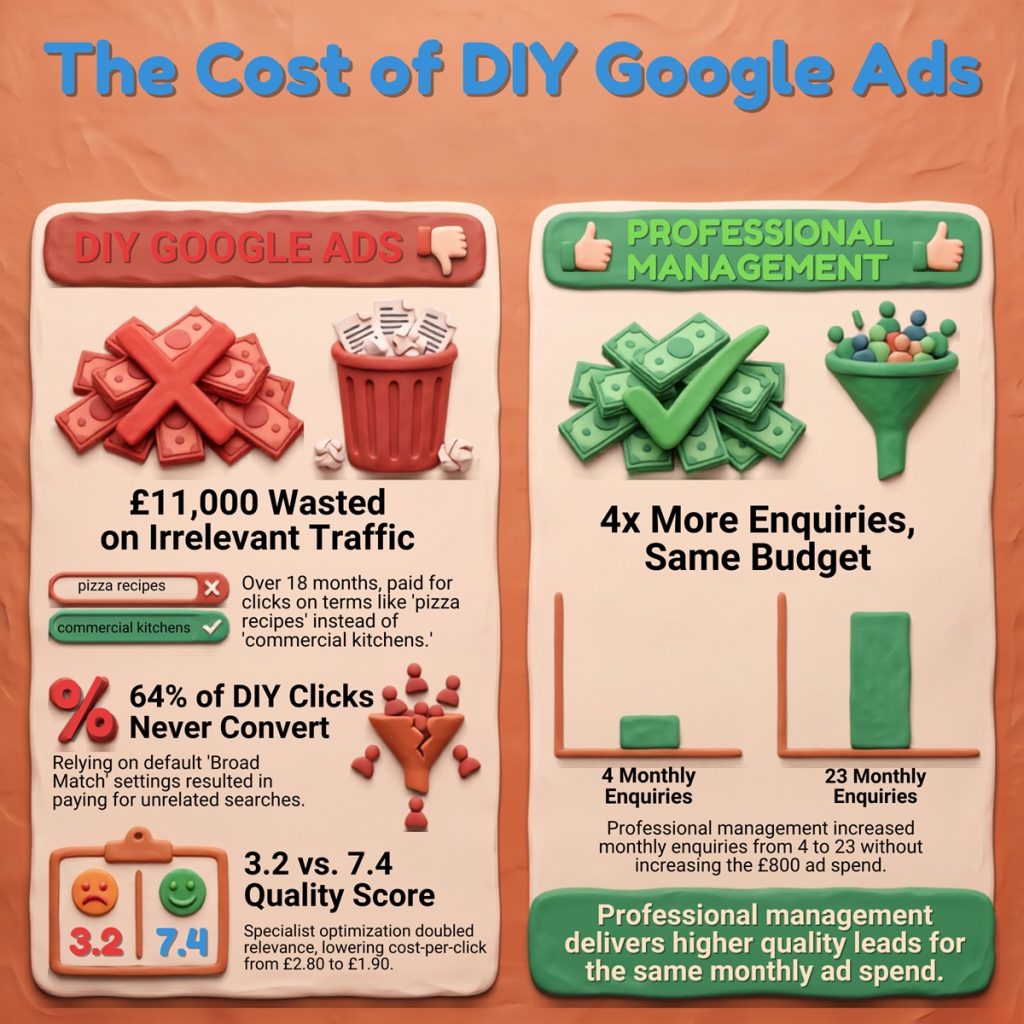
That’s the figure the PPC specialist gave me when they finally reviewed the account. Not money that vanished into thin air, but budget that delivered almost nothing in return, clicks from people who were never going to buy, search terms that had nothing to do with what we actually sold, and campaigns structured so poorly that Google was charging us two or three times what we should’ve been paying per click.
I’m a Sheffield-based business owner. We manufacture and install commercial kitchen equipment across South Yorkshire and the East Midlands. Good margins, long sales cycles, and a very specific target customer. I’m not naming the company because frankly, I’m still a bit embarrassed about how long I let this run.
But if you’re reading this and you’ve been managing your own Google Ads on a “small” budget, thinking you can’t afford to hand it to someone else, this is what I wish someone had told me eighteen months earlier.
The Review That Changed Everything
The specialist I eventually spoke to, after a particularly frustrating month where we’d spent £890 and generated exactly one enquiry, offered a free account review. No obligation, just a look under the bonnet.
I expected them to tell me the budget was too low or that PPC “doesn’t work” for our industry. Instead, they sent me a twelve-page document that was basically a list of everything I’d got wrong.
The Search Terms I Was Actually Paying For
This was the part that made me wince. I thought I’d set up the campaigns to target commercial kitchen installers, catering equipment suppliers, and similar terms. What I was actually paying for:
- “Second-hand kitchen units Sheffield” (we don’t sell second-hand, and we’re not domestic)
- “Cheap restaurant equipment” (our average order is £18,000, not the market for “cheap”)
- “Kitchen fitter jobs Sheffield” (I’d been paying for clicks from people looking for employment)
- “Pizza oven recipes” (I genuinely don’t know how this one happened)
Google’s default match type is broad match. I didn’t know that. So every keyword I’d added was triggering ads for loosely related, or completely unrelated, searches. Over eighteen months, 64% of my clicks came from search terms that had nothing to do with commercial catering equipment.
At an average cost-per-click of about £2.80, that’s roughly £7,100 on traffic that was never going to convert.
The Quality Score Problem
Every keyword in Google Ads gets a Quality Score from 1 to 10. It’s Google’s way of measuring how relevant your ad and landing page are to the search term. Higher scores mean lower costs and better ad positions.
My average Quality Score across all active keywords: 3.2.
The specialist explained that anything below 5 is essentially Google telling you that your ads are a poor match for what people are searching. You pay more per click, your ads show lower on the page, and you’re competing with one hand tied behind your back.
For context, a well-managed account in our industry should be averaging 7 or above.
The reason mine was so low: I was sending everyone to our homepage. Someone searching for “commercial dishwasher installation Sheffield” landed on a generic page with our full product range, company history, and a contact form. No specific information about dishwashers, no installation pricing, no case studies.
Google saw the mismatch. So did the people clicking. Most of them left within seconds.
What Changed When I Finally Handed It Over
I signed up for PPC management in early March. The agency I chose, a Sheffield-based outfit, rebuilt the account from scratch. Here’s what the first properly managed quarter (April to June) actually delivered.
Budget: £2,400 (same £800/month)
- Clicks: 287 (down from an average of 321 per month previously)
- Enquiries: 23 (up from an average of 4 per month)
- Qualified leads: 12 (previously, I’d been lucky to get 2)
- Sales: 3, totalling £52,000
The previous eighteen months, running it myself on the same budget, had generated roughly 72 enquiries total and closed seven sales.
Three months with a specialist: twelve qualified leads and three sales. One of those sales alone paid for a year’s worth of management fees.
What Actually Changed in the Account
I asked for a plain-English explanation of what they’d done differently. No jargon, just the changes that mattered.
1. Negative keywords everywhere
They added over 200 negative keywords in the first week, terms like “jobs,” “courses,” “DIY,” “residential,” “second-hand,” and dozens of specific product terms we don’t sell. This stopped my ads showing for irrelevant searches.
The click volume dropped, but every click was now from someone actually looking for commercial equipment.
2. Exact match and phrase match only
They switched everything from broad match to exact and phrase match. Much tighter control over what triggers the ads. I’m no longer paying for Google’s “interpretation” of what my keywords mean.
3. Dedicated landing pages for each campaign
They built (well, worked with our web developer to build) specific landing pages for each product category. Someone searching for commercial ovens now lands on a page entirely about commercial ovens, models, pricing, installation, case studies from South Yorkshire businesses.
Quality Scores jumped to an average of 7.4 within six weeks. Cost-per-click dropped from £2.80 to £1.90.
4. Geographic targeting that actually made sense
I’d set my campaigns to target “Sheffield” because that’s where we’re based. But we install across South Yorkshire, Derbyshire, Nottinghamshire, and Lincolnshire.
They expanded the targeting to cover our actual service area and adjusted bids by location, higher bids for Sheffield and Rotherham (our core areas), lower bids for the edges of our range.
5. Ad schedules based on when we can actually answer the phone
This one felt obvious in hindsight. I’d been running ads 24/7. They scheduled ads to show Monday to Friday, 8am to 6pm, and Saturday mornings, the times when our office is staffed and we can respond to enquiries immediately.
No more paying for clicks at 11pm on a Sunday from someone who’s moved on to a competitor by Monday morning.
What It Actually Costs to Get PPC Management in Sheffield
I’ll be straight about this because it’s the question I should’ve asked eighteen months earlier: is paying someone to manage this actually worth it at my budget level?
The agency I use charges £400 per month for management on an £800 ad spend. That felt steep at first, I’m paying 50% of my ad budget just for someone to manage the account.
But here’s the maths that made sense of it:
DIY approach (18 months):
- Total ad spend: £14,400
- Management cost: £0 (but countless hours of my time)
- Estimated wasted spend: £11,000
- Sales: 7 (approx. £126,000 revenue)
Managed approach (3 months, extrapolated):
- Total ad spend: £9,600 (12 months)
- Management cost: £4,800
- Wasted spend: minimal
- Projected sales based on Q1 performance: 12 (approx. £208,000 revenue)
Even accounting for seasonal variation and the fact that Q1 happened to be strong for us, the managed approach is delivering at least 60% more revenue for roughly the same total investment (ad spend + management).
And I’m getting my evenings and weekends back. I was spending at least four or five hours a month fiddling with the account, trying to work out why it wasn’t performing, pausing and restarting campaigns. That time’s worth something.
The Stuff I Wish I’d Known Before I Started
If you’re running your own Google Ads and you’re reading this thinking “maybe I should get someone to look at mine,” here’s what I’d tell you:
Low budget doesn’t mean low risk. I genuinely thought £800 a month was too small to worry about. But £800 a month badly spent is nearly £10,000 a year down the drain. At our margins, that’s real money.
Google wants you to spend, not to spend well. The Google Ads interface is designed to be easy to set up and hard to optimise. Broad match is the default because it generates more clicks (and more revenue for Google), not because it’s better for you. The suggestions Google makes, “add this keyword,” “increase your budget,” “expand your targeting”, are almost always about increasing spend, not improving results.
Quality Score is the thing that actually matters. I’d never even looked at Quality Score until the specialist pointed it out. It’s the single biggest lever for reducing costs and improving performance, and I’d ignored it completely.
You can’t optimise what you’re not tracking. I had Google Ads conversion tracking set up wrong. It was counting every form submission as a conversion, including contact forms, newsletter signups, and job applications. I thought I was getting 12–15 conversions a month. I was getting 3–4 actual sales enquiries.
The specialist set up proper conversion tracking in the first week so we could see exactly which keywords and ads were generating genuine leads, not just traffic.
What to Look for in a Sheffield PPC Service
I spoke to four different agencies before choosing one. Here’s what separated the good from the mediocre:
They asked about my business before talking about PPC. The agency I chose spent the first call asking about our sales process, average order value, lead times, and what actually makes a good customer for us. They wanted to understand the business outcome, not just run ads.
They were honest about timelines. I was told it would take 4–6 weeks to see meaningful improvement and a full quarter to properly evaluate performance. One agency promised “results in 14 days.” I didn’t believe them.
They explained what they’d do in the first 30 days. Rebuild the account structure, add negatives, fix tracking, create new landing pages (or advise on what was needed), and establish a baseline. Specific actions, not vague promises.
They showed me accounts they’d worked on in similar industries. Not naming clients, but showing the kind of results they’d achieved for other B2B businesses with long sales cycles and high order values. I wanted to see proof they understood how commercial sales work.
They didn’t promise a specific return. The one thing nobody can guarantee with PPC is a precise return on investment, especially in the first few months. The good agencies talked about process, optimisation, and learning. The bad ones threw out numbers like “300% ROI guaranteed.”
Is It Worth Handing Over Your Google Ads?
For me, yes. Unambiguously.
But I think the answer depends on three things:
1. How much are you currently spending?
If you’re spending less than £300–400 a month, the management fees might not make sense yet. You might be better off pausing PPC altogether and focusing on SEO or other channels until you have the budget to do it properly.
2. How much is a customer worth to you?
Our average order value is £18,000. One extra sale every quarter pays for a year of PPC management. If your average order is £200, the maths looks very different.
3. How confident are you that your current setup is working?
If you’re getting consistent, qualified leads and you know your conversion tracking is accurate, you might be fine managing it yourself. But if you’re not 100% certain you’re tracking the right things and targeting the right people, it’s worth getting a specialist to review it.
The review itself is usually free. It took about a week and cost me nothing. What it revealed cost me my pride but saved me from wasting another year’s budget.
Frequently Asked Questions
Q: How much should a Sheffield business expect to pay for PPC management?
A: Most Sheffield-based PPC agencies charge between £300 and £800 per month for management, depending on your ad spend and campaign complexity. Some charge a flat fee, others take a percentage of ad spend (typically 15–20%). For ad budgets under £1,000/month, expect to pay around £400–500 for proper management.
Q: Can I just use Google’s automated campaigns instead of hiring a specialist?
A: Google’s Smart campaigns and automated bidding can work for very simple, local businesses (like a single-location shop with a clear service area), but they give you almost no control and often waste budget on irrelevant clicks. For B2B businesses or anything with a specific target audience, manual campaign management by someone who understands your business will almost always outperform automation.
Q: How long does it take to see results from properly managed PPC?
A: You should see improvements in Quality Score and click costs within 4–6 weeks. Meaningful improvements in lead volume typically take 2–3 months as the account learns and optimises. Sales results depend on your sales cycle, for us, with a 4–8 week cycle, it took a full quarter to see the revenue impact.
If you’re a Sheffield business that’s been managing Google Ads yourself, or you’ve had it running on autopilot for months, we offer a no-obligation account review that’ll show you exactly where your budget’s going and what could be improved. You can reach Thickrope Marketing at our Sheffield office, and we’ll give you the same straight answers that finally got my own PPC working properly.