
Why Oxford’s Expensive PPC Market Actually Makes Professional Management Pay for Itself Faster
Most agencies tell you that professional PPC management is worth it because “campaigns are complex” or “you’ll save time.” Both true, but neither gets to the real point in Oxford.
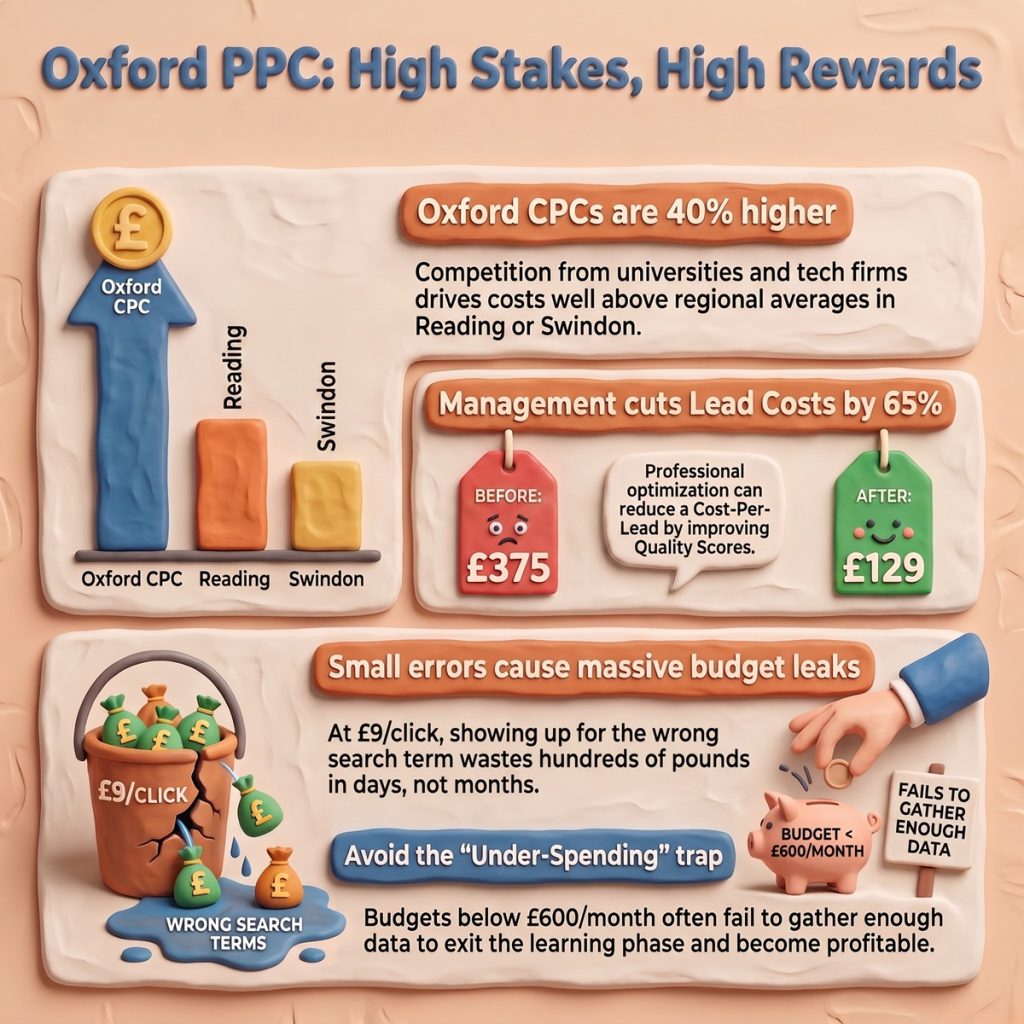
Here’s what actually matters: Oxford sits in one of the most expensive paid search markets outside central London. The concentration of well-funded universities, established professional services firms, national retailers with local branches, and venture-backed tech companies creates competition that drives cost-per-click significantly above what businesses pay in Reading, Swindon, or Milton Keynes.
In that environment, the margin between profitable and unprofitable PPC isn’t about whether you’re “doing paid search”, it’s about how precisely you’re doing it. A 20% improvement in campaign efficiency that might save £300/month in Northampton saves £600/month here. The math changes.
This isn’t an argument against running PPC in Oxford. It’s an argument that the stakes are higher, so the quality bar matters more.
What Actually Drives Oxford’s High CPCs (and Why You Can’t Avoid It)
The city’s economy creates structural upward pressure on ad costs in specific verticals:
Education and training: Oxford and Oxford Brookes bring constant demand for student accommodation, tutoring, educational services, and hospitality. National providers budget aggressively for terms like “student accommodation Oxford” because lifetime value justifies it.
Professional services: Accountants, solicitors, and consultants compete against London firms with Oxford offices and regional firms targeting the affluent OX1–OX4 postcodes. These businesses have high margins and can afford £8–£12 per click on “solicitor Oxford” terms.
Healthcare and wellness: Private medical services, dental practices, and wellness providers target one of the UK’s most affluent populations. That drives clicks for “private dentist Oxford” well above £5.
Home services: Plumbers, electricians, and builders know Oxford homeowners have property values that support premium pricing. Emergency terms like “emergency plumber Oxford” regularly exceed £15 per click.
You’re not competing with other local independents. You’re bidding against national chains with centralised marketing budgets, institutional advertisers, and businesses that have already optimised their conversion paths.
That context matters because it changes what “good enough” looks like.
The Contrarian Bit: Most Oxford Businesses Underspend on PPC, Not Overspend
The standard agency narrative is that businesses waste money on PPC by spending recklessly. In Oxford, we see the opposite problem more often.
Business owners see £6 CPCs, panic at the cost, and either:
- Set budgets so low (£300–£500/month) that campaigns never exit the learning phase
- Pause campaigns frequently, destroying historical performance data
- Obsess over cost-per-click instead of cost-per-acquisition
- Compete only on the cheapest, lowest-intent terms where competition is lighter
The result: they spend just enough to prove PPC “doesn’t work for them,” but not enough to make it work properly.
Here’s the uncomfortable truth: if your target customer acquisition cost is £150 and your close rate from enquiry to sale is 20%, you can afford a £30 cost-per-lead. At a 5% click-to-lead conversion rate, that’s £1.50 per click, comfortably below most Oxford CPCs even in expensive categories.
The businesses succeeding with Oxford PPC aren’t the ones spending least per click. They’re the ones who’ve built conversion paths that justify higher CPCs because they convert traffic efficiently.
What Professional Management Actually Does Differently in High-CPC Markets
The value of professional PPC management isn’t evenly distributed. It matters more when CPCs are high because small optimisations have larger absolute returns.
Negative keyword hygiene becomes non-negotiable: At £2/click, appearing for “free solicitor Oxford” when you’re a paid service is annoying. At £9/click, it’s £270/month disappearing on unqualified traffic. Proper negative keyword lists, built from search term reports, not guesswork, typically reduce wasted spend by 15–25% in the first month.
Ad schedule and device bid adjustments compound: If your leads from mobile between 9pm–6am convert at half the rate of desktop during business hours, but you’re paying the same CPC, you’re subsidising unprofitable traffic. In a £1,000/month Oxford campaign, proper bid adjustments usually recover £150–£200 in wasted budget within weeks.
Audience layering cuts cost-per-conversion, not just CPC: Showing different ad copy and landing pages to people who’ve already visited your site versus cold traffic improves conversion rates. That doesn’t reduce what you pay per click, it reduces what you pay per customer. In high-CPC markets, that’s the game.
Quality Score optimisation actually matters here: Quality Score affects what you pay relative to competitors. The difference between a Quality Score of 5 and 8 can mean paying 40% less per click for the same ad position. At £3/click, that’s a £1.20 saving per click. At £8/click, it’s £3.20. The effort required is identical; the return scales with CPC.
Geographic precision prevents postcode bleed: “Oxford” as a location target includes areas 15 miles out where your service doesn’t extend or your pricing isn’t competitive. Every click from OX29 (Witney) when you only serve central Oxford is pure waste. Radius targeting, postcode exclusions, and bid adjustments by location aren’t nice-to-haves in expensive markets.
The Real Cost Comparison: Managed vs. Unmanaged in Oxford
Let’s use actual numbers from a professional services business spending £1,500/month on Google Ads:
**Unmanaged campaign (business owner running it):
- Average CPC: £7.80
- Clicks per month: 192
- Conversion rate (click to enquiry): 2.1%
- Leads per month: 4
- Cost per lead: £375
Same budget, professionally managed:
- Average CPC: £6.20 (better Quality Scores, tighter targeting)
- Clicks per month: 242
- Conversion rate: 4.8% (ad copy testing, landing page alignment, audience segmentation)
- Leads per month: 11.6
- Cost per lead: £129
The difference isn’t £1.60 per click. It’s £246 per lead, and nine additional leads monthly.
Management fee at 15% (£225/month) pays for itself if it generates two extra leads. It’s generating nine.
This isn’t hypothetical. These are the margins we see repeatedly when businesses move from self-managed to structured campaigns in high-CPC UK markets.
What You Should Actually Look for in an Oxford PPC Provider
Not all professional management delivers the results above. Here’s what separates competent PPC work from box-ticking:
Weekly active management, not monthly check-ins: Search behaviour changes constantly. Competitor budgets shift. New negative keywords emerge in search term reports. Agencies charging for monthly optimisation but touching campaigns once every four weeks aren’t managing, they’re monitoring.
Transparent reporting on metrics that matter: Cost-per-click is interesting. Cost-per-lead and return on ad spend are what pay your bills. If reporting focuses on impressions and click-through rates but buries conversion data, it’s performance theatre.
Landing page consultation, not just ad management: If your ad promises “same-day emergency response” but your landing page has a contact form that says “we’ll reply within 48 hours,” conversion rates will suffer. Good PPC managers identify these disconnects even though the landing page isn’t technically their job.
Search term report review, not just keyword bidding: The keywords you target and the searches you actually appear for are different things. Agencies that optimise bids on keywords without reviewing what real people typed are managing the wrong layer.
Conversion tracking that actually works: Roughly 30% of Google Ads accounts we audit have broken or incomplete conversion tracking. You cannot optimise what you cannot measure. This should be table stakes, but it frequently isn’t.
When Oxford Businesses Should Reconsider PPC Entirely
Professional management makes expensive PPC work harder, but it doesn’t overcome fundamental business model problems.
If your average transaction value is £45 and your close rate is 10%, you can afford roughly £4.50 per lead. In Oxford, that’s difficult to achieve in most competitive categories unless you’re running highly specific long-tail campaigns.
If you’re a local business with strong organic rankings already generating enquiries and your capacity is nearly full, incremental PPC leads at £150 each might not be your best marginal investment.
If your conversion path requires three touchpoints and a two-week consideration period, PPC can work, but attribution becomes complicated and you need enough budget to stay visible throughout that window.
These aren’t reasons to avoid PPC forever. They’re reasons to fix the economics or the conversion process before pouring budget into a channel where the unit costs don’t support your model.
Frequently Asked Questions
Q: What’s a realistic monthly budget for PPC in Oxford for a local service business?
A: £800–£1,500/month typically provides enough data to optimise effectively in moderately competitive categories. Below £600/month, you’re often spending just enough to prove it doesn’t work, but not enough to make it work properly. Very competitive sectors (legal, healthcare, emergency services) usually need £2,000+ to compete meaningfully.
Q: How long before we see whether Oxford PPC is working for our business?
A: You’ll see click and traffic data immediately, but meaningful conversion data typically needs 4–6 weeks in Oxford’s market because CPCs mean you’re accumulating clicks more slowly than in cheaper regions. Budget at least two months before making major strategic decisions. Three months is better.
Q: Should we run Google Ads and Microsoft Ads, or just focus on Google in Oxford?
A: Start with Google, it represents 85–90% of UK search volume. Once Google campaigns are profitable and you’ve got conversion tracking working reliably, Microsoft Ads (Bing) often delivers 10–15% additional volume at 20–30% lower CPCs. But nail one platform before splitting focus and budget across two.
Q: Can we run PPC effectively in Oxford without an agency, or is it genuinely too complex?
A: You can run it, the platform isn’t locked to agencies. The question is whether your time learning, testing, and optimising is better spent there or on your actual business. In high-CPC markets, the financial cost of inefficiency (wasted clicks, poor Quality Scores, broad match bleed) tends to exceed management fees quickly. Most business owners underestimate how much active management PPC requires to stay efficient.
If you’re spending £800+ monthly on Google Ads in Oxford and genuinely unsure whether it’s working as hard as it should, we’ll audit your account and show you specifically where budget is leaking, no charge, no obligation.