
Why Sheffield’s Economic Transition Has Created PPC Opportunities That Didn’t Exist Five Years Ago
Sheffield isn’t the city it was a decade ago. The steel industry that defined it for generations now accounts for a fraction of its economy. In its place: a growing tech sector clustered around the Digital Campus, two major universities pumping out 60,000 students annually, the Advanced Manufacturing Research Centre, and a creative industries scene that’s expanded by roughly 30% since 2015.
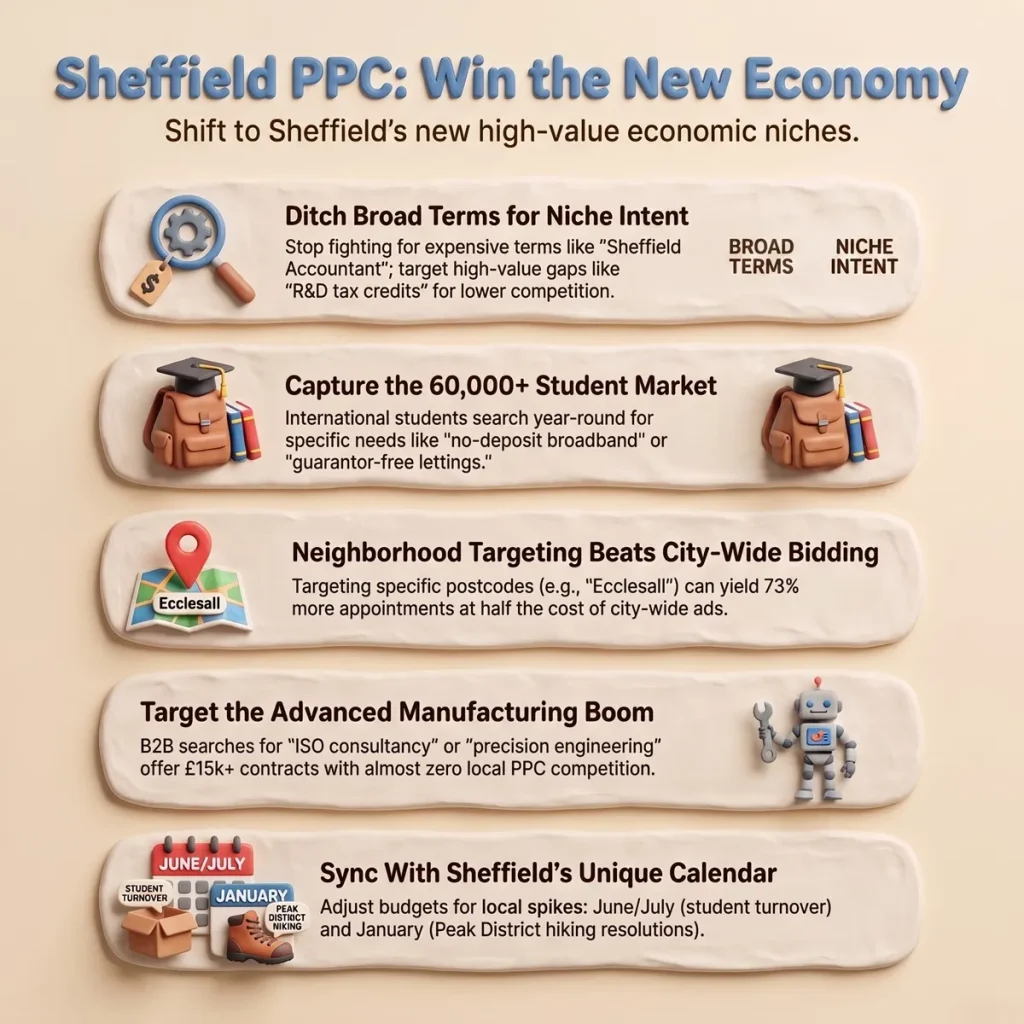
The gap isn’t subtle. It’s the difference between bidding on “Sheffield accountant” (which every three-person practice in S1 is already fighting over at £8+ per click) and recognising that search volume for “R&D tax credits Sheffield” has climbed steadily since 2018 whilst competition remains comparatively light. It’s understanding that “coworking space Sheffield” now generates more monthly searches than “office space Sheffield” in certain postcodes, but most commercial landlords are still running campaigns built for a different decade.
This isn’t about PPC theory. It’s about matching your paid search spend to the economy Sheffield actually has now, not the one it had in 2010.
The University-Driven Economy Creates Year-Round Search Patterns Most Local Businesses Ignore
Between the University of Sheffield and Sheffield Hallam, you’ve got roughly 60,000 students. Add in Sheffield College and various specialist institutions, and the student population represents a significant chunk of the city’s consumer base.
Most Sheffield businesses recognise September as peak student season and adjust accordingly. What fewer businesses spot: the search demand patterns students create don’t follow the traditional academic calendar anymore.
International student enrolment has grown substantially, these students arrive throughout the year for pre-sessional courses, foundation years, and January intake programmes. They’re searching for accommodation, furniture, phone contracts, and banking services in July, in January, and in April. They’re often searching with more specific queries than domestic students: “guarantor free lettings Sheffield”, “international student bank account UK”, “no-deposit broadband Sheffield.”
The businesses capturing this demand year-round, not just in September, are running PPC campaigns that most local competitors haven’t considered. They’re bidding on long-tail queries with clear intent, often at 40-60% lower cost-per-click than the generic terms, and they’re converting at higher rates because the search intent is more specific.
One Sheffield letting agency we worked with shifted 25% of their PPC budget from broad student accommodation terms to guarantor-specific and international student queries. Their cost per letting enquiry dropped by £18, and their conversion rate from click to enquiry improved from 3.2% to 5.7%. Not because they changed their service, because they matched their paid search to what people were actually typing.
The Advanced Manufacturing Sector Is Searching for Services Most Sheffield Agencies Don’t Think to Target
The Advanced Manufacturing Park and the various manufacturing and engineering firms around Sheffield represent a B2B opportunity that’s vastly under-targeted in paid search.
These businesses are searching for highly specific services: “ISO 9001 consultancy Sheffield”, “industrial automation training South Yorkshire”, “precision engineering subcontractor”, “cleanroom design UK.” The search volumes aren’t massive, sometimes 20-50 searches per month for a given term. But the contract values are often £15,000 to £150,000+.
Most Sheffield B2B service providers either don’t run PPC at all (relying on word-of-mouth and LinkedIn), or they’re bidding on impossibly broad terms like “business consultancy Sheffield” where they’re competing against hundreds of other advertisers.
The opportunity sits in the middle: specific enough that competition is manageable and search intent is clear, broad enough that you’re not bidding on five searches per month.
A Sheffield-based training provider we advised was spending £1,200/month on generic business training terms with minimal return. We identified 34 manufacturing and engineering-specific training queries with clear commercial intent. They reallocated £600 of their budget to these terms, added location extensions showing their proximity to the Advanced Manufacturing Park, and wrote ad copy that spoke directly to compliance requirements and apprenticeship levy funding. Within three months, they’d secured two contracts worth £48,000 combined, both from PPC leads.
The cost per click was actually higher on these niche terms (£4.20 average versus £2.80 on generic terms), but the conversion rate and contract value made the economics unambiguous.
The Creative and Digital Sector Gap: High Intent Searches With Surprisingly Low Competition
Sheffield’s creative and digital sector has grown substantially. The Digital Campus, the cluster of agencies and studios in the Cultural Industries Quarter, the game development studios, the post-production facilities, it’s a genuinely different landscape than it was in 2015.
This sector creates demand for specific services that often go untargeted in local paid search: “video production Sheffield”, “motion graphics studio”, “podcast recording Sheffield”, “e-learning development UK.”
What’s interesting: many of the businesses providing these services don’t run PPC themselves. They’re digital-savvy enough to have good organic visibility, active social channels, strong portfolios. But they often view PPC as either unnecessary or too expensive.
That creates an odd dynamic: genuine search demand from businesses looking to commission work, but limited paid search competition because the natural suppliers don’t use the channel.
A Sheffield e-learning company launched PPC campaigns targeting “e-learning development”, “bespoke training videos”, and similar terms, all geo-targeted to Yorkshire and the wider East Midlands. Their average position was 1.2 (meaning they were almost always top of the page), their cost per click averaged £3.10, and over seven months they generated 23 qualified enquiries that led to nine projects worth £127,000 total.
They weren’t doing anything technically sophisticated. They were simply present in a channel where their competitors weren’t, targeting searches with clear commercial intent.
Retail and Hospitality: The Independent Venue Advantage Most Chains Haven’t Exploited
Sheffield’s independent retail and hospitality scene, particularly around Kelham Island, the city centre’s independent quarter, and Sharrow Vale, has become a genuine draw. People specifically search for independent options: “independent coffee shop Sheffield”, “indie bookshop Sheffield”, “craft beer Kelham Island.”
The search volume for these “independent” and “indie” modified queries has grown consistently. It’s a conscious consumer choice, particularly among the student population and young professionals.
Most independent venues don’t run PPC because budgets are tight and organic social feels more natural to their brand. Most chains don’t bid on these terms because they assume “independent” excludes them by definition.
But there’s a tactical opportunity for independents with modest budgets: bidding on their own brand name and their immediate competitors’ brand names (where legally and ethically appropriate), plus targeting those “independent” modified searches with small daily budgets.
A three-location independent café group in Sheffield started running PPC with a £12/day budget, targeting their own brand name (which was generating 90-140 searches per month, mostly from people who’d heard of them but didn’t know the exact location), plus “independent café [neighbourhood]” variations. Cost per click averaged £0.47. Over four months, they tracked 67 people who clicked a PPC ad and subsequently made a purchase (using a simple discount code system for tracking). Average transaction value was £8.20. Total PPC spend: £1,440. Tracked revenue: £549.40 directly, plus an estimated 30-40% additional visits that didn’t use the tracking code.
The return wasn’t enormous, but it was positive, trackable, and scalable. More importantly: they were capturing demand that would otherwise have gone to competitors or dissipated entirely.
Why Sheffield’s Postcode Geography Matters More in PPC Than in Most Cities
Sheffield’s geography is unusual. It’s a city of distinct neighbourhoods separated by hills, valleys, and genuine distance. Someone in Hillsborough doesn’t casually pop over to Crystal Peaks. Someone in Crookes isn’t likely to drive to Woodseats for a routine service.
That postcode specificity matters enormously in local PPC, but most Sheffield businesses either target “Sheffield” as a single entity or use a 10-mile radius from a central point (which inevitably captures a lot of irrelevant geography).
The better approach: separate campaigns or ad groups for specific Sheffield postcodes or neighbourhoods, with ad copy and landing pages that acknowledge the local area. “Plumber in Crookes”, “Electrician Woodseats”, “Dentist Ecclesall”, these get lower search volume than “Plumber Sheffield”, but the intent is often stronger and the competition is usually lighter.
A Sheffield dental practice with locations in both the city centre and Ecclesall ran a test: one campaign targeted “dentist Sheffield” broadly with a £25/day budget. A second campaign used £15/day split between “dentist Ecclesall”, “dentist Hunters Bar”, “dentist Sharrow”, and similar neighbourhood-specific terms, with ad copy mentioning parking availability and the specific location.
The neighbourhood-specific campaign generated 40% fewer clicks but 73% more booked appointments. Cost per appointment: £34 for neighbourhood-specific versus £67 for city-wide. The difference was entirely down to relevance and reduced competition.
The Seasonal Patterns That Don’t Match National Trends
Sheffield’s economy has seasonal patterns that don’t quite match national norms, largely due to the university influence and the outdoor/Peak District connection.
June and July see a spike in searches related to moving, storage, and end-of-tenancy services, driven by students leaving and the turnover of rental properties. Most national PPC campaigns treat June/July as quieter months and reduce budgets accordingly. In Sheffield, that’s a mistake for certain sectors.
January has the usual New Year spike for gyms and fitness, but Sheffield also sees a surge in outdoor gear and Peak District-related searches as people commit to walking/hiking resolutions. Outdoor retailers and activity providers who increase PPC budgets in January specifically for this intent often see strong returns.
September is obviously peak for student-related services, but there’s also a significant spike in B2B searches as the academic year starts and university-adjacent businesses kick into gear. Training providers, B2B software, event services, all see Sheffield-specific demand in September that exceeds the typical “back to business” autumn pattern.
Running PPC campaigns with Sheffield-standard seasonal adjustments rather than national defaults can shift campaign performance by 15-25% in certain sectors. It requires local knowledge and historical data, not just Google’s seasonal recommendations.
What Sheffield-Specific PPC Strategy Actually Looks Like
Based on 25+ years working with UK businesses across various sectors, here’s what actually works for Sheffield-based PPC:
Segment by Economic Sector, Not Just by Product/Service
Don’t run one campaign for “web design Sheffield.” Run separate campaigns (or at minimum, separate ad groups with tailored copy) for web design targeting manufacturing businesses, creative sector clients, healthcare, retail, hospitality. The search queries, the decision-making process, the contract values, and the conversion paths are all different.
Use Neighbourhood-Level Targeting Where Service Delivery Is Local
For any business where the customer needs to visit a physical location or where you’re delivering a service to their home/business, postcode and neighbourhood specificity almost always outperforms city-wide targeting. Higher relevance, lower competition, better conversion rates.
Bid on the Economic Transition, Not Just the Established Categories
If your service is relevant to Sheffield’s growing sectors, tech, creative, advanced manufacturing, university-adjacent services, target the specific queries those sectors generate. Don’t just compete in the established, saturated categories.
Adjust Seasonality for Sheffield’s Specific Patterns
University calendar, rental market turnover, outdoor/Peak District seasonality, these create demand patterns that justify budget shifts throughout the year. Track your own data, but don’t assume Sheffield follows national norms.
Track Beyond the Click
Sheffield’s a relationship-driven business community. Many high-value conversions happen after multiple touchpoints. Track phone calls, track footfall (where possible), use offline conversion tracking, implement CRM integration. The initial click might cost £5, but if it contributes to a £30,000 contract three months later, the economics are entirely different.
Frequently Asked Questions
Q: Is PPC worth it for small Sheffield businesses with limited budgets?
A: It depends entirely on what you’re targeting. Broad, competitive terms like “solicitor Sheffield” or “accountant Sheffield” require budgets of £500-1,500/month to make meaningful impact. But if you’re targeting specific niches, neighbourhood-level queries, or long-tail terms with clear intent, £10-15/day can generate measurable returns. The key is matching your budget to realistic targets, not trying to compete in saturated categories with insufficient spend.
Q: Should Sheffield businesses target Manchester and Leeds in PPC campaigns?
A: Only if you genuinely serve those markets and the contract value justifies the travel/delivery cost. Manchester and Leeds PPC is generally 20-40% more expensive than Sheffield for equivalent terms, and conversion rates are often lower because you’re competing against local providers. If you’re B2B with regional reach and decent contract values (£5,000+), it can work. For local services, retail, or hospitality, it’s usually poor economics.
Q: How long does it take to see results from PPC in Sheffield?
A: You’ll see clicks immediately. Meaningful conversion data typically takes 4-8 weeks depending on your conversion cycle and budget. B2B services with longer sales cycles might need 3-6 months to properly assess campaign performance. The mistake many Sheffield businesses make is either expecting instant ROI in week one or running campaigns for years without proper tracking and optimisation. Somewhere between those extremes, give it 6-8 weeks with proper tracking, then make data-driven decisions.
If you’re a Sheffield business and suspect you’re missing paid search opportunities specific to where the city’s economy has actually moved, we’d be happy to have a look. We offer a free PPC audit that maps your current approach against the search demand patterns in your specific sector and postcode, no obligation, just a straightforward assessment of where the gaps might be.