

Why Belfast PPC Campaigns Need DifferentStructuring Than the Rest of the UK
If you’re running a Belfast business that serves customers in both Northern Ireland and the Republic, you’re dealing with a PPC challenge that most UK agencies have never encountered: how do you target audiences separated by an invisible border, operating in two currencies, under different VAT regimes, whilst managing a single advertising budget?
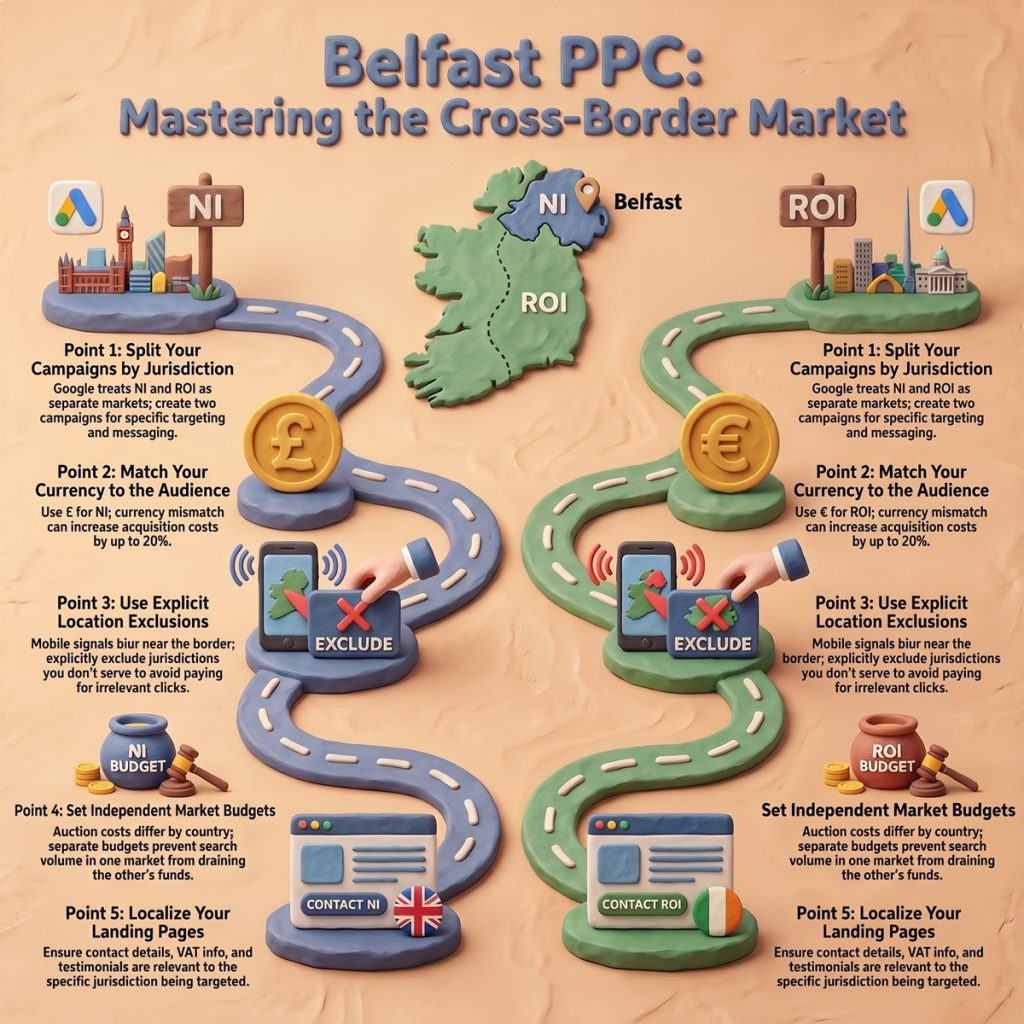
The cross-border economy around Belfast isn’t a political issue for your Google Ads account, it’s a structural one. Get it wrong, and you’ll waste budget showing pound-sterling prices to euro-spending customers, or worse, exclude half your potential market because your campaign targeting doesn’t account for how Google interprets location signals in Northern Ireland.
Here’s what most Belfast businesses don’t realise about how the border affects their PPC campaigns, and how to structure your account to serve both markets efficiently.
Google Treats Northern Ireland and the Republic as Separate Markets (But Your Customers Don’t)
When you set up location targeting in Google Ads, you’re forced to choose: target Northern Ireland as part of the UK, or target the Republic of Ireland separately. There’s no “Greater Belfast catchment area” option that respects how people actually move and shop.
A Lisburn-based kitchen fitter might serve customers within a 40-mile radius, that includes significant parts of Counties Louth, Monaghan, and Cavan. A Newry retailer draws shoppers from Dundalk and beyond. But Google’s location targeting makes you split these naturally overlapping audiences into separate campaigns.
The practical implication: You need separate campaigns for NI and ROI targeting, even when you’re offering the same service. This isn’t optional if you’re serving both markets, it’s the only way to control budget allocation, ad copy, and landing page experience for two distinct audiences.
Currency Display Isn’t Just a Checkout Problem, It Affects Ad Performance
Here’s what catches most Belfast businesses out: if someone in Dundalk clicks your ad and lands on a page showing prices in pounds sterling, your conversion rate drops. Not dramatically, but enough to make your cost per acquisition 15-20% higher than it needs to be.
The reverse is equally true. Northern Ireland customers expect to see pound pricing. Show them euros, and you’ve introduced friction at exactly the point where you need confidence.
What this means for campaign structure:
- Separate landing pages for each currency, even if the product or service is identical
- Ad copy that either omits currency symbols or matches the target market (£ for NI campaigns, € for ROI campaigns)
- Extensions (price extensions, promotion extensions) built separately for each campaign to display the correct currency
This sounds obvious once you see it written down, but we regularly audit Belfast PPC accounts where a single campaign targets “Ireland” or “Northern Ireland or Ireland” with one landing page showing pound prices. The business wonders why their Irish traffic converts poorly, this is usually why.
VAT and Regulatory Differences Create Search Behaviour Splits
Northern Ireland businesses operating under the Windsor Framework face a regulatory environment that’s different from both Great Britain and the Republic. For certain product categories, particularly anything involving goods moving across the border, the search terms people use reflect this complexity.
Someone in Belfast searching for “buy [product] NI” may be specifically looking for a supplier that understands the VAT and customs position. Someone in Drogheda searching for “order [product] Ireland” expects straightforward ROI delivery without border complications.
The campaign implication: Keyword research needs to be done separately for each market. Don’t assume that the same search terms with the same intent apply to both audiences. Build separate keyword lists, then look for overlap, not the other way around.
We’ve seen this particularly with B2B campaigns. A Newtownards manufacturer targeting both markets needs different ad messaging: Northern Ireland businesses may be searching with concerns about supply chain continuity or dual-market access, whilst Republic-based businesses are looking for reliable UK suppliers post-Brexit.
Mobile Location Signals Blur Faster in Belfast Than Anywhere Else in the UK
Google uses multiple signals to determine where a searcher is located: IP address, GPS data from mobile devices, and location history. In most of the UK, these signals align neatly.
In Belfast and the border corridor, they don’t.
Someone living in Newry might work in Dundalk. Their mobile device has location history in both jurisdictions. A Derry resident might shop regularly in Letterkenny. Google’s algorithm doesn’t always know which side of the border represents their “home” market for purchasing decisions.
What this means for your campaigns:
- Radius targeting (e.g., “30 miles from Belfast city centre”) will include both jurisdictions whether you intend it to or not
- You need to explicitly exclude locations you’re not set up to serve, rather than relying on inclusion targeting alone
- Mobile bid adjustments should be tested separately for cross-border campaigns, mobile traffic near the border often behaves differently than desktop traffic from clearly defined locations
If you’re only set up to take orders in one currency or only deliver to one jurisdiction, explicit location exclusions are essential. Otherwise, you’ll pay for clicks from customers you can’t serve.
Budget Allocation Needs to Reflect Two Separate Competitive Environments
The cost-per-click for the same keyword in Northern Ireland and the Republic of Ireland is rarely identical. You’re bidding in two different auctions, against different competitors, with different levels of advertiser demand.
For many service categories, CPC in the Republic is higher, Dublin’s agency market, for instance, is more competitive and expensive than Belfast’s. For retail and ecommerce, it varies by category.
The structural requirement: Don’t pool your budget into a single campaign targeting “Northern Ireland or Ireland.” You’ll end up with Google automatically allocating more spend to whichever market has higher search volume, regardless of which market delivers better returns for your business.
Separate campaigns let you control budget splits based on what actually works:
- Set different daily budgets for NI and ROI campaigns based on your customer distribution, not Google’s default allocation
- Track ROI separately for each market, one may be more profitable even if the other has higher volume
- Adjust bids independently based on the competitive environment in each auction
We’ve worked with Belfast businesses where 60% of their customer base is in Northern Ireland, but 70% of their PPC budget was being spent in the Republic because that’s where search volume was higher. They didn’t realise it until they split the campaigns and looked at cost-per-acquisition by market.
Conversion Tracking Gets Complicated When You’re Measuring Two Customer Journeys
If you’re running separate campaigns for two markets, you need to track conversions separately to know which is performing. But many Belfast businesses are still using a single “purchase” or “lead” conversion action across their entire account.
This makes it impossible to answer basic questions:
- What’s my cost per acquisition for Northern Ireland customers versus Republic customers?
- Which market has the better conversion rate?
- Should I increase spend in one market and reduce it in the other?
The fix: Set up separate conversion actions (or at minimum, use campaign-level conversion tracking) so you can measure performance by market. If you’re using Google Analytics 4, create audiences that segment by location and build reports that show conversion value by geography.
For ecommerce businesses handling both currencies, this also means tracking revenue in a consistent currency (usually pounds) so you can compare performance. A €1,000 sale and a £1,000 sale aren’t equivalent, your reporting needs to reflect that.
Ad Scheduling Should Account for Different Peak Hours Across the Border
This is subtle, but it matters for businesses with limited budgets: peak search and conversion times aren’t identical in Northern Ireland and the Republic.
Lunch hours, commute times, evening browsing patterns, these shift slightly based on work patterns, time zone perception (yes, it’s the same clock time, but behavioural patterns differ), and even TV schedules that influence when people are online.
For most Belfast businesses, this won’t be a dramatic difference, but if you’re running campaigns with aggressive dayparting (only showing ads during specific hours to stretch budget), test ad scheduling separately for each market rather than assuming one schedule works for both.
The Single Campaign Mistake: Why “Northern Ireland and Ireland” Targeting Wastes Money
The most common structural mistake we see in Belfast PPC accounts is the single campaign targeting both “Northern Ireland” and “Ireland” with:
- One set of ads
- One landing page
- One currency displayed
- One budget pool
This approach guarantees you’re serving the wrong experience to at least half your audience, and it prevents you from optimising spend based on which market actually delivers better returns.
The fix takes an afternoon to implement:
1. Duplicate your existing campaign
2. Campaign 1: Target Northern Ireland only, ads and landing pages in pounds
3. Campaign 2: Target Republic of Ireland only, ads and landing pages in euros
4. Split your budget based on current customer distribution (you can adjust this as data comes in)
5. Track conversions separately for each market
Yes, it’s more campaigns to manage. But it’s the only way to serve both markets properly and know where your money is actually working.
When One Market Outperforms: Don’t Abandon the Other Without Testing
Once you’ve split campaigns and tracked performance separately, you might discover that one market significantly outperforms the other, better conversion rates, lower CPA, higher customer value.
The temptation is to shift all your budget to the winning market. Sometimes that’s correct, but not always.
Often, the underperforming market just needs different messaging, a different landing page, or different keyword targeting. The customer demand exists; your campaign structure hasn’t addressed the market’s specific needs yet.
Before you write off an entire market, test:
- Different ad copy that speaks to that market’s specific concerns or language patterns
- Landing page variations with testimonials or case studies from that jurisdiction
- Different offers or promotions (what works in Belfast may not resonate in Dublin, and vice versa)
We’ve seen Republic campaigns that looked like failures until the business added Irish customer testimonials and changed “UK-based” messaging to “serving customers throughout Ireland”, conversion rate jumped 40% with that change alone.
Frequently Asked Questions
Q: Should Belfast businesses always run separate campaigns for Northern Ireland and the Republic?
A: If you serve customers on both sides of the border, yes. The only exception is if you’ve tested a combined approach and proven it works for your specific business, but for 90% of Belfast businesses, separate campaigns deliver better control over budget, messaging, and landing page experience for each market.
Q: How should I split my PPC budget between Northern Ireland and Republic of Ireland campaigns?
A: Start with your current customer distribution, if 65% of your customers are in NI and 35% in the Republic, use that as your initial budget split. Then adjust based on actual cost-per-acquisition data after 30-60 days. Don’t let Google’s automatic budget allocation decide this for you based purely on search volume.
Q: Do I need different Google Ads accounts for each market, or just separate campaigns?
A: Separate campaigns within one account is sufficient for most Belfast businesses. You only need separate accounts if you’re operating as legally distinct entities in each jurisdiction or need completely separate billing. Separate campaigns give you all the targeting and measurement control you need whilst keeping management simpler.
Q: What’s the biggest mistake Belfast businesses make with cross-border PPC?
A: Showing pound-sterling prices to Irish customers (or vice versa) because they’re running one campaign with one landing page for both markets. It seems like a small detail, but currency mismatch creates friction at exactly the wrong moment and typically reduces conversion rates by 15-20% in the mismatched market.
If you’re running PPC for a Belfast business with customers on both sides of the border, we’ve structured accounts for this exact challenge more times than we can count. [Book a free Belfast PPC audit](https://thickrope.com/contact) and we’ll show you exactly where your current campaign structure is leaving money on the table, and how to fix it.