
Why Oxford’s Two Economies Mean Your Digital Marketing Company Needs to Know the Difference
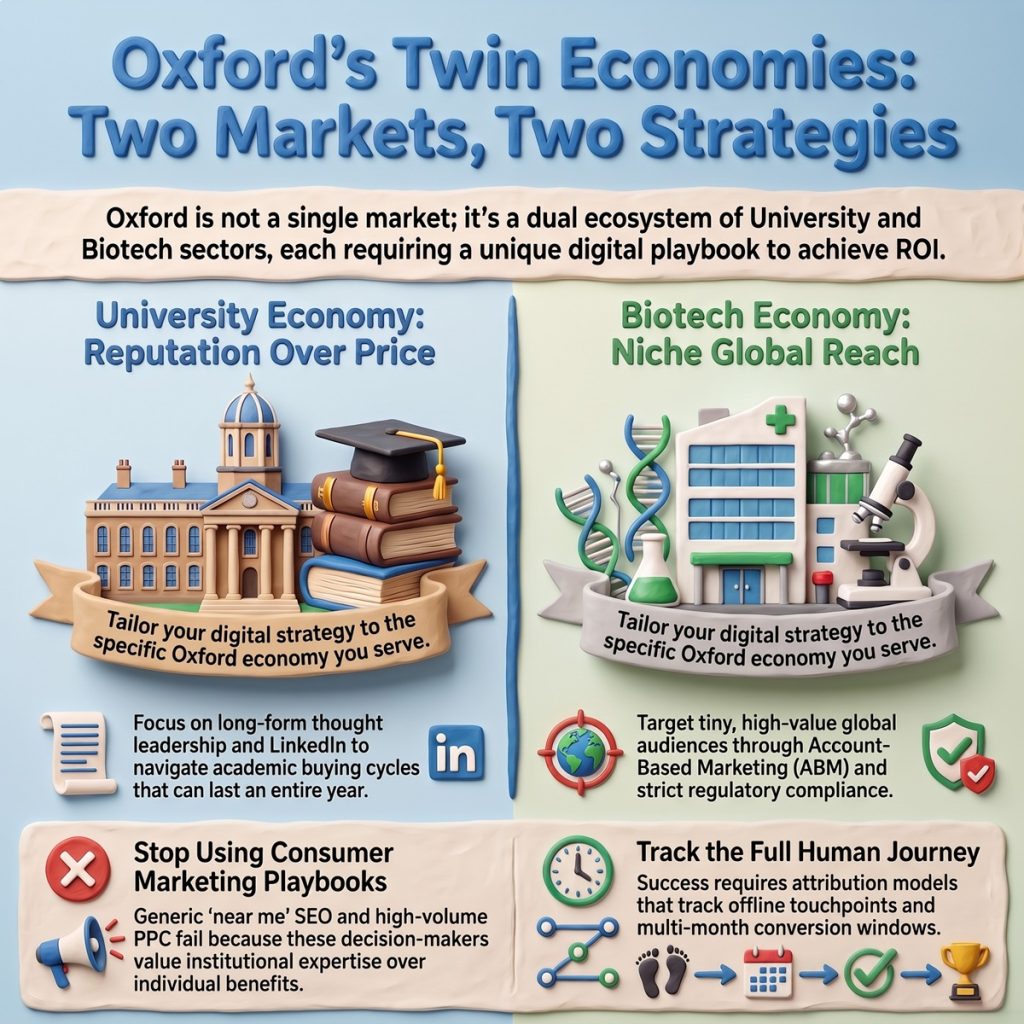
Oxford isn’t one market. It’s two, operating side by side with entirely different buying cycles, audience behaviours, and conversion paths. On one side: the university ecosystem, colleges, academic publishers, EdTech suppliers, student accommodation providers, and the constellation of service businesses that orbit a 900-year-old institution. On the other: the Oxford-Cambridge Arc’s booming biotech and life sciences corridor, where clinical research organisations, medtech startups, and pharmaceutical companies cluster around the Science Park and surrounding innovation hubs.
Most digital marketing companies treat Oxford as a single entity. They’ll talk about “local SEO” or “targeting Oxford businesses” without acknowledging that a company selling laboratory equipment to a spin-out at Oxford Science Park has almost nothing in common with a tutoring agency marketing to international undergraduates.
Choose a digital marketing company that doesn’t understand this distinction, and you’ll waste budget on the wrong channels, target audiences who’ll never convert, and benchmark yourself against competitors who aren’t actually competing for the same customers.
The University Economy: Long Decision Cycles and Reputation-Led Buying
The university ecosystem operates on academic calendars, collegial decision-making structures, and procurement processes where reputation often outweighs price. If you’re a business serving this market, whether that’s publishing, educational software, conference venues, or professional services marketed to researchers, your digital marketing strategy needs to account for buying cycles that can stretch across terms or even academic years.
What this means for channel selection:
LinkedIn becomes disproportionately valuable. Academics and university administrators use it as a professional network in ways that consumer-facing businesses rarely see. Content marketing that demonstrates subject matter expertise, white papers, case studies with methodology transparently explained, webinars with genuine educational value, outperforms paid advertising for awareness and credibility building.
PPC can work, but conversion tracking needs to be configured differently. The click-to-conversion window might be three months, not three days. A digital marketing company running Google Ads for a university supplier using the same attribution model they’d use for an e-commerce client will consistently undervalue top-of-funnel campaigns and overspend on bottom-funnel keywords where the real decision has already been made elsewhere.
SEO content needs to speak the language. Oxford’s academic community has its own vocabulary, and they search accordingly. Generic business terminology underperforms compared to precise academic or technical language. A digital marketing company without experience in this sector will optimise for search volume rather than search intent, bringing traffic that looks good in Google Analytics but never inquires.
The Biotech Economy: Compliance, Niche Audiences, and Global Reach from a Local Base
The Oxford biotech cluster operates under different constraints entirely. These are businesses with highly specialised offerings, often selling to a global market from an Oxfordshire postcode. Their audiences are small, sometimes numbering in the hundreds worldwide, but each conversion represents significant contract value.
Regulatory compliance shapes everything. If you’re marketing clinical trial services, medical devices, or pharmaceutical products, every piece of content, every ad, every landing page sits under MHRA oversight or equivalent regulatory frameworks. A digital marketing company that doesn’t build compliance review into their workflow from the start will create material that can’t be published, wasting time and budget.
What this means for targeting and measurement:
Account-based marketing approaches outperform broad campaigns. When your total addressable market is 300 decision-makers globally, mass-market digital tactics are inefficient. LinkedIn advertising with company-specific targeting, personalised content sequences, and direct outreach supported by SEO-optimised thought leadership becomes the foundation, not pay-per-click campaigns optimised for volume.
Technical SEO matters more than content volume. A biotech company’s website might have 40 pages, not 400. Each page needs to rank for extremely specific, low-volume keywords where intent is unambiguous. Schema markup for scientific content, clean site architecture that demonstrates information hierarchy, and page speed optimisation that works for international users on varying connection speeds deliver more value than publishing three blog posts a week.
Conversion tracking needs to account for offline steps. A biotech purchase might begin with a white paper download, continue through a conference meeting (often outside the UK), and conclude with a contract negotiated over months. Attribution modelling that credits only the last click before form submission will systematically misallocate budget. A digital marketing company experienced in complex B2B will build tracking that follows the full journey, even when it moves offline and back.
What Most Oxford Digital Marketing Companies Get Wrong
The single biggest mistake: applying consumer marketing playbook tactics to either of these economies.
University suppliers aren’t selling to consumers, even when the end users are students. The decision-makers, department heads, procurement teams, college bursars, operate with institutional priorities. Marketing that emphasises individual benefit over institutional value proposition simply doesn’t connect.
Biotech companies aren’t local businesses, even when they’re headquartered in Oxford. Their competition is global, their customers are global, and their search presence needs to reflect that. Local SEO strategies focused on “near me” searches and Google Business Profile optimisation waste resources that should be directed at international organic visibility and industry-specific content marketing.
The second mistake: channel selection based on agency capability rather than client need.
If a digital marketing company’s core strength is Meta advertising, they’ll recommend Meta advertising, regardless of whether your Oxford biotech company will find procurement managers for pharmaceutical manufacturing equipment scrolling Facebook. If they specialise in content marketing, they’ll propose a blog strategy even if your university press needs PPC targeting researchers searching for specific academic titles.
A digital marketing company that genuinely understands Oxford’s twin economies will occasionally recommend channels they don’t provide in-house, or acknowledge when organic tactics will take 12 months to show meaningful return in a market where reputation is built over years, not campaigns.
How to Evaluate Whether a Digital Marketing Company Understands Your Oxford Market
Ask specific questions before you commit budget:
For university economy businesses: “How would you structure a campaign where the person clicking the ad isn’t the person approving the purchase, and the approval might take two terms?” If they start talking about retargeting without mentioning CRM integration, multi-touch attribution, or content designed for internal advocacy, they’re thinking transactionally when your market operates institutionally.
For biotech economy businesses: “How do you handle compliance review for regulated marketing content, and what does that do to your production timeline?” If they’ve never built approval workflows with regulatory teams, you’ll discover that problem after they’ve created unusable content.
For both: “Show me an example of keyword research you’ve done for a business with a highly specialised product and a small total addressable market.” Volume-focused keyword strategies that prioritise search volume over search intent will bring visitors who are researching, not buying.
Why Oxford’s Dual Economy Actually Creates Opportunity
Here’s what most articles about choosing a digital marketing company won’t tell you: Oxford’s split economic identity creates competitive advantage if you work with someone who understands it.
Your competitors, whether they’re university suppliers or biotech companies, are often working with London agencies applying generic strategies, or local agencies treating Oxford as a single market. The businesses that recognise the distinction and build digital marketing specifically calibrated to their ecosystem’s buying behaviour, decision-making structures, and channel preferences consistently outperform their market on cost-per-acquisition and customer lifetime value.
University suppliers that invest in LinkedIn thought leadership and long-form educational content build authority that shortens sales cycles despite lengthy procurement processes. Biotech companies that focus budget on account-based approaches and technical SEO see higher conversion rates from smaller traffic volumes because every visitor is genuinely qualified.
The ROI difference isn’t marginal. It’s the difference between a PPC campaign that generates 100 clicks and two inquiries versus one that generates 30 clicks and eight qualified conversations, because the targeting, messaging, and landing page experience were built for how your specific Oxford market actually buys.
Frequently Asked Questions
Q: Do I need a digital marketing company physically located in Oxford?
A: Location matters less than sector experience. A London or Birmingham agency with demonstrated biotech or education sector experience will outperform a local generalist every time. That said, a company with Oxford clients in your specific economy can leverage existing market knowledge and local network intelligence that reduces your ramp-up time and wasted exploratory spend.
Q: How long should it take to see results from digital marketing in Oxford’s biotech sector?
A: Account-based marketing and technical SEO typically show measurable engagement within 90 days, website visits from target accounts, content downloads from decision-makers, LinkedIn profile views from relevant companies. Actual pipeline contribution usually appears at 4-6 months. Anyone promising leads in 30 days doesn’t understand complex B2B sales cycles or is defining “lead” so loosely it’s meaningless.
Q: What should a university supplier expect to invest in digital marketing?
A: Depends entirely on market size and contract value, but effective campaigns typically start at £2,000-£3,500 monthly for combined SEO, LinkedIn advertising, and content creation. Less than that and you’re spreading budget too thin to build momentum in any single channel. More established suppliers with larger addressable markets might invest £5,000-£8,000+ to support multiple product lines or geographic markets simultaneously.
Q: Can one digital marketing company handle both Oxford economies, or do I need a specialist?
A: The skills overlap more than the strategies do. A good B2B digital marketing company can serve both, provided they take time to understand your specific market’s buying behaviour and don’t apply template approaches. The warning sign is a company that proposes identical channel mix and tactics for a tutoring agency and a medtech startup, that suggests they’re not actually customising strategy to market reality.
If your Oxford business operates in either the university or biotech economy and your current digital marketing feels like it’s built for someone else’s customers, we should talk. Thickrope works with businesses where buying cycles are long, audiences are specialised, and generic tactics don’t work, [get in touch for a straightforward conversation](https://thickrope.com/contact) about what would actually move the needle for your market.