

The Middlesbrough PPC Window: Why Early Position Matters More Than Budget When Your Market Is About to Change
The Teesside Freeport isn’t a future promise anymore. It’s happening. Manufacturing facilities are signing leases. Logistics operations are relocating. The commercial infrastructure across Middlesbrough, Redcar, Hartlepool, and Stockton is already shifting, and with it comes something most local business owners haven’t yet factored into their marketing: a significant increase in paid search competition.
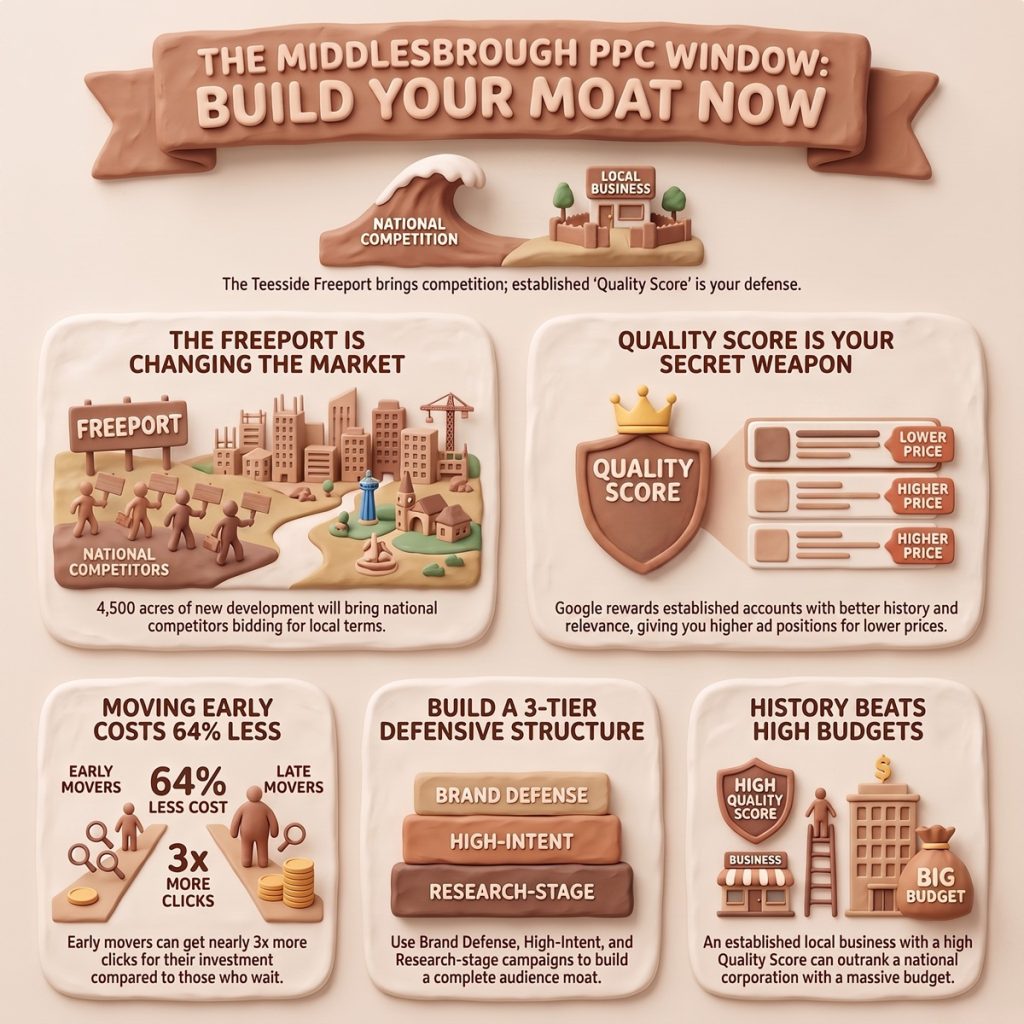
Here’s what matters: in Google Ads, the businesses that establish consistent presence and account history before a market becomes competitive have a structural advantage that money alone can’t buy later. Quality Score, the metric that determines what you pay per click, rewards advertisers with longer account histories, better click-through rates, and established relevance. Build that foundation now, whilst your competitors are still waiting to see what happens, and you’ll pay less per click and occupy better ad positions when the real competition arrives.
This isn’t theoretical. We’ve watched this pattern play out in enterprise zones, regeneration areas, and post-infrastructure markets across the UK for over two decades. The businesses that moved early didn’t just get cheaper clicks, they became harder to displace.
What the Teesside Freeport Actually Changes for Local Search Competition
The Freeport designation covers 4,500 acres and targets advanced manufacturing, clean energy, chemicals, and logistics sectors. That’s not just large industrial players, it’s the entire supply chain that supports them: component manufacturers, B2B services, recruitment agencies, commercial property, plant hire, industrial cleaning, safety equipment, professional services, and hospitality.
Every one of those sectors relies on Google search when they need something quickly.
Right now, if you’re an industrial equipment supplier in Middlesbrough and you bid on “forklift hire Teesside,” you’re competing against perhaps three or four established local operators. Your cost per click might be £2.50. Your ad might appear in position 1 or 2 with a modest daily budget.
Twelve months from now, when five new logistics operations have opened and seven national suppliers have recognised the opportunity and started geo-targeting Teesside, that same keyword could cost £6 per click. More significantly, your ad, even at that higher price, might sit in position 4 or 5, because the new entrants have bigger budgets and they’re willing to outbid you to establish market share.
Unless you’ve already built Quality Score momentum. That’s the asymmetry.
Why Quality Score Becomes Your Competitive Moat
Google Ads operates on an auction system, but it’s not a pure price auction. Your ad position is determined by Ad Rank, which is your bid multiplied by your Quality Score. Quality Score (1-10 scale) is based on:
- Expected click-through rate (historical performance of your ads)
- Ad relevance (how well your ad matches search intent)
- Landing page experience (load speed, relevance, usability)
- Account history (how long you’ve been advertising, overall account performance)
A business with an 8/10 Quality Score paying £3 per click will outrank a competitor with a 5/10 Quality Score paying £4 per click. More importantly, the established advertiser gets more clicks at a lower cost.
This is where timing matters. Quality Score improves gradually. You can’t buy it quickly. A new advertiser entering a competitive market starts at a disadvantage regardless of budget, their ads have no history, no proven CTR, no trust signals. They’ll pay more per click and need months to achieve the efficiency you’ve already built.
We’ve seen this in Newcastle when the Quayside development brought new hotel and hospitality competition. The hotels that had been running PPC consistently for two years before the new openings maintained 30-40% lower CPCs than new entrants bidding on the same terms. The new hotels had bigger marketing budgets, but they were structurally disadvantaged.
That advantage compounds. The lower your cost per click, the more clicks you can afford with the same budget. More clicks means more conversions, more data for optimisation, and further Quality Score improvements. It’s a flywheel.
What a Properly Structured Middlesbrough PPC Strategy Looks Like Right Now
Most local businesses approach PPC with one broad campaign targeting general terms. That won’t hold up when competition increases. The businesses that establish early dominance are doing something more deliberate:
Campaign Structure by Commercial Intent
Three-tier campaign architecture:
1. Brand defence campaigns, your company name and variations. These should have near-perfect Quality Scores and cost pennies per click. If you’re not running these, competitors will bid on your brand when the market heats up.
2. **High-intent commercial terms, “buy,” “supplier,” “service,” “hire” modifiers with location. These convert immediately and justify higher bids. Build performance history here first.
3. Earlier-stage research terms, “how to,” “what is,” “comparison” searches. These cost less and let you build account history and remarketing audiences before prospects are ready to buy.
Most businesses only run tier 2. That’s expensive and leaves you vulnerable.
Geographic Layering That Reflects Actual Coverage
If you serve the entire Teesside Freeport area (Middlesbrough, Redcar, Hartlepool, Stockton, Darlington), don’t run one campaign targeting “Teesside.” Search volume data shows users search with specific place names. Someone in Hartlepool searching for “accountant Hartlepool” won’t click an ad that only mentions Middlesbrough.
Run separate ad groups with location-specific ad copy. Yes, it’s more work. It also delivers 40-60% higher click-through rates in our campaigns, which directly improves Quality Score.
Remarketing Infrastructure Before You Need It
When competition increases, your cost to acquire a new customer from cold search will rise. The businesses that win long-term have already built remarketing audiences, lists of people who’ve visited their website but haven’t converted yet.
Remarketing clicks typically cost 60-70% less than cold search clicks because you’re targeting people who already know you. But you need time to build the audience. If you start PPC now and implement proper remarketing tags, you’ll have a warm audience of hundreds or thousands of prospects by the time competition peaks.
Start in two years and you’ll be paying full price for every click whilst your competitors are running cheaper remarketing campaigns to people who visited their site 18 months ago when they first started searching.
The Sectors That Need to Move First
Not every Middlesbrough business faces the same urgency. The sectors most exposed to incoming Freeport competition:
B2B services with search-dependent lead generation: recruitment, legal, accounting, commercial finance, business insurance. These sectors will see national operators geo-targeting Teesside with significant budgets.
Industrial and construction supply chain: plant hire, safety equipment, industrial supplies, trade materials. Increased development means increased demand, but also national suppliers recognising the opportunity.
Commercial property and workspace: as occupancy increases, so does competition for search terms around industrial units, warehouse space, and office facilities.
Hospitality and accommodation: more workers, more business visitors, more search volume for hotels and corporate hospitality, and more competitors targeting those terms.
If your business falls into any of these categories and you’re not currently running PPC, the window to establish cost-efficient position is narrowing.
What Businesses Get Wrong When They Finally Start PPC Under Pressure
When competition arrives and businesses realise they need paid search, they typically make three expensive mistakes:
Mistake one: Starting with maximum coverage. They target every keyword variation, every location, every possible search term. Budget spreads thin, nothing gets enough data to optimise, and Quality Score stays low because no campaign element has concentrated volume. Better to start narrow and expand from proven performance.
Mistake two: Optimising for clicks instead of margin. When you’re paying £8 per click because you have no Quality Score history, every click feels expensive. The temptation is to reduce bids to lower cost per click. That pushes your ads down the page, reduces volume, and extends the time it takes to build the performance data you need. If the economics work at £8 per click, pay it whilst you build efficiency.
Mistake three: Treating PPC as a campaign rather than infrastructure. Turning PPC on and off based on short-term cash flow destroys account history. Google’s algorithms reward consistency. An account that’s been running continuously for 18 months will outperform an account that’s run sporadically for 24 months, even if total spend is similar.
These mistakes are fixable, but they’re expensive. Each one adds months to the timeline for achieving competitive efficiency.
The Actual Cost of Waiting vs. Moving Now
Let’s put numbers to this for a Middlesbrough B2B service business (recruitment, professional services, commercial supplier):
Scenario A: Start PPC now, modest budget, 18-month runway before competition peaks
- Months 1-6: £1,500/month budget, building account history, Quality Score 5-6, CPC averaging £3.50, approximately 430 clicks/month
- Months 7-12: Same budget, Quality Score improves to 6-7, CPC drops to £2.80, approximately 535 clicks/month
- Months 13-18: Same budget, Quality Score 7-8, CPC drops to £2.20, approximately 680 clicks/month
- Total investment: £27,000. Total clicks: approximately 9,800. Established Quality Score advantage when competition arrives.
Scenario B: Wait 18 months, start PPC when competition has increased
- Months 1-6: £1,500/month budget, starting from zero history in now-competitive market, Quality Score 4-5, CPC averaging £5.50, approximately 270 clicks/month
- Months 7-12: Same budget, Quality Score slowly improves to 5-6, CPC drops to £4.80, approximately 310 clicks/month
- Total investment: £18,000. Total clicks: approximately 3,500.
The business that moved early got 2.8 times more clicks for 1.5 times the investment, and crucially, has established market presence whilst competitors are still building theirs.
This calculation ignores the conversion value of those additional 6,300 clicks, and it ignores the compounding advantage of owning top positions when search volume increases due to Freeport activity.
What Good PPC Management Actually Involves (Because Most Businesses Underestimate This)
If you’re considering managing PPC internally to save on agency fees, understand what’s required to build the advantage we’re discussing:
- Weekly bid adjustments based on performance data (not monthly — algorithms move faster than that)
- Ad copy testing (running 2-3 variations per ad group, letting them accumulate statistically significant data, then pausing losers and testing new variants)
- Search term reviews to identify negative keywords (otherwise you pay for irrelevant clicks that damage Quality Score)
- Landing page speed and relevance optimisation (a slow landing page can reduce Quality Score by 2-3 points regardless of ad performance)
- Audience building and segmentation for remarketing
- Conversion tracking implementation and maintenance (surprisingly fiddly when you factor in cookie consent regulations)
- Monthly budget reallocation between campaigns based on performance
- Competitor monitoring and bid strategy adjustment
This isn’t a criticism of DIY approaches, some business owners have the time and inclination to learn this properly. Most don’t. The ones who attempt it without adequate time investment tend to set up campaigns, leave them running, and check in monthly. That doesn’t build competitive Quality Score. It just spends budget.
A managed PPC service costs £400-£800/month for a local business spending £1,500-£3,000 on ads, depending on complexity. That management fee buys you the continuous optimisation that actually builds account strength. It’s not about mystique or secret knowledge, it’s about consistent attention.
When to Start, and What “Start” Actually Means
If your business serves the Middlesbrough and Teesside area, and you expect increased competition in the next 12-24 months (either from Freeport growth or other market factors), the decision framework is straightforward:
Start now if:
- Your customer lifetime value justifies a £20-£50 acquisition cost
- You have functional website infrastructure (mobile-responsive, reasonable load speed, clear conversion points)
- You can commit to at least 12 months of consistent spend (doesn’t need to be large, but needs to be consistent)
- You’re in a sector where competitors will likely increase PPC investment when Freeport activity grows
Wait if:
- Your website needs significant work first (PPC sends traffic to your site, if the site doesn’t convert, you’re building nothing)
- You’re genuinely unsure whether you’ll still be targeting this market in 12 months
- Your margins can’t support paid acquisition (some businesses are better served by organic search and referral)
“Start” doesn’t mean spending thousands per month immediately. It means establishing presence, building account history, and proving out which keywords and ad approaches actually convert for your business. A £750/month starting budget is enough for most local B2B service businesses to begin building the foundation. You can scale spend when you’ve proven the unit economics work.
The Middlesbrough Context: Why Local Presence Still Matters in PPC
National agencies can run PPC campaigns targeted to Middlesbrough, and some do it competently. But there’s a layer of local knowledge that materially affects performance:
Understanding that Teesside is searched as both a collective term and individual towns (Middlesbrough, Redcar, Stockton, Hartlepool, Billingham), and which term each business type should prioritise.
Knowing that searches spike around shift patterns at industrial sites (early morning, mid-afternoon) and that B2B campaigns often perform better with dayparting to focus budget on business hours.
Recognising local events, holidays, and seasonal patterns that affect search behaviour (Stockton International Riverside Festival, Middlesbrough FC fixtures, Redcar Races, etc.), these create temporary search volume spikes that either need bid adjustments or negative scheduling depending on your business.
Understanding the commercial geography, knowing that a “Middlesbrough” search often includes intent from Thornaby, Ingleby Barwick, or even Yarm, whilst a “Stockton” search might not.
These aren’t make-or-break factors, but cumulatively they represent 10-15% efficiency improvements. When you’re trying to build Quality Score advantage before competition arrives, those margins matter.
What the Next Two Years Look Like
Teesside Freeport development will accelerate through 2026-2027. Site development and infrastructure work is underway. Major occupiers are announced every quarter. The supply chain activation follows with a 6-12 month lag as businesses recognise the opportunity.
Paid search competition follows commercial activity. When a new manufacturer opens, their suppliers start targeting the area. When suppliers arrive, service businesses follow. The sectors with the longest sales cycles (professional services, recruitment, financial services) are usually last to recognise the shift and first to complain about PPC costs when they finally enter.
The businesses reading this article now have a choice: establish position whilst it’s still affordable to build account quality, or enter later when you’re bidding against competitors with 18 months of performance data and optimised Quality Scores.
Neither choice is wrong. But they have different costs.
Frequently Asked Questions
Q: How long does it take to build a Quality Score that gives you a competitive advantage in PPC?
A: Quality Score improvements are gradual. Expect 3-6 months to move from a baseline 5-6 score to 7-8 with consistent optimisation, good ad relevance, and decent click-through rates. Accounts that have been running well for 12+ months typically have structural cost advantages of 30-50% over new entrants in the same market.
Q: Can’t I just increase my bids later to compete when more advertisers target Middlesbrough?
A: You can, but you’ll pay significantly more per click because your Quality Score will be lower than established competitors. A new advertiser with a 5 Quality Score bidding £6 per click will still rank below an established advertiser with an 8 Quality Score bidding £4 per click, and the established advertiser gets more volume at lower cost. Budget alone doesn’t overcome poor account history.
Q: Is it worth running PPC if I’m already ranking well organically for my keywords?
A: Usually yes, for three reasons: First, paid ads appear above organic results and capture clicks even from businesses ranking #1 organically. Second, competitors can run ads even if you don’t, pushing your organic result further down the page. Third, if your market is about to become more competitive, competitors will start running ads targeting your keywords, establishing your own paid presence now protects your visibility.
Q: What’s a realistic monthly budget for a Middlesbrough B2B service business to start building PPC presence?
A: £750-£1,500/month is typically enough to build meaningful account history in moderately competitive local B2B markets. That’s sufficient volume to gather performance data, test ad variations, and steadily improve Quality Score. Much less than £750 and you’re spreading budget too thin to accumulate useful data. Much more than £1,500 early on risks waste before you’ve optimised which keywords and approaches actually convert for your business.
Q: Should I hire an agency or use Google’s automated campaign options?
A: Google’s Smart campaigns can work for very simple local businesses (single-location retailers, basic service businesses) but they don’t build the structured account history and Quality Score advantages discussed in this article. If your market is about to become more competitive and you want to establish defensible position, you need either proper campaign management expertise internally or an agency partner who’ll actively optimise weekly rather than just monitor spend.
If your business serves Middlesbrough and the wider Teesside area, and you’re expecting the Freeport development to bring new competition to your market, we’d be happy to review your current paid search position (or lack of one) and show you specifically what early PPC establishment would mean for your sector. [Get in touch for a straightforward conversation](https://www.thickrope.com/contact) about whether this timing matters for your business.